Upper Lower Split Reddit Guide: Practical, Evidence-Based Plan for Strength & Size

If you're considering an upper/lower split because you saw it recommended on Reddit, you're not alone — it’s one of the most talked-about, flexible training splits for lifters of all levels. This guide breaks down what the upper/lower split is, why it works, how to program it for strength and hypertrophy, sample workouts, progression strategies, recovery tips, and how to track progress effectively.
What is an upper/lower split?

An upper/lower split separates training days into upper-body and lower-body sessions. Most commonly it's done four days per week (Upper A, Lower A, Upper B, Lower B), but you can adapt it to three days, two days, or more depending on your schedule and recovery. The split balances frequency and volume: each muscle group is typically trained twice per week — a sweet spot for many goals.
Why Reddit talks about it so much: the upper/lower split is simple to program, easy to adjust for individual weaknesses, and scales well as you progress. Search threads like "upper lower split reddit" and you'll find countless variations, success stories, and common pitfalls — many of which we'll address below.
Benefits of the upper/lower split
Balanced frequency: most muscle groups are trained twice weekly, which research shows is effective for hypertrophy and strength.
Flexible volume: easy to increase or decrease weekly volume by adjusting sets per session.
Recovery-friendly: separating upper and lower body reduces local fatigue on consecutive days.
Time-efficient: four weekly sessions typically fit busy schedules while delivering solid results.
Scalable: works for beginners through advanced lifters by adjusting load, sets, and intensity.
Who should use an upper/lower split?
Use an upper/lower split if you:
Want a simple, scalable program that hits each muscle twice per week.
Prefer sessions that are 45–90 minutes long rather than full-body workouts that can be longer.
Need to manage fatigue across workouts (athletes, time-constrained lifters).
Are intermediate or beginner lifters making consistent progress.
Contraindications: if you have severe recovery limitations, very high training volume needs, or training goals requiring frequent sport-specific practice, you may need a different approach.
How to structure a 4-day upper/lower split
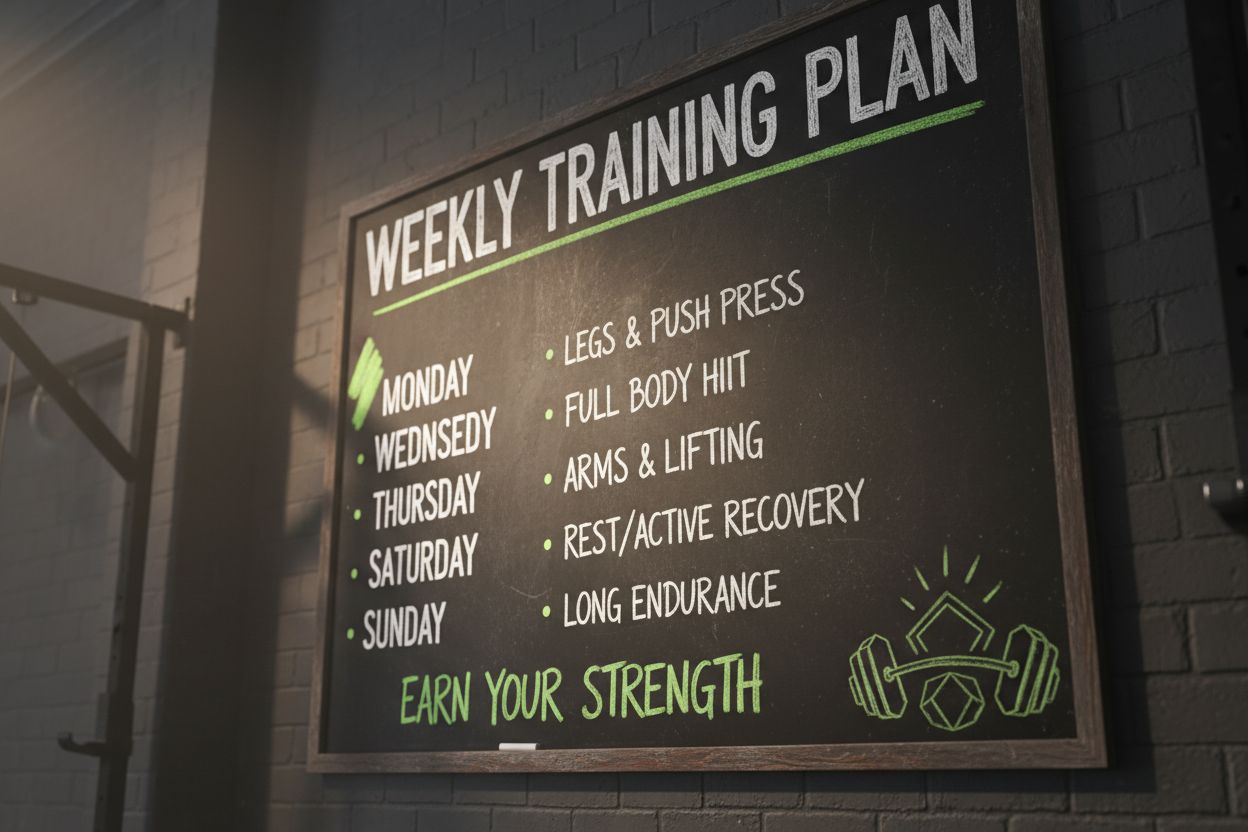
A typical week looks like:
Monday: Upper A (heavy)
Tuesday: Lower A (heavy)
Wednesday: Rest or active recovery
Thursday: Upper B (volume/accessory)
Friday: Lower B (volume/accessory)
Weekend: Rest or light activity
Key principles when building each session:
Prioritize compound lifts early (squats, deadlifts, bench press, rows, overhead press).
Use heavier loads and lower reps (3–6) for strength-building main lifts on one of the weekly sessions.
Use moderate loads and higher reps (8–15) for hypertrophy and accessories on the other session.
Manage total weekly volume per muscle (often 10–20+ hard sets per muscle per week depending on experience).
Sample 4-day program (balanced strength & hypertrophy)
Upper A — Heavy (Strength focus)
Barbell Bench Press — 5 sets x 3–5 reps
Bent-Over Barbell Row — 4 sets x 4–6 reps
Overhead Press — 3 sets x 4–6 reps
Weighted Chin-Up or Pull-Up — 3 sets x 4–6 reps
Face Pulls — 3 sets x 10–15 reps
Lower A — Heavy (Strength focus)
Back Squat — 5 sets x 3–5 reps
Romanian Deadlift — 3 sets x 5–8 reps
Bulgarian Split Squat — 3 sets x 6–8 reps per leg
Standing Calf Raise — 4 sets x 8–12 reps
Plank — 3 x 60 seconds
Upper B — Volume (Hypertrophy focus)
Incline Dumbbell Press — 4 sets x 8–12 reps
Seated Cable Row — 4 sets x 8–12 reps
Dumbbell Lateral Raise — 3 sets x 12–15 reps
Dumbbell Hammer Curl — 3 sets x 10–12 reps
Triceps Rope Pushdown — 3 sets x 10–15 reps
Lower B — Volume (Hypertrophy focus)
Deadlift (conventional or trap bar) — 3 sets x 3–6 reps (or 4 sets x 6–8 if lighter)
Front Squat or Goblet Squat — 4 sets x 8–12 reps
Glute Bridge or Hip Thrust — 4 sets x 8–12 reps
Seated Calf Raise — 4 sets x 12–15 reps
Hanging Leg Raise — 3 sets x 10–15 reps
Adjust exercise selection for available equipment and individual weaknesses. If a lifter has a weak pull, add volume for rows and posterior chain. If shoulders are the limiting factor, reduce pressing variations and increase rotator cuff work.
Progression strategies — getting stronger and bigger
Progressive overload is the non-negotiable principle. Use one or a mix of these progression methods:
Linear progression: increase weight each session or week until you stall (works well for beginners).
Percentage-based waves: plan cycles of heavy, moderate, and light weeks using percentages of 1RM.
Autoregulatory progression (RPE): add load or reps when sets are completed below target RPE.
Volume progression: increase sets per muscle over weeks, then deload.
Practical progression template for intermediates:
Weeks 1–3: Focused accumulation phase (higher volume; 3–4 sets for accessories; 8–12 reps).
Week 4: Slight reduction in volume but maintain intensity (a mini-deload).
Weeks 5–7: Intensification (heavier loads on main lifts; lower reps 3–6).
Week 8: Deload week (reduce volume by 40–60% and intensity moderately).
Measure progress with consistent metrics: total volume (sets x reps x weight), rep maxes, and performance on benchmark lifts.
Managing volume and frequency
How much volume is enough? It depends on training age:
Beginner: 8–12 hard sets per muscle per week is often sufficient.
Intermediate: 12–20 sets per muscle per week may produce better gains.
Advanced: 16–25+ sets for some muscles may be necessary, but be attentive to recovery.
Split these sets across the two weekly sessions. For example, 16 sets for chest could be 5–6 sets on Upper A and 10–11 sets on Upper B (or vice versa depending on intensity). The key is to distribute hard sets so you can perform them with reasonable quality.
Variations: 3-day and 2-day upper/lower approaches
3-day (Upper/Lower/Upper or Lower/Upper/Lower): useful when you have limited time. A common pattern is Upper — Lower — Rest — Upper — Rest — Rest — Rest, rotating the emphasis weekly so each muscle still gets ~1.5–2x weekly frequency.
2-day (Full upper one day, full lower another): good for beginners or when life is busy. It reduces frequency to once per week per muscle unless you perform additional full-body sessions.
Advanced: some lifters use 6-day upper/lower (alternating focus and varying intensities) for high-volume phases but only if recovery, sleep, and nutrition are dialed in.
Sample 8-week plan (practical microcycle)
Weeks 1–3 (Build)
Upper A: Heavy (3–5 reps on compounds)
Lower A: Heavy
Upper B: Volume (8–12 reps)
Lower B: Volume
Focus: add 2.5–5 lb to main lifts weekly or add 1 rep per set until you hit top of rep range
Week 4 (Recovery week)
Reduce volume 30–50% and drop intensity slightly.
Weeks 5–7 (Intensify)
Shift more sets to heavier loads (5–8 rep range) and include 1–2 AMRAP sets to failure on accessory work.
Week 8 (Deload)
Reduce both volume and intensity to let progress consolidate.
This simple cycle mirrors many effective Reddit recommendations but adds structure to avoid chronic under-recovery.

Common mistakes (and Reddit myths) to avoid
Doing too many hard sets every session: quality > quantity. Accumulating 30+ weekly sets per muscle often leads to burnout.
Copying random Reddit routines without personalization: what works for one person may not for you.
Treating every session like a maximum-effort day: include planned lighter sessions and deloads.
Ignoring nutrition and sleep: training adaptations require adequate protein, calories, and rest.
Popular Reddit claim: "Train each muscle twice a week and you'll always grow." True in principle, but growth still depends on progressive overload, sufficient volume, and recovery.
Recovery, nutrition, and cardio
Protein: aim for ~0.7–1.0 g/lb (1.6–2.2 g/kg) for muscle growth.
Calories: slight surplus (~250–500 kcal/day) for muscle gain; deficit for fat loss while retaining as much muscle as possible.
Sleep: 7–9 hours per night for most lifters.
Cardio: 2–3 moderate sessions per week (20–40 minutes) can be included without compromising strength gains if you manage intensity and total training load.
How to track workouts and log progress
Tracking is what turns random training into progress. Log the exercise, sets, reps, weight, and subjective notes (RPE, movement quality). Use simple spreadsheets, a notebook, or an app.
If you want a dedicated tracker, consider tools designed for workout logging and progression tracking. For example, you can explore the Setgraph workout tracker to log sets, reps, and monitor progress over time. Reading user experiences may help you decide — see Setgraph App Reviews (2025) for community feedback.
For programming help and structured articles, there are practical guides you can read to fine-tune technique and progression: Setgraph Training Guide | Maximize Your Workout and Optimize Your Training | Expert Tips and Workout Guides.
Also check the site's general collection of tips and articles for exercise guidance: Fitness & Workout Tips | Setgraph.
Frequently asked questions (FAQs)
Q: How long should each session take?
A: Aim for 45–90 minutes. Heavy strength sessions often take longer due to rest between sets. Volume-focused sessions are typically shorter if you limit rest.
Q: Can I include Olympic lifts or CrossFit-style workouts in an upper/lower split?
A: Yes, but be conscious of CNS fatigue. If you include high-skill Olympic lifts, place them early in the session and reduce heavy compound volume that day.
Q: Is an upper/lower split better than Push/Pull/Legs (PPL)?
A: Neither is objectively better. Upper/lower simplifies scheduling and hits muscles twice per week. PPL provides more direct separation between pushing and pulling movements and can allow slightly more volume per muscle per session. Choose based on preference and schedule.
Q: How do I know if volume is too high?
A: Signs include persistent soreness, declining performance across sessions, poor sleep, and lack of motivation. Reduce sets or increase rest and reassess.
Q: Should beginners use upper/lower?
A: Beginners can use a 3–4 day upper/lower split, but many beginners benefit from full-body linear progression routines until they stall, then transition to a split.
Final action plan — how to start this week
Choose a 4-day schedule that fits your week.
Pick main compound lifts you want to improve (squat, deadlift, bench, press, row).
Start with conservative volume: 3–5 sets for main lifts and 8–12 sets for large muscles per week. Track everything.
Use a simple progression: add 2.5–5 lb to main lifts each week or add a rep until you hit top of range.
Plan a deload every 4–8 weeks depending on fatigue.
If you prefer to log and analyze your sets automatically, consider a workout tracking solution like Setgraph and read community reviews to see if it fits your workflow: Setgraph App Reviews (2025).
An upper/lower split offers a powerful combination of frequency, simplicity, and adaptability. Use the sample programs above, tailor volume to your recovery, and track progress consistently. Whether you found the idea on Reddit or elsewhere, structure and consistency are what turn interest into results.
If you want deeper reading on technique and lifting principles to pair with this split, see Core Principles & Techniques for Every Lifter - Setgraph for practical tips to improve your lifts.
Good luck — start light, track everything, and adjust based on how your body responds.
Article created using Lovarank