One Rep Max Calculator Squat: How to Test, Estimate, and Use Your 1RM Safely

Knowing your squat 1RM unlocks smarter programming, safer progressions, and clearer strength goals. Whether you prefer a direct test or an estimated value from an online one rep max calculator squat, this guide gives you squat-specific advice: how to test, which formulas work best for squats, warm-up and mobility routines, common mistakes, and practical programming to raise your max over 8–12 weeks.
What is a 1RM and why the squat is different
A 1RM (one rep max) is the maximum weight you can lift for one clean, technically correct repetition. For the squat, several factors make 1RM testing special: depth (parallel vs competition depth), bar position (high-bar vs low-bar), stance width, ankle and hip mobility, and equipment (shoes, belt). These variables change the mechanical demands and mean that squat 1RM estimates can be more sensitive to technique than other lifts.
How to calculate your squat 1RM
There are two main approaches: direct testing and estimation with formulas.
Direct 1RM testing (the gold standard)
Pick a day when you feel fresh and rested (no heavy lower-body work in the past 72 hours).
Warm up progressively (see the squat-specific warm-up below).
Perform single attempts, increasing weight each set and taking 3–5 minutes rest between maximal singles.
Use a competent spotter or safety pins on a power rack.
Stop if form breaks in a way that changes depth, knees cave, or you lose control.
Direct testing gives the most accurate snapshot but increases risk and fatigue. For many lifters, especially beginners or those with recent injuries, estimated 1RM is safer.
Estimation formulas (when using a one rep max calculator squat)
Common formulas used by calculators include:
Epley: 1RM = weight × (1 + reps/30)
Brzycki: 1RM = weight × (36 / (37 - reps))
Lombardi: 1RM = weight × reps^0.10
Mayhew: more complex, used in some tools for better accuracy with multiple reps
Each formula gives slightly different answers. For squats, Epley and Brzycki are widely used and generally reliable for sets of 1–10 reps, but they assume good form and consistent rep speed.

Example: Estimating from a 5-rep set
If you squat 315 lb for 5 clean reps:
Epley: 315 × (1 + 5/30) = 315 × 1.1667 ≈ 367 lb
Brzycki: 315 × (36 / (37 - 5)) = 315 × (36/32) = 315 × 1.125 = 355 lb
Most calculators will show a small range. Use the average of reasonable formulas or a formula you’ve found consistent with your testing history.
Which formula is best for squats?
Epley tends to be accurate for moderate rep ranges (3–10 reps) and for lifters who maintain consistent rep speed.
Brzycki is simple and works well up to about 10 reps.
For very strong, technical lifters (powerlifters), differences between formulas are smaller but technique differences (low-bar vs high-bar) can shift estimates.
Bottom line: treat formula output as an estimate. If you plan a peaking cycle or a meet, do at least one supervised heavy single as a reality check.
Repetition percentage table (quick programming reference)
Use this table to convert percentages of your 1RM into working weights. Percentages below are commonly used in programming.
% of 1RM | Reps (approx.) |
|---|---|
100% | 1 |
95% | 1 |
90% | 2 |
85% | 3 |
82% | 3–4 |
80% | 4–5 |
75% | 6 |
70% | 8 |
65% | 10 |
60% | 12 |
55% | 15 |
Use a one rep max calculator squat to generate a full percentage table from 1–30 reps if you want granular targets.
Squat-specific warm-up and mobility (test-ready protocol)
A good warm-up reduces injury risk and helps you lift more on test day.
Mobility checks (10–15 minutes): hip flexor and ankle dorsiflexion test, thoracic rotation, and hamstring flexibility.
Activation: glute bridges, banded lateral walks, bodyweight squats (2 sets 10).
Barbell warm-up sets:
Empty bar × 8–10
40% × 5
60% × 3
75% × 2
85% × 1
92–98% × single attempts (if attempting singles)
Rest 3–5 minutes between heavy singles. If doing a test with multiple heavy singles, keep the total number of maximal attempts low (3–5) to avoid CNS fatigue.
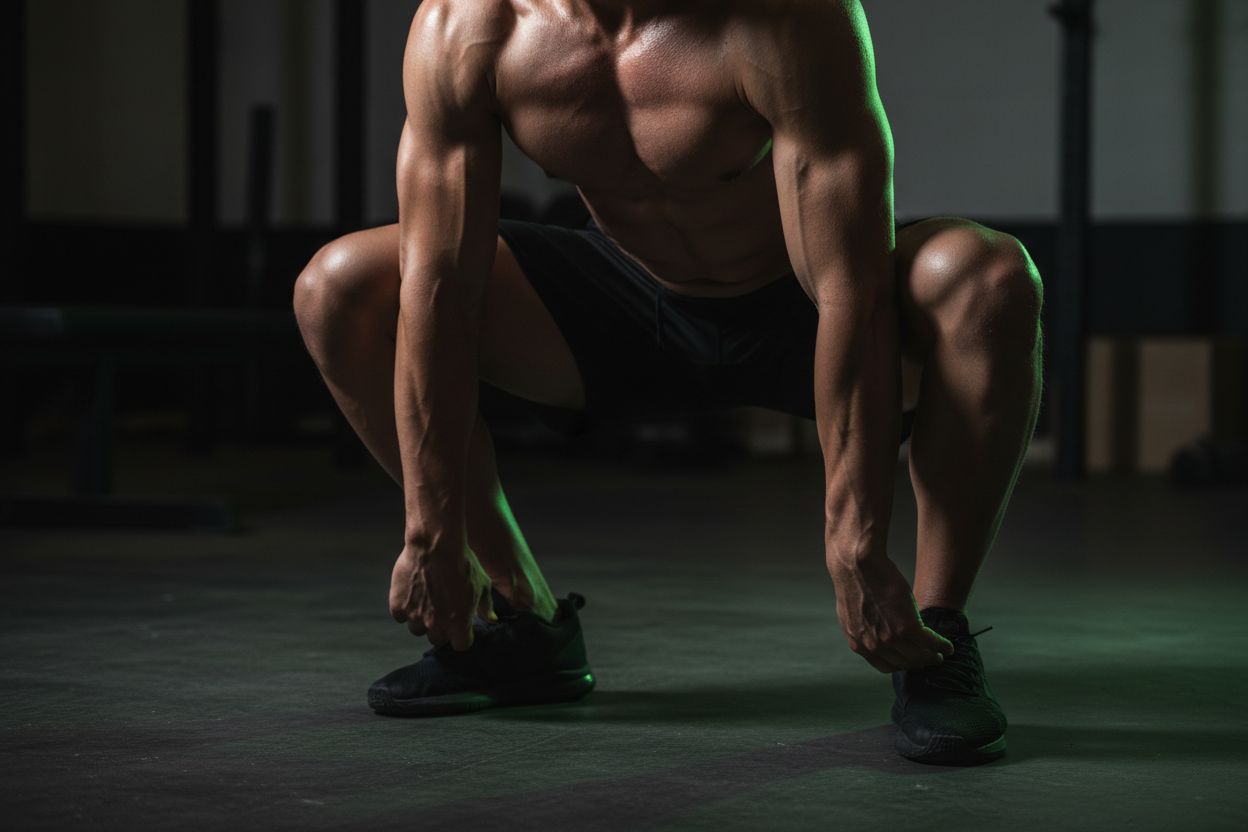
Squat depth, bar position, and equipment: how they change your 1RM
Depth: Hitting competition depth (hips below parallel) reduces the weight you’ll move compared to a higher parallel or partial squat. Always test to the depth you intend to train or compete at.
Bar position: Low-bar squats generally allow more hip drive and slightly higher 1RMs for powerlifters; high-bar is more quad-dominant and may yield a different 1RM.
Shoes and belt: Heeled shoes improve depth for lifters with limited ankle mobility; a belt can increase intra-abdominal pressure and add a few percent to your true max. Sleeve and knee wraps change results—consistency matters.
When you record your 1RM, note depth, bar position, and equipment so future comparisons are valid.
Common technical mistakes during 1RM attempts
Knee valgus (knees caving inward)
Butt wink (lumbar flexion at the bottom)
Excessive forward trunk lean
Rising heels or unstable stance
Bouncing out of the hole (loses tension)
If any of these occur, stop and correct. A failed lift due to technical breakdown isn’t useful data for programming.
Safety, spotters, and rack setup
Use safety pins set at a height that catches the bar at or just below your lowest acceptable depth.
If using spotters, rehearse the plan: how many hands, what cues you’ll give, and where they’ll make contact.
Communicate verbally: call for “spot” before heavy singles and say “take it” if you want them to support you.
When in doubt, use the rack and safety pins instead of spotters; it’s often safer and more consistent.
How to use your squat 1RM in programming
Different goals require different intensity zones:
Strength/Power: 85–95% of 1RM, low reps (1–5)
Hypertrophy: 65–80% of 1RM, moderate reps (6–12)
Endurance/Work Capacity: <65% of 1RM, higher reps (12+)
Sample microcycle for strength (3 sessions/week):
Day 1 (Heavy): 5×3 at 85% 1RM
Day 2 (Speed/Technique): 8×2 at 60% 1RM (focus on bar speed)
Day 3 (Volume): 4×6 at 75% 1RM
8-week block to increase squat 1RM (example)
Week 1–3: Build
Week 1: 4×6 @ 70% (progress weight each week)
Week 2: 5×5 @ 75%
Week 3: 6×4 @ 78%
Week 4: Deload
3×5 @ 60% – focus on speed and mobility
Week 5–7: Intensify
Week 5: 5×3 @ 82%
Week 6: 4×2 @ 88%
Week 7: 3×1 @ 92% (single heavy attempts)
Week 8: Peak/Test
Light week then test a new 1RM on day 6 or 7
Deloads are essential—your CNS and connective tissues need scheduled recovery.
For tracking sets, reps, and progress over time, consider a simple tracker like Setgraph - Workout Tracker Gym Log App to record your working sets and compare 1RM estimates across cycles.

Mobility checklist before attempting a new 1RM
Ankle dorsiflexion: can you squat with heels flat and knees forward?
Hip internal rotation: adequate to reach depth without torso collapse?
Thoracic extension: can you maintain upright torso if high-bar?
Knee tracking: do knees track over toes without valgus?
Core readiness: can you brace and hold intra-abdominal pressure?
If any area fails, address it with targeted mobility and re-assess before testing.
When not to test your 1RM
Avoid testing if you have:
Acute joint pain or recent injury
Poor sleep, high stress, or illness
Recent heavy matches or competitions
Inadequate warm-up or no experienced spotter available
If any of these apply, use submaximal testing (e.g., 3–5RM) and estimate your 1RM with a calculator.
Formula accuracy comparison (practical example)
A lifter completes 4 reps at 295 lb. Estimated 1RMs:
Epley: 295 × (1 + 4/30) = 334 lb
Brzycki: 295 × (36/(37-4)) = 320 lb
Lombardi: 295 × 4^0.10 ≈ 330 lb
Variation is normal—use a consistent method and track changes rather than obsessing over single numbers.
Age, sex, and training experience considerations
Beginners often see rapid 1RM increases due to neural adaptations; use conservative jumps (2–5% per cycle).
Older lifters should place greater emphasis on recovery, mobility, and technique; progress slower but can still gain strength.
Sex differences exist in absolute strength but programming principles remain the same.
For tailored guidance on foundational techniques, see Core Principles & Techniques for Every Lifter - Setgraph.
Common mistakes when using a one rep max calculator squat
Plugging in a rep performed with poor form (overestimates strength)
Ignoring bar position or depth (inconsistent comparisons)
Using high-rep sets (>10) to estimate a 1RM—errors grow as reps increase
Not accounting for equipment (belt, wraps)
Always annotate your recorded 1RM with context: depth, belt, shoes, rep tempo.
Advanced topics: CNS fatigue, peaking, and competition differences
CNS fatigue: multiple maximal attempts and heavy singles tax the nervous system. Space tests at least 6–8 weeks apart for beginners, and 8–12 for advanced lifters.
Peaking: reduce volume while maintaining intensity for 1–3 weeks before a max attempt.
Competition vs gym: adrenaline, warm-up area specifics, and commands affect performance—your gym max may differ from a meet day.
Practical checklist before a 1RM squat attempt
Appropriate warm-up and mobility: complete
Correct squat depth and stance rehearsed: yes
Rack pins set and/or spotters ready: yes
Verbal cues planned with spotters: yes
Nutrition, hydration, and sleep sufficient: yes
If any item is missing, postpone testing or use an estimated 1RM from a recent submaximal set.
Tools and apps to help (tracking and calculators)
Several online calculators provide instant estimates and percentage tables. If you log workouts, tracking apps let you visualize 1RM changes across weeks and automatically compute percentage-based programs. For straightforward workout logging and tracking sets/reps, see Setgraph Training Guide | Maximize Your Workout and user feedback at Setgraph App Reviews (2025).
For programming optimization and expert tips on structuring blocks around a 1RM, check Optimize Your Training | Expert Tips and Workout Guides.
Final advice: use the one rep max calculator squat as a tool, not an absolute
A one rep max calculator squat is most useful when combined with good testing practice, consistent technique, and smart programming. Treat estimates as guides. Prioritize technique, mobility, and recovery—improvements in those areas reliably raise your 1RM over time.
If you want sample templates to log sets and progressively increase weight safely, explore resources on tracking and training principles at Setgraph - Workout Tracker Gym Log App and the broader article collection at Setgraph App: Insights, Tips & Training Guides.
Ready to test? Follow the warm-up and safety checklist above, use a consistent formula or direct testing method, and record everything so your next cycle starts from a reliable baseline.
Article created using Lovarank