Best Exercises for Each Muscle Group: A Complete Guide to Build Strength and Size

Training the right movements is the fastest way to see consistent progress in strength, size, and function. This guide lists the best exercises for each muscle group, explains why they work, and gives practical programming tips you can use in any gym or at home. You will get exercise choices, tempo and set recommendations, alternatives for limited equipment, and clear cues to avoid the most common form mistakes.
How to choose exercises: compound versus isolation and when each matters
Compound exercises should make up the foundation of most programs because they load multiple joints and allow heavier weights. Isolation exercises shine when you want to target a specific muscle for hypertrophy or correct a weakness.
Compound examples: squat, deadlift, bench press, pull-up, overhead press
Isolation examples: biceps curl, triceps extension, leg curl, calf raise
When selecting the best exercises for each muscle group, prioritize movements that:
Allow progressive overload over time.
Produce the range of motion needed to stress the target muscle.
Are safe to perform with reliable technique.
Consider equipment. If you have only dumbbells or resistance bands, choose compatible exercises and increase reps, sets, or time under tension to compensate. For structured principles on technique and progression, see this practical guide: Core Principles & Techniques for Every Lifter - Setgraph.
Best exercises for each muscle group

Below are the top exercise selections by muscle group with programming notes and alternatives. For each muscle group I list primary choices, why they work, sets and rep ranges, tempo suggestions, and common form cues.
Chest
Barbell bench press - primary horizontal pressing movement for maximal load.
Sets/reps: 3–5 sets of 4–8 reps for strength; 3–5 sets of 8–12 reps for hypertrophy.
Tempo: 2-1-1 (lowering 2s, pause 1s, press 1s).
Cue: tuck shoulder blades, drive through feet, keep the bar path diagonal towards lower chest.
Alternatives: dumbbell bench press, push-up, floor press.
Incline dumbbell press - targets upper chest and improves shoulder stability.
Best for building balanced chest shape.
Chest dip - deep stretch and strong lower chest/direct triceps involvement.
Use a weighted belt for progression.
Common mistake: flaring elbows too wide increases shoulder strain. Keep elbows at 30–45 degrees where possible.
Back
Barbell deadlift - total posterior chain builder that recruits the lats, spinal erectors, glutes, and hamstrings.
Sets/reps: 2–5 sets of 3–8 reps.
Cue: neutral spine, push the floor away, keep the bar close to the shins.
Bent-over row - horizontal pull that targets mid-back and lats.
Variations: chest-supported row to reduce lower back fatigue.
Pull-up / Chin-up - vertical pulling to shape the lats and develop grip.
Progression: assisted bands, negative reps, weighted.
Single-arm dumbbell row - fixes unilateral imbalances and improves scapular control.
Common mistake: using momentum or excessive torso rotation on rows. Slow controlled reps increase muscle time under tension.
Shoulders
Overhead press (barbell or dumbbell) - best compound lift for shoulder mass and pressing strength.
Sets/reps: 3–5 sets of 4‐8 reps strength, 3–5 sets of 8–12 reps hypertrophy.
Lateral raise - isolation for the medial deltoid to widen the shoulder appearance.
Use lighter weights and controlled tempo.
Rear delt fly - balances the anterior dominance from pressing and protects the shoulder girdle.
Include rotator cuff work for long-term shoulder health: external rotation with band or light dumbbell. Small, frequent volume here helps durability.
Legs (quads, hamstrings, glutes, calves)
Back squat - prime mover for quad and overall leg strength.
Sets/reps: 3–5 sets of 4‐10 reps.
Cue: drive knees out, sit between the heels, maintain an upright chest as required by depth.
Romanian deadlift - targets hamstrings and glutes with hip hinge mechanics.
Tempo: slow lowering 3s for increased time under tension.
Bulgarian split squat - unilateral leg builder that stresses quads and glutes while exposing imbalances.
Glute bridge / hip thrust - best for direct glute development and horizontal hip extension.
Standing calf raise - calves often need higher frequency and volume; 3–5 sets of 10–20 reps recommended.
If you train at home, use front squats or Goblet squats with heavier dumbbells as substitutes for a barbell back squat.
Arms (biceps, triceps, forearms)
Triceps: close-grip bench press, weighted dips, overhead triceps extension.
Triceps make up most of the arm mass so prioritize a compound push followed by an isolation.
Biceps: barbell curl, incline dumbbell curl, hammer curl.
Tempo: control the eccentric for maximal muscle damage and hypertrophy.
Forearms: reverse curl, farmer carry, wrist curl.
Farmer carries are practical and improve grip plus posterior chain stability.
Common mistake: swinging the body during curls. Anchor the elbows and use a slow eccentric phase.
Core and Abs
Plank variations - build endurance in the anterior core without spinal flexion.
Sets/reps: 2–5 sets of 30–90 seconds depending on strength.
Hanging leg raise - trains hip flexors and lower abdominals with a long lever.
Pallof press - anti-rotation core strength for sports and functional stability.
For hypertrophy of the midsection use multiple sets of controlled repetitions, but remember nutrition and overall body fat are primary determinants of visible abs.
Traps and Upper Back
Barbell shrug and farmer carry - for heavy loading of the upper trapezius.
Face pulls - target mid and lower traps and improve scapular health.
Do face pulls regularly as a corrective exercise after pressing heavy loads.
Rotator Cuff and Shoulder Health
External rotation with band - low load high frequency exercise to protect the shoulder.
Prone Y/T raises - train the lower trap and scapular control.
Small weekly volume here prevents injury and supports heavy overhead pressing.
Hip Adductors and Abductors
Cable or banded hip abduction - targets gluteus medius and lateral stability.
Copenhagen plank and side-lying adduction - effective for adductor strength and injury prevention in athletes.
Include at least 8–16 sets per week across hip stabilizers for runners and multi-directional athletes.
Programming specifics: frequency, volume, tempo, and progression

Training frequency: most muscles respond well to 2 sessions per week when the goal is hypertrophy. Beginners can see progress with 1–2 full-body sessions per week, while intermediates and advanced trainees benefit from 2–3 sessions per muscle per week.
Volume landmarks (per muscle per week):
Beginner: 8–12 hard sets
Intermediate: 12–18 hard sets
Advanced: 16–24+ hard sets
Hard sets mean sets taken near technical failure while maintaining form.
Progressive overload strategies:
Increase load once you can complete the top of your rep range across all sets.
Add a set or add 1–2 reps per set when load increases are not possible.
Manipulate tempo to increase time under tension if weight cannot increase.
Tempo and time under tension: aim for a controlled eccentric phase (2–3 seconds) and a deliberate concentric contraction. For hypertrophy, total time under tension of 30–60 seconds per set is an effective target.
Recovery indicators: rested performance, stable sleep, appetite, consistent training weights, and reduced soreness are good signs of recovery. If performance drops or fatigue accumulates, reduce volume or take a deload week.
For deeper programming frameworks and periodization ideas, consult this guide: Setgraph Training Guide | Maximize Your Workout.
Sample workout schedules (2-day, 3-day, 4-day splits)
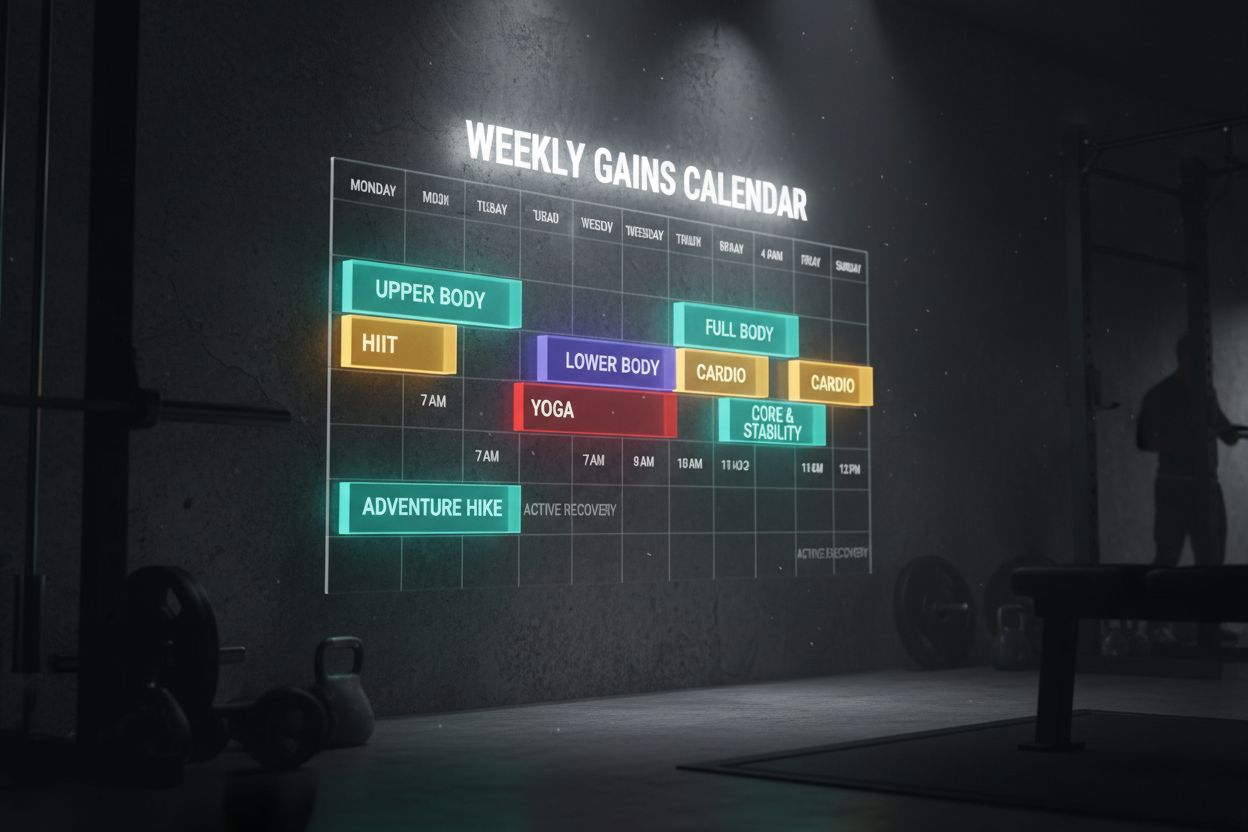
Choose a split based on available time and recovery capacity.
2-Day Full-Body Split (twice weekly)
Day A: Squat 3x5, Bench press 3x6, Bent-over row 3x8, Plank 3x45s
Day B: Deadlift 2x5, Overhead press 3x6, Pull-ups 3x6–8, Lunges 3x8/leg
3-Day Upper/Lower/Full
Day 1 - Upper: Bench press 4x6, Pendlay row 4x6, Overhead press 3x8, Lateral raises 3x12
Day 2 - Lower: Back squat 4x6, Romanian deadlift 3x8, Calf raises 3x15, Ab wheel 3x10
Day 3 - Full: Deadlift 3x5, Pull-ups 3x8, Bulgarian split squat 3x8/leg, Face pulls 3x12
4-Day Push/Pull/Legs/Upper or classic Push/Pull/Legs/Full
Push: Bench variations, overhead press, triceps work
Pull: Rows, pull-ups, biceps, rear delts
Legs: Squats, deadlift variation, lunges, calves
Upper or full accessory day: fill with weak point work and mobility
Track sets, reps, and progression each session to ensure steady overload. If you use a digital tracker, it helps identify trends and plateaus. For a simple logging solution, consider the app here: Setgraph - Workout Tracker Gym Log App.
Form cues and common troubleshooting
Squat knees caving in: focus on pushing knees out, strengthen glute medius with band walks and single-leg work.
Low back rounding on deadlift: reduce load and correct hip hinge pattern with Romanian deadlifts and hip hinge drills.
Shoulder pain during benching: check elbow angle and scapular retraction, reduce range or switch to floor press temporarily.
Stalled bench or press: add paused reps and increase upper back and scapular stability work.
Use tempo and reduced load to refine technique before adding weight. Microprogressions such as 1.25 kg plates, extra reps, or additional sets are safer long-term than large jumps in load.
If persistent pain limits movement quality, consult a qualified clinician or coach and avoid forcing through sharp pain.
For additional technique tips and troubleshooting drills, see this optimization resource: Optimize Your Training | Expert Tips and Workout Guides.
Putting it together: templates and next steps
Pick 2–3 compound lifts for major muscle groups each week.
Add 1–2 accessory isolation movements to address weak points.
Aim for weekly volume targets based on your training age.
Use progressive overload and track workouts consistently.
If you want a structured routine and a place to monitor progress and PRs, user feedback and reviews can help you choose the right tracking tool: Setgraph App Reviews (2025): User Ratings for Tracking Sets, Reps & Workouts.
Conclusion
Selecting the best exercises for each muscle group is as much about purpose as it is about movement. Use compound lifts to build strength and mass, and isolation work to shape and correct imbalances. Prioritize consistent progression, respect recovery, and refine technique with tempo and accessory work. With the right selection and a plan, you will make steady gains and reduce injury risk. Track your workouts, reassess every 4–6 weeks, and adjust volume and intensity to match your progress and goals.
For more articles on building organized programs and technique, browse a wider set of training resources: Fitness & Workout Tips | Setgraph.
Article created using Lovarank