Progressive Overload vs Volume: What's the Difference and Which Drives More Muscle Growth?

Most lifters have heard both terms so often they start using them interchangeably. You'll see it in gym conversations, fitness forums, and training articles: "just add more volume" and "focus on progressive overload" treated as if they mean the same thing. They don't, and confusing the two is one of the most common reasons training programs stall.
Here's the distinction that changes everything: progressive overload is the principle, and volume is one tool you can use to apply it. Understanding that hierarchy doesn't just clear up the terminology, it gives you a practical framework for making smarter decisions about how to structure your training at any experience level.
The Key Distinction Most Lifters Miss
Progressive overload means systematically increasing the demands placed on your muscles over time so your body continues to adapt. That's it. It's a principle, not a method. Volume, on the other hand, is a specific variable you can manipulate. It's one lever among several.
When someone says "do progressive overload," they're describing a goal. When someone says "increase your volume," they're describing one way to achieve that goal. The confusion arises because volume progression is probably the most commonly discussed form of progressive overload, but it's far from the only one.
Once you internalize this, the question shifts from "which is better" to "which mechanism of progressive overload should I be using right now, given my training age, recovery capacity, and goals?"
What Is Training Volume (And Why Volume Load Is a Flawed Metric)
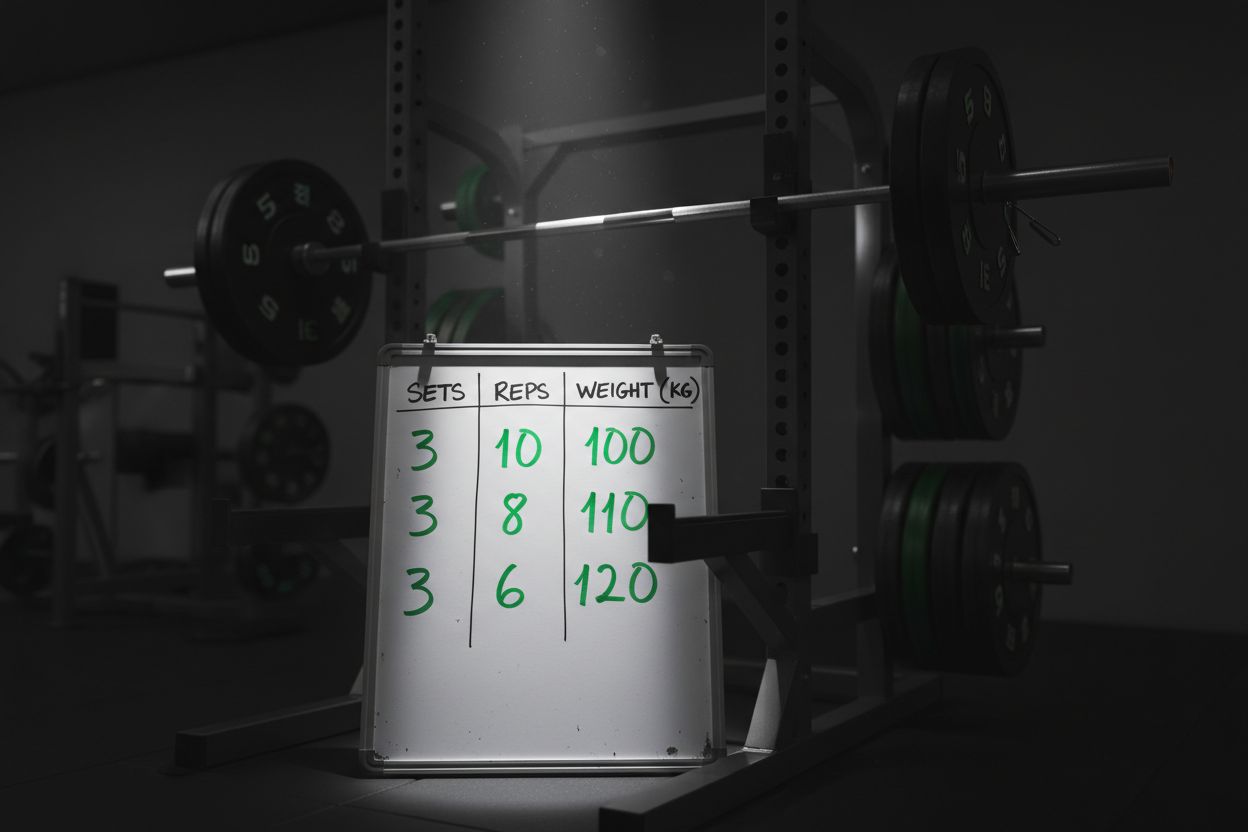
Training volume is typically defined as sets × reps × weight, sometimes called volume load or tonnage. So if you do 4 sets of 10 reps at 100 lbs, your volume load is 4,000 lbs for that exercise.
This sounds like a clean metric, but it breaks down quickly. Consider two scenarios:
Scenario A: 4 sets of 10 at 100 lbs, stopping 6 reps before failure
Scenario B: 3 sets of 10 at 100 lbs, stopping 1 rep before failure
Scenario A has higher volume load (4,000 lbs vs 3,000 lbs), but Scenario B is almost certainly more effective for muscle growth. Why? Because the proximity to failure matters enormously. Sets performed with several reps still in the tank don't provide sufficient mechanical tension to drive meaningful adaptation. They're sometimes called junk volume, and they waste recovery capacity without producing results.
Hard Sets vs. Volume Load: Which Actually Predicts Growth?
The research increasingly points to hard sets near failure as the better unit of measurement for hypertrophy. A hard set is typically defined as one performed within 0-3 reps in reserve (RIR), meaning you stop when you have 0 to 3 reps left before muscular failure.
This is why researchers like Dr. Mike Israetel and others in the hypertrophy field have moved away from volume load as a primary metric. The question isn't how many total pounds you moved, it's how many quality sets you completed close to your limit.
For practical purposes, 10-20 hard sets per muscle group per week is the range most commonly cited in the literature as effective for hypertrophy. Below 10 is considered minimum effective volume for many lifters, and above 20 starts pushing into the zone where recovery becomes the limiting factor.
You can explore more foundational training principles like these on the Core Principles & Techniques for Every Lifter resource library.
What Is Progressive Overload (Beyond Just "Add Weight")
Most people think progressive overload means adding weight to the bar every session. That's one form of it, but it's not the full picture, and for intermediate and advanced lifters it becomes increasingly unsustainable as a solo strategy.
Here are the primary mechanisms through which you can apply progressive overload:
Load progression: Increasing the weight used for the same rep range
Volume progression: Adding sets or reps (more total work)
Density progression: Doing the same work in less time (shorter rest periods)
Range of motion progression: Increasing the depth or stretch of a movement
Technique progression: Improving movement quality, which increases effective stimulus per rep
For beginners, load progression often happens naturally and rapidly because neural adaptations drive early strength gains. For intermediate lifters, volume progression becomes more valuable as load increases slow down. For advanced lifters, periodized combinations of both, alongside technique and density work, become necessary.
Volume Progression vs. Load Progression: What the Research Says

Both approaches drive hypertrophy. The debate is about which is more efficient under what conditions.
When Volume Progression Wins
Adding sets and reps tends to be more effective when:
You're already training at moderate-to-high loads relative to your capacity
You've stalled on load progression for a given exercise
You're in a hypertrophy-focused mesocycle (typically 4-8 weeks)
You're training smaller muscle groups like biceps or lateral deltoids that respond well to higher rep ranges and accumulated volume
When Load Progression Wins
Increasing weight tends to be more effective when:
You're a beginner or early intermediate, where strength and neural adaptations are still rapid
You're training large compound movements (squats, deadlifts, bench press, rows) where mechanical tension from heavier loads provides a strong stimulus
You're in a strength-focused phase where 1-5 rep work near maximal loads is the priority
What the Research Shows
A 2023 study by Nobrega and colleagues found that load progression produced slightly greater hypertrophy over an equivalent period compared to rep progression under matched volume conditions. This doesn't mean load progression is always superior, but it does suggest that for most lifters, prioritizing load increases before defaulting to volume increases is a reasonable default strategy.
The practical takeaway: try to add weight before adding sets. When load progression stalls, add a set. When recovery can't support more sets, reduce load slightly and build back up.
How to Choose Based on Your Training Level
Generic advice rarely helps anyone. Here's how the progressive overload vs volume question plays out differently depending on training age.
Beginners (0-1 Year of Consistent Training)
Beginners improve rapidly because most early gains are neural adaptations, not muscle growth. The brain gets better at recruiting motor units, not just the muscle fibers themselves growing. This means load progression works almost automatically.
For beginners, the recommendation is simple: focus on adding weight to the bar consistently, keep rep ranges between 5-15, and don't overcomplicate volume. Starting with 3-4 hard sets per muscle group twice a week is sufficient. Volume can increase gradually, but chasing high volume early often leads to overuse injuries before the connective tissue has adapted.
Intermediate Lifters (1-3 Years)
This is where the progressive overload vs volume question becomes genuinely strategic. Neural adaptations have largely plateaued, and actual hypertrophy (muscle fiber growth) is now the primary driver of progress.
Intermediate lifters benefit most from periodizing both variables within a structured mesocycle. A common approach is to increase volume across the first half of a training block, then prioritize load progression in the second half, followed by a deload.
At this stage, tracking your training becomes increasingly important. Tools like Setgraph can help you log sets, reps, and loads consistently so you can identify patterns and catch stalls early.
Advanced Lifters (3+ Years)
Advanced lifters are close to their genetic ceiling for neural efficiency and have significant muscle mass already. Progress is slower by nature. Both volume and load increases require more careful management to avoid overreaching.
Autoregulation becomes essential here. Rather than following a fixed weekly set count, advanced lifters benefit from adjusting volume and intensity based on how they're actually recovering. This leads us to one of the most practical tools available.
How to Combine Both: A Practical 8-Week Mesocycle
Instead of choosing between volume and load progression, structure your training so both are applied at different phases of the same block.
Here's a practical example for a single muscle group (e.g., chest), starting from a baseline of 4 hard sets per session, 2 sessions per week:
Week | Sets per Session | Target Reps | Load | Notes |
|---|---|---|---|---|
1 | 4 | 10-12 | Moderate (RPE 7-8) | Establish baseline |
2 | 4 | 10-12 | Same or +2.5% | Settle into the block |
3 | 5 | 10-12 | Same as Week 2 | Volume increase |
4 | 5 | 10-12 | +2.5-5% | Volume held, load up |
5 | 6 | 8-10 | +5% | Volume peaks |
6 | 6 | 8-10 | +2.5% | Load continues rising |
7 | 4 | 12-15 | -20% from peak | Deload week |
8 | Start new block | Reassess | Reset | New baseline higher |
This structure lets you accumulate volume in the early weeks to create a metabolic and mechanical stimulus, then capitalize on that work by pushing loads upward before fatigue outpaces recovery. The deload in Week 7 resets systemic fatigue so you can start the next block at a higher baseline.
For more structured guidance on training programming, the Optimize Your Training section covers expert strategies worth exploring.
The Junk Volume Problem: When More Sets Hurt Progress

Junk volume is a term for sets that don't meaningfully contribute to hypertrophy but still consume recovery resources. The defining characteristic is low proximity to failure: if you're finishing a set with more than 4-5 reps still in the tank (RIR > 4-5), those sets are unlikely to produce significant muscle-building stimulus.
Here's a concrete example: performing 8 sets of 10 at a comfortable weight where you could easily do 15 generates a lot of volume load on paper, but most of those sets aren't hard enough to recruit the high-threshold motor units responsible for hypertrophic adaptation.
Junk volume is problematic not because it does nothing, but because it uses up your recovery capacity. The body has a finite ability to repair and rebuild each week. Filling that budget with low-quality sets means you have less capacity to recover from the hard sets that actually matter.
The rule of thumb: every working set should be performed within 0-4 RIR, meaning you stop when you genuinely have 4 or fewer reps remaining before failure. If you wouldn't struggle to add several more reps at the end of every set, your volume may look high on paper but actually be quite low in terms of effective stimulus.
Autoregulation: A Smarter Way to Progress
Rigid progression schemes assume your body recovers identically every week. It doesn't. Sleep quality, stress, nutrition, and accumulated fatigue all affect how much you can handle in any given session.
Autoregulation is the practice of adjusting your training loads and volumes based on how you're actually performing, rather than following a fixed script. The two most common tools are:
RPE (Rate of Perceived Exertion): A 1-10 scale where 10 is maximal effort. Training at RPE 8 means you could do 2 more reps. This keeps intensity consistent relative to your actual capacity on a given day.
RIR (Reps in Reserve): The number of reps you have left before failure. Training at 2 RIR means stopping 2 reps short of failure.
For intermediate and advanced lifters, building autoregulation into your programming means you avoid grinding through sessions when recovery is compromised (which increases injury risk and reduces adaptation) and push harder when you're fully recovered.
A simple autoregulation rule for progressive overload: if your target weight feels easy and RPE is below 7 in week 1, increase load in week 2. If you complete all sets with RIR > 3, add a set or increase weight next session. If you can't hit your target reps with good form, reduce load by 5-10% and rebuild.
Tracking these metrics over time is where a dedicated workout log becomes useful. Consistent data on your sets, reps, and perceived effort makes it much easier to spot patterns and make informed adjustments. The Setgraph Training Guide has practical information on how to structure this kind of tracking.
Common Mistakes When Applying Progressive Overload and Volume
Chasing load at the expense of technique: Adding weight before your form can handle it shifts stress to passive structures (joints, tendons) rather than the target muscle. The result is often injury, not growth.
Adding volume without a deload plan: Volume accumulation without structured deloads leads to overreaching. Most lifters should plan a deload every 4-8 weeks, reducing volume by roughly 40-50% for one week.
Measuring progress in total tonnage: As discussed, volume load is a poor predictor of hypertrophy. Hard sets near failure are what matter, not the sum of weight moved.
Treating progressive overload as a weekly requirement: For beginners, weekly progression is realistic. For intermediate lifters, monthly progression is more appropriate. For advanced lifters, meaningful progress can occur over a full mesocycle. Adjust your expectations to your training age.
Ignoring recovery variables: Volume and load capacity are downstream of sleep, nutrition, and stress. If you're sleeping 5 hours a night or in a significant caloric deficit, your ability to recover from high volume training is severely limited. Pushing volume in these conditions creates more fatigue without more adaptation.
FAQ
Is progressive overload the same as increasing volume?
No. Progressive overload is the broader principle of increasing training demands over time. Increasing volume is one way to apply it, but so is adding load, improving technique, or reducing rest periods. Volume increase is a tool; progressive overload is the goal.
Should I add weight or reps first?
Generally, prioritize adding weight before adding reps or sets. When load progression stalls (no increases for 2-3 sessions), try adding a rep or set. This keeps the stimulus novel and prevents plateaus from becoming permanent.
How do I know when to deload?
Common indicators include persistent joint soreness, declining performance across multiple sessions, disrupted sleep, or losing motivation to train. A planned deload every 4-8 weeks prevents most of these symptoms before they become serious.
What's the minimum volume for muscle growth?
Research suggests approximately 4-6 hard sets per muscle group per week is the minimum effective dose for most intermediate lifters. Beginners can see growth at even lower volumes. The key is that those sets are performed close to failure.
The Bottom Line
Progressive overload and volume aren't competing concepts. They're different levels of the same framework. Progressive overload tells you what to do: make training harder over time. Volume tells you one way to do it: more quality work. Load progression tells you another: move heavier weights.
For beginners, prioritize load progression while keeping volume moderate. For intermediates, periodize both within a structured mesocycle. For advanced lifters, autoregulation and periodized programming that alternates emphasis become necessary.
The most important practical takeaway: measure your training in hard sets near failure, not total tonnage. Plan your progression in phases, not just week to week. And treat recovery, including sleep, nutrition, and scheduled deloads, as a non-negotiable part of the equation.
You can find more articles on training optimization and evidence-based fitness programming at Setgraph's Fitness & Workout Tips hub.
Article created using Lovarank