Lengthened Partials: Do Stretch-Position Reps Build More Muscle?

Lengthened partials cover the portion of a repetition in which the target muscle is relatively long. Research makes them worth examining, but the results depend on the muscle, exercise, loading profile and comparison used.
So are stretch-position reps a genuine upgrade or just a recycled trend? Here is what lengthened partials actually are, what the data shows, and how to put them to work without overcomplicating your training.
What Are Lengthened Partials?
A lengthened partial uses only a defined part of an exercise’s range, chosen to train the target muscle at a longer length. “Bottom half” is not a universal definition: muscle length depends on the joints involved and the exercise setup.
In a curl, elbow extension lengthens the elbow flexors, while shoulder position also changes the length of the biceps. A dumbbell may exert little elbow torque near the bottom when its vertical line of force passes close to the elbow. A stretched position therefore does not automatically mean the target muscle is heavily loaded.
A shortened partial works a different section of the range. Comparing long- and short-length partials is a different research question from comparing long-length partials with full repetitions.
Why the Stretched Position Seems to Matter
One proposed explanation is that force applied while a muscle is relatively long influences hypertrophy signaling. Mechanisms are still being investigated; a plausible explanation should not be treated as proof of a universal best training range.
In Pedrosa and colleagues’ knee-extension trial, 45 untrained women were assigned to different ranges or a control group. Training the more-flexed-knee range produced greater growth at some measured regions than several comparison conditions. It does not establish the best range for every muscle or exercise.
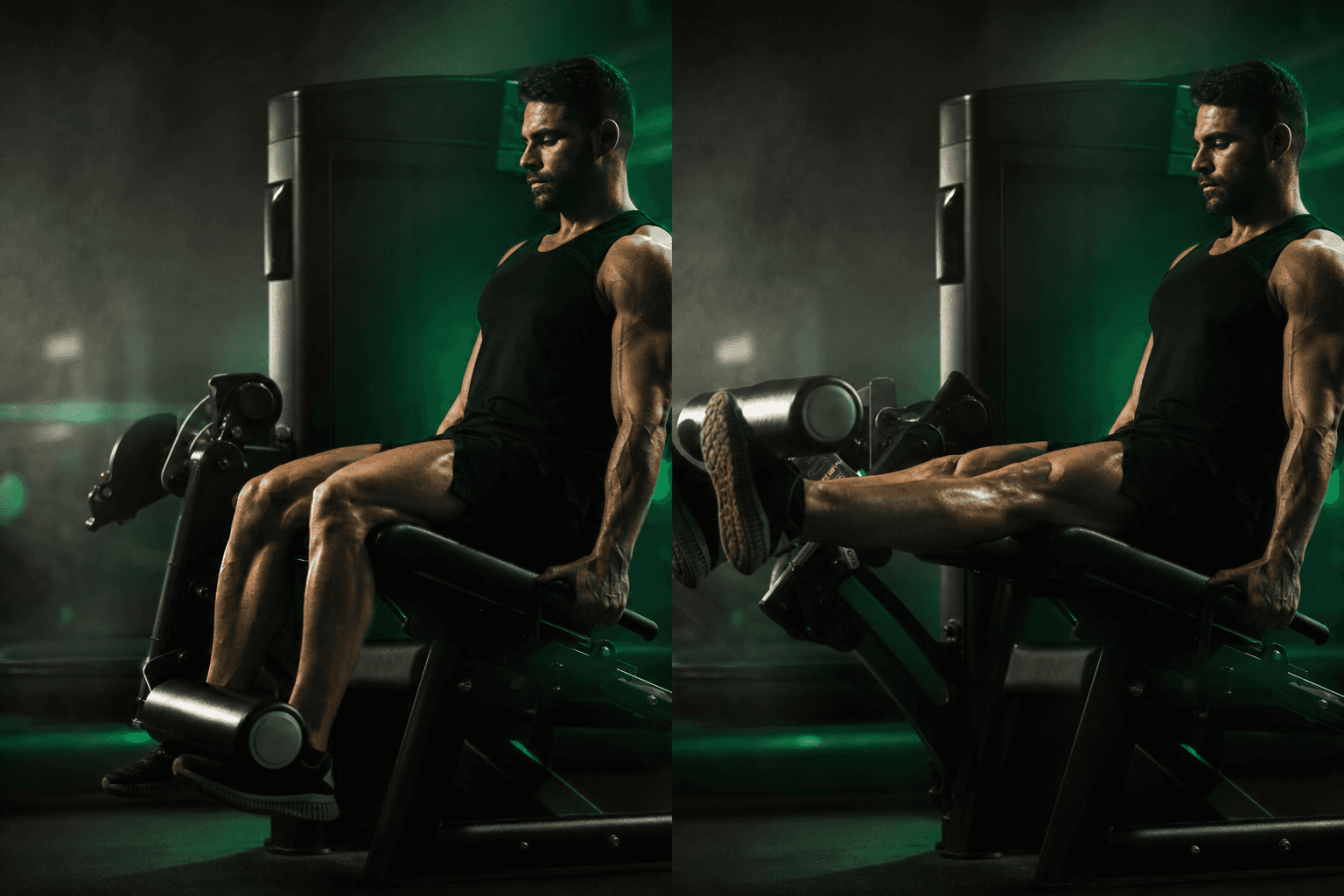
A seated-versus-prone leg-curl trial favored seated training for several hamstring muscles. It compared exercise positions, not lengthened partials with full reps, so it supports a narrower muscle-length point.
What Direct Comparisons Show
A 2025 study in trained adults compared lengthened partials with full-range upper-body training over eight weeks and found similar changes in measured arm muscle thickness and strength-endurance. Its scope is more relevant to trained lifters than assuming every result in beginners will transfer unchanged.
Taken together, the evidence supports lengthened partials as an option. It does not prove that full-range work is obsolete, that long-length work always wins, or that adding partials after failure is the same intervention as the studied standalone sets.
When Lengthened Partials Are Actually Useful
Lengthened partials are not something you bolt onto every set of every exercise. They shine in specific situations:
As a deliberate range variation on an exercise whose setup you understand.
When the selected range actually loads the target muscle rather than simply feeling stretched.
When you can keep the range and effort repeatable and count the work within the existing program.
As an optional advanced technique, not a requirement to keep adding repetitions after full-range failure. Lengthened work is not inherently gentler on joints.
For most lifters, the smart move is to keep full range of motion as the backbone of training and deploy lengthened partials strategically, not to convert your whole program overnight. If you are still building your base, our guide to what hypertrophy is and how to achieve it covers the fundamentals these techniques sit on top of.
How to Program Stretch-Position Reps
An illustrative way to try the technique on one suitable exercise:
Keep most of your familiar program unchanged. Pick one movement and clearly define the partial range.
Use a manageable load and stop when you cannot maintain that range and control. Do not force a painful stretch.
Count these sets within your existing work rather than automatically adding a finisher to every set.
Log partial and full reps separately. Change one variable at a time so you can interpret the next session. See progressive overload for the general framework.
No universal dose of one or two exercises two or three times weekly has been established. Begin conservatively within a suitable program and assess tolerability. If you have pain or a rehabilitation goal, get individualized guidance rather than using a hypertrophy article as treatment advice.
The Catch: Why Tracking Matters Here
A full-range set and a partial-range set are different tasks. Record the range for each instead of combining unlike repetitions into one total.
This is exactly where a dedicated tracker earns its place. You want to know, set by set, what you did last time so you can decide whether to add load, add a full rep, or add a partial today.
How to Apply This in Setgraph
Example entries for a knee-extension exercise: “Set 1: 8 full-range reps” and “Set 2: 8 partial reps from the same bent-knee position to halfway up.” Record load and estimated effort for each. This illustrates separate logging; it is not a recommendation to add a set or continue past failure.
Setgraph’s iOS listing describes set logging, exercise notes and progress charts. Record the exercise, load, repetitions and a consistent technique standard. Charts summarize what you logged; they do not measure muscle growth, tissue tension or injury risk. Check the features and access terms shown in your app.
Frequently Asked Questions
Q: Are lengthened partials better than full range of motion?
They can produce similar growth in some tested conditions, but are not universally better. A trained-adult upper-body trial found similar adaptations; knee-extension findings in untrained women were region-specific. Neither result makes post-failure partials mandatory.
Q: Which exercises work best for stretch-position reps?
Choose an exercise that applies meaningful resistance in the intended long-muscle position and lets you control the range. Machine geometry, cable direction and joint position matter; a stretch sensation alone does not identify the best exercise.
Q: Should beginners use lengthened partials?
Beginners can make progress with a manageable program using a controlled, comfortable range. They do not need post-failure partials. Establish consistent technique before adding range variations.
Q: How do I progress lengthened partials over time?
Keep the same defined range and record full and partial reps separately. Increase reps or load only when control and planned effort allow. Increasing depth changes the task, so note it rather than comparing the totals as if they were identical.
Q: Do lengthened partials cause more soreness?
Unfamiliar training can cause soreness, but soreness is not proof of growth or a requirement for an effective set. Reduce or stop work that causes pain rather than treating it as an expected benefit of a loaded stretch.
Use partials deliberately, keep the range repeatable and log what you actually performed. A training record helps compare performance; it cannot determine muscle growth from rep totals alone.