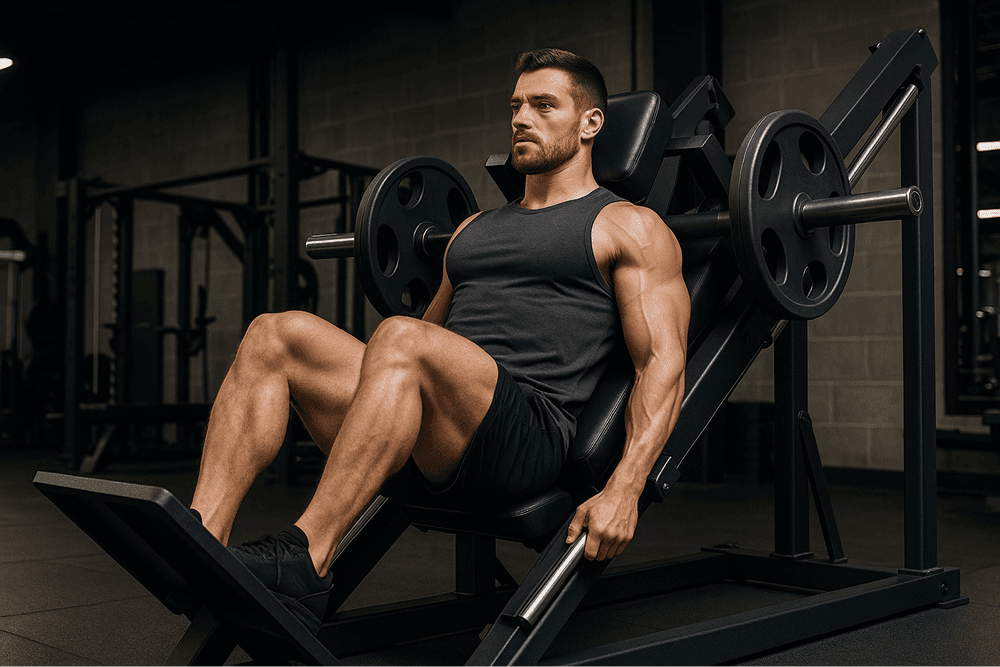
Hack Squat: Proper Form, Benefits, and Common Mistakes
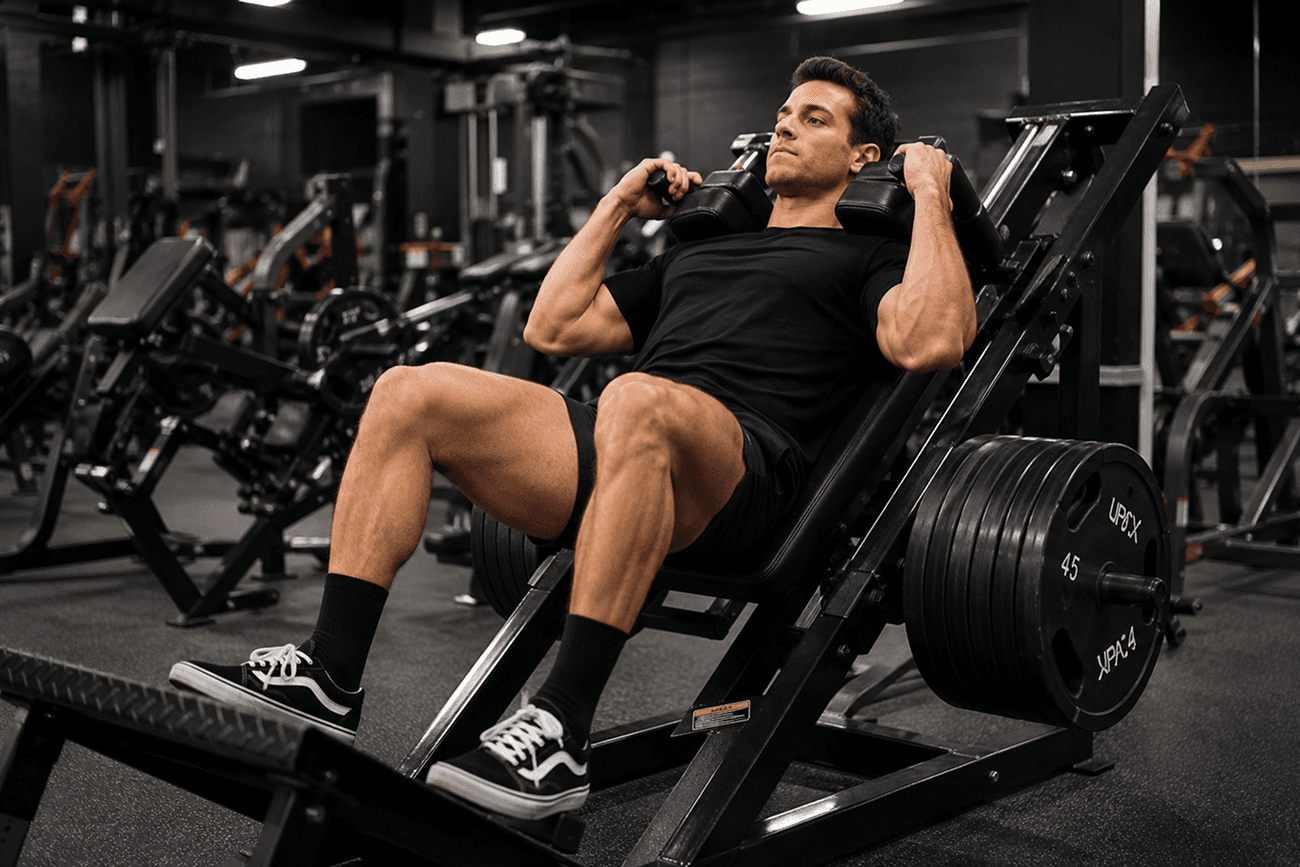
The machine hack squat trains the quadriceps and glutes with the torso supported on a pad. It reduces balance demands compared with a free-weight squat, but the machine does not eliminate spinal or knee loading or make every setup suitable for every lifter.
Whether you’re a beginner learning the movement or an experienced lifter trying to maximize quad development, mastering proper hack squat form is essential for getting results safely.
In this guide, you’ll learn:
How to do a hack squat correctly
The muscles worked
The biggest benefits of hack squats
Common mistakes to avoid
Tips for better quad growth and knee comfort
What Is a Hack Squat?
A hack squat is a machine-based squat variation where your torso stays supported against a back pad while your legs move through a squat pattern on a fixed track.
Unlike free-weight squats, the hack squat machine provides stability, allowing you to focus more on:
Quad development
Controlled movement
Progressive overload
Lower-body hypertrophy
Because the machine stabilizes your body, hack squats are especially popular among:
Bodybuilders
Beginners
Lifters who prefer a supported squat, provided it is comfortable and appropriate for them
Athletes training for leg strength and size
Muscles Worked During Hack Squats
Hack squats primarily target the quads, but several other lower-body muscles are involved.
Primary Muscles Worked
Quadriceps
Glutes
Secondary Muscles Worked
Hamstrings
Calves
Adductors
Core stabilizers
How Foot Placement Changes the Setup
Foot Placement | Practical effect |
|---|---|
Low on platform | Can require more forward knee travel; keep the whole foot planted |
High on platform | Changes hip and knee motion; does not turn the exercise into a hamstring curl |
Narrow stance | May change comfort and range; does not reliably isolate the outer quadriceps |
Wide stance | Changes hip position and range; choose a comfortable stance rather than promising isolation |
How to Do a Hack Squat Properly
Step 1: Check the Machine and Set Up
Read the machine instructions, locate the re-rack handles, and set/test the safety stops with no added load before starting
Set shoulders comfortably under the pads and keep the torso and pelvis supported
Position your feet shoulder-width apart
Keep toes slightly pointed outward
Step 2: Unlock the Machine
Straighten your legs slightly
Release the safety handles
Maintain a braced core
Step 3: Lower Into the Squat
Bend your knees slowly
Keep your heels flat on the platform
Lower to the deepest comfortable position you can control while keeping your feet and pelvis supported
Avoid letting your lower back round
Step 4: Drive Back Up
Push through your midfoot and heels
Extend your knees and hips together
Extend smoothly without forcefully snapping the knees backward; follow the machine’s re-rack procedure when finished
Step 5: Repeat With Control
Use controlled reps
Avoid bouncing at the bottom
Maintain tension throughout the set
Proper Hack Squat Form Tips
Keep the Whole Foot Planted: Choose a position that lets you maintain stable contact instead of rolling onto the toes or edges of the feet.
Don’t Let Your Knees Collapse Inward: Your knees should track in line with your toes throughout the movement.
Control the Lowering Phase: Use a speed that lets you keep the machine and your body position under control, rather than bouncing into the bottom.
Use a Repeatable Range: Build depth as control and comfort allow. Partial range can be a deliberate modification; do not force depth to satisfy a universal parallel rule.
Brace Your Core: Even though the machine provides support, core tension still matters for spinal stability.
Benefits of Hack Squats
1. Excellent Quad Development
The hack squat can provide challenging knee-extension work while the machine supplies support. The resistance and joint demand change through the rep; quad tension is not literally constant.
The supported position may make it easier to focus on knee extension. Feeling the quadriceps work does not establish greater activation or growth than a free-weight squat.
2. Supported Torso Position
Back support reduces balance and torso-stabilization demands, but does not prove that spinal loading is always lower than in a barbell squat. Machine angle, load, body proportions, and depth all matter.
A supported setup may suit:
Lifters who find the particular machine comfortable; existing back pain warrants individual assessment
High-volume leg training
Accessory lower-body work
3. Easier to Learn Than Barbell Squats
The fixed movement path reduces balance demands, making the exercise beginner-friendly.
You can focus on:
Proper squat depth
Knee tracking
Controlled reps
without worrying as much about stability.
4. Great for Progressive Overload
Hack squat machines make it easy to:
Add weight consistently
Progress within the machine’s rated limits while using correctly set stops
Track progression over time
This is ideal for hypertrophy-focused training.
5. Built-In Safety Features to Learn
Safety handles and stops are helpful only when correctly adjusted and used. Before a demanding set, make sure you can re-rack and that the stops will catch the sled at a suitable depth. The Hammer Strength plate-loaded owner’s manual illustrates model-specific carriage stops; use the instructions for your own machine.
The machine supports your body
Safety handles are built in
Balance demand is lower, but failure is not automatically safe; beginners should leave reps in reserve
Common Hack Squat Mistakes
1. Placing Feet Too Low
When feet are extremely low on the platform:
More knee travel may be required; forward knee travel alone is not a technique fault
Heel lift becomes more likely
Knee discomfort can increase
A moderate foot position usually works best.
2. Locking Out Aggressively
Avoid forcefully snapping the knees backward under load. Smooth knee extension and a controlled re-rack are different from aggressive hyperextension.
Choose a repeatable top position that follows the machine instructions and feels comfortable.
3. Using Too Much Weight
Many lifters load the machine excessively and shorten their range of motion.
Instead:
Prioritize a comfortable, repeatable depth
Use controlled reps
Focus on muscle tension
4. Allowing the Lower Back to Round
If your pelvis lifts off the pad or you lose control at depth, reduce the range or load and adjust the setup. Do not use a visible pelvic movement alone to diagnose an injury.
Only squat as deep as your mobility allows while maintaining spinal position.
5. Bouncing at the Bottom
Bouncing makes the bottom position harder to control, especially with an unfamiliar load.
Pause briefly at the bottom for better control.
Are Hack Squats Bad for Your Knees?
There is no universally safe or unsafe hack-squat setup. Many people tolerate the exercise, but appropriate load, comfortable range, and individual circumstances matter.
Do not force the movement through sharp, worsening, or persistent pain. Seek qualified assessment if symptoms recur, or if you have an injury or a relevant condition.
However, knee discomfort may occur if you:
Use excessive weight
Lift your heels
Use poor foot placement
Allow knees to cave inward
Force a depth or stance you cannot control comfortably
If you experience pain:
Reduce load
Adjust foot position
Slow down your reps
Stop the painful movement and seek help when symptoms persist; ankle mobility work is not a universal cure
Hack Squat vs Barbell Squat
Hack Squat | Barbell Squat |
|---|---|
Supported knee- and hip-extension exercise | More full-body involvement |
Less balance required | Greater stabilization demands |
Torso supported; spinal load still depends on the setup | Torso unsupported; load and technique affect spinal demand |
Easier for beginners | More technical |
Can build size and strength | Can build size and strength; practices free-weight squat skill |
Both exercises are effective, the best option depends on your goals.
Best Rep Ranges for Hack Squats
Goal | Recommended Reps |
|---|---|
Strength-focused example | 4–6 reps |
Muscle-growth example | 8–15 reps |
Higher-rep example | 15–20 reps |
These ranges overlap and are examples, not exclusive zones. Choose a load and rep range that allow controlled, challenging work. Beginners can start with moderate loads and several reps in reserve.
Controlled tempo
Moderate-to-high reps
Full range of motion
Sample Hack Squat Workout
Example Quad-Focused Leg Day
Hack Squat — 2–3 sets × 8–12 reps
Romanian Deadlift — 2–3 sets × 8–12 reps
Leg Extension — optional 2 sets × 12–15 reps
Walking Lunges — optional alternative to leg extensions, 2 sets × 8–12 reps per leg
Standing Calf Raises — 2–3 sets × 10–20 reps
Final Thoughts
A hack squat can be a useful supported option for leg training. Learn its safety features, choose a comfortable stance and range, and increase demand gradually as you can repeat the same technique.
When performed correctly, it can:
Improve quad development
Increase lower-body strength
Support muscle growth
Provide supported squat practice when the machine fits the lifter
Focus on:
Controlled reps
Proper depth
Stable foot placement
Progressive overload
and the hack squat can become one of the best lower-body exercises in your training program.
Track Comparable Hack-Squat Sessions
Warm up with lighter sets, rest about 2–3 minutes between demanding hack-squat sets, and leave a few reps in reserve while learning. Add the smallest manageable load only after all sets reach the upper rep target with consistent depth and effort. Record the machine, foot position, range, and whether your logged load means plates-only or includes stated starting resistance. Different machines cannot be compared by plate weight alone.
For the equipment choice, see hack squat versus leg press. A notebook or Setgraph can preserve the setup and set history.