Hack Squat: Setup, Technique and Programming Guide
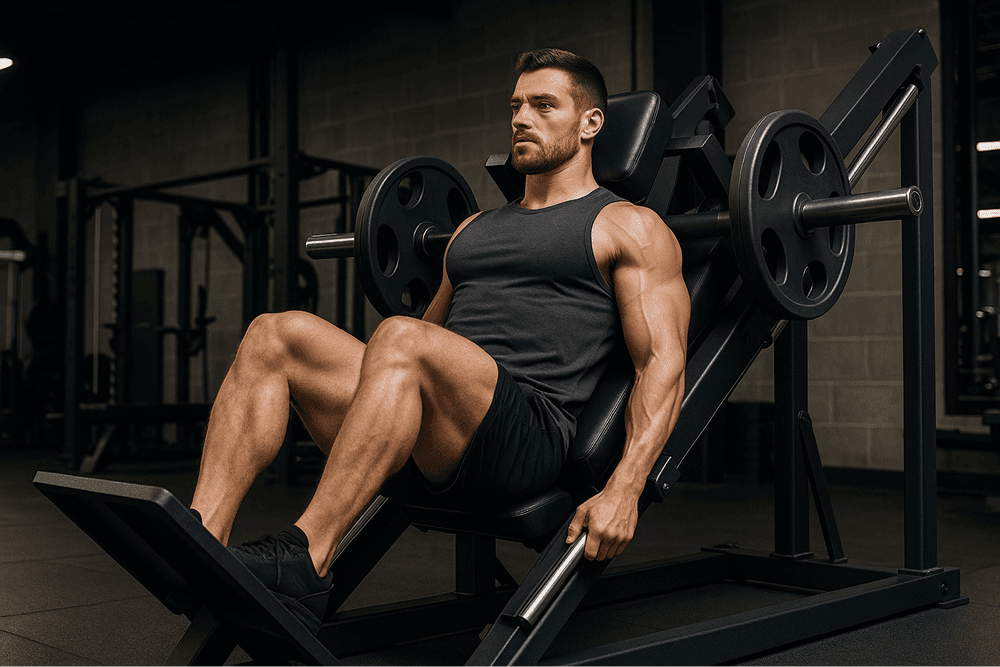
What Is the Hack Squat? Understanding This Powerful Quad Builder
The machine hack squat is a lower-body exercise usually performed on an angled sled with shoulder and back pads. Designs vary. The support reduces balance demands, but it does not remove spinal or knee loading.
Follow the instructions for the particular machine, including its starting position, safety catches and range stops. Practise unloading and re-racking with a light load before hard sets.
This guide covers the machine version. A barbell hack squat, performed with a bar held behind the legs, is a separate free-weight exercise with a different setup.
Hack Squat Benefits: Why This Exercise Deserves a Place in Your Program
Targeted Quadriceps Development
The fixed path can make it easier to focus on knee and hip extension. Potential practical advantages include:
Supported positioning with less need to balance a free bar.
Repeatable setup when you use the same foot position and machine.
A loading option for quadriceps and glutes alongside other lower-body exercises.
Back support and loading
A back pad changes the task, but the machine still loads the body through the shoulder pads and feet.
Do not assume hack squats are suitable after a back injury.
Use a load and range you can control without losing supported position.
If you have pain or a relevant condition, get individualized exercise guidance.
Controlled Range of Motion
The hack squat machine provides distinct advantages for form consistency:
Use adjustable stops according to the machine instructions, where available.
Aim for a consistent, comfortable range rather than forcing an arbitrary depth.
Lower under control; muscle damage is not the goal.
Versatility in Training Application
From beginners to advanced bodybuilders, the hack squat offers programming flexibility:
Can be programmed with different manageable rep ranges
Can serve as a main or accessory lower-body movement
Does not require drop sets, partials or short-rest finishers
How to perform a machine hack squat
Setup and Starting Position
Check the machine’s instructions and safety mechanisms; not every back pad or platform is adjustable.
Position your back and shoulders against the pads and place your feet securely on the platform. Start with a comfortable stance.
Hold the handles, brace your trunk, and follow the machine’s procedure for releasing the catches.
Use a light practice set to confirm that you can move and re-rack safely.
Execution: Proper Hack Squat Technique
Lower the sled with control, keeping your feet planted and your back supported.
Let knees travel in a comfortable direction over the toes. Forward knee travel can also occur in free-weight squats.
Descend only as far as you can control the movement without losing position or provoking pain.
Press evenly through the feet and return to the start without bouncing or snapping the knees into hyperextension.
Follow the machine’s re-racking procedure before changing stance or plates. If you cannot complete a rep, use the prescribed stop/safety procedure rather than forcing it.
Foot position and comfortable range
Foot placement changes the joint positions and available range. Adjust conservatively, following the machine instructions; no stance is a universal solution for knee pain or a guaranteed way to isolate one part of the quadriceps.
High and Wide Foot Placement
A higher or wider stance may change the relative hip and knee demands.
Keep the whole foot supported and test the range with a light load.
Do not treat this stance as rehabilitation or as a replacement for direct hamstring work.
Low and Narrow Foot Placement
A lower stance can require more ankle movement and knee flexion, depending on the machine.
Avoid moving so low that your heels lift or you lose control.
Stance width does not reliably isolate the inner quadriceps or create a particular muscle shape.
Mid-Platform, Standard Width
Start around a comfortable shoulder-width stance and adjust within the platform.
Record your setup if you want to compare performance across sessions.
Single-Leg Variation
Use single-leg loading only if the manufacturer permits it and you can control and re-rack the machine.
For unilateral work, a supported split squat or another suitable exercise may be easier to set up.
This is not a rehabilitation prescription or a guaranteed correction for asymmetry.
Common Hack Squat Mistakes and How to Fix Them
Rising Hips/Sliding Up the Pad
Problem: Losing back contact with the pad during the ascent Fix:
Reduce load and check the machine setup.
Keep your back and shoulders supported through the controlled range.
Stop if you cannot keep position; do not add towels or improvised padding that changes the intended support.
Losing control at depth
Problem: Descending farther than you can control, or using inconsistent range.
Use a comfortable repeatable depth.
Reduce load while learning the movement.
Have a qualified coach check your setup if you cannot maintain position.
Knee Valgus (Inward Collapse)
Problem: Knees collapsing inward during the movement Fix:
Reduce the load if your knees move abruptly or you lose foot contact.
Try a small stance adjustment and keep movement controlled.
Persistent pain or loss of control warrants individual assessment; do not diagnose a weak muscle from one movement.
Bouncing at the Bottom
Problem: Using momentum rather than muscle to initiate the ascent Fix:
Implement a brief pause at the bottom of each repetition
Focus on controlled eccentrics (3-second lowering)
Reduce weight until control is reestablished
Use verbal cues like "smooth transition" at the bottom
Hack Squat Programming: Sets, Reps and Training Strategies
For Strength Development
Example: 3 work sets × 5–8 reps for a lifter familiar with the machine.
Rest about 2–3 minutes or longer as needed.
Include one or two weekly exposures only if they fit the rest of your leg training.
Increase load slightly after all sets reach the top of the range with consistent control.
For Hypertrophy (Muscle Growth)
Example: 2–3 work sets × 8–15 reps.
Rest long enough to maintain the planned reps and technique, often about 2 minutes or more.
Count these sets alongside squats, lunges and leg presses.
Straight sets are sufficient; a double drop set is not necessary.
For local muscular endurance
Lighter sets of 15–20 controlled reps are one option.
Use rests that let you maintain position rather than chasing a fixed 45-second deadline.
Stop the set when technique deteriorates; high-repetition hack squats are not a complete aerobic program.
Optional advanced techniques
Experienced lifters can use a slower lowering phase or a brief pause, with a load that still permits controlled movement. These are optional variations; they do not guarantee extra growth.
For a drop set, fully re-rack and secure the sled before unloading plates. Reposition your feet only with the sled safely supported. Do not shift stance under a moving loaded sled or rely on exhaustion to make an exercise effective.
Incorporating Hack Squats Into Your Leg Training Split
Push-Pull-Legs Split
Place In Routine: Primary quad exercise on leg day
Accompanying Exercises: Romanian deadlifts, leg curls, calf work
Example Sequence: Hack Squats → RDLs → Leg Curls → Calf Raises
Upper-Lower Split
Example lower session: back squat, a modest amount of hack-squat work, leg curl and calf raise.
Avoid stacking large volumes of squat, hack squat and leg press without checking the total.
Body Part Split
Example quad-focused session: hack squat, a lunge variation and leg curl.
Choose accessory work to fill a gap rather than adding every available quad exercise.
Hack Squat Alternatives for Different Training Environments
If No Hack Squat Machine Is Available
A leg press, suitable squat machine, front squat or goblet squat can provide lower-body resistance.
These are alternatives, not mechanically identical replacements; compare loads only within the same exercise and setup.
For Home Gym Settings
A stable goblet squat or split squat is a simple home alternative.
Use purpose-built equipment for belt squats or landmine exercises; avoid improvised anchors or unstable heel supports.
Who Should and Shouldn't Use the Hack Squat
Ideal Candidates
Lifters who prefer a supported squat pattern and can operate the machine safely.
People who want a quadriceps-focused option within a balanced lower-body plan.
Beginners may use it with suitable instruction and conservative loading.
Exercise Caution
Pain, recent injury or a medical restriction requires individual guidance.
Powerlifters still need appropriate practice of their competition squat.
Sport training should include the movements and skills relevant to the sport.
Hack Squat FAQ: Common Questions Answered
How does the hack squat compare to the leg press?
Both can train the quadriceps and glutes. Their joint angles, range and support depend on the specific machines and your setup. A larger displayed load on a leg press does not establish greater strength or better results.
Can hack squats replace traditional squats?
A hack squat can be a main lower-body exercise for general strength or muscle-building goals. A competition squat or sport-specific task still needs its own practice; decide from the goal rather than calling one tool universally better.
How deep should I go on hack squats?
Use a repeatable range you can control while keeping the feet planted and back supported. Do not force parallel or extra depth if the machine, your mobility or symptoms make that unsuitable.
Are hack squats bad for the knees?
No exercise is universally safe or harmful. Machine setup, load, range and your circumstances matter. If hack squats provoke knee pain, stop that variation and seek appropriate advice rather than trying to fix it with a particular foot position.
How often should I include hack squats in my training?
One or two sessions per week can be a practical choice, depending on your total leg work and recovery. This is not a proven optimal frequency for everyone.
Using hack squats in a balanced leg program
The hack squat offers supported lower-body training. Choose a comfortable setup, use the machine’s safety mechanisms and build workload gradually from what you can repeat with control.
For a practical log, record the machine, load, reps and setup. A change of machine can change the task substantially, so start a new comparison rather than carrying over the old load automatically.
For equipment-specific instructions, use the manufacturer’s guidance, such as the Hammer Strength hack-squat product information, and the instructions on your gym’s actual machine. Training consistency, food and recovery still matter alongside exercise choice.
