Progressive Overload Meaning: A Practical, Beginner-Friendly Guide

Stalled progress in the gym is frustrating, but the solution is almost always the same: give your body a bit more to adapt to. Progressive overload means gradually increasing the stress you place on your muscles and nervous system so they continue to grow stronger, bigger, and more resilient. This guide explains the concept in plain language, shows multiple ways to apply it, and gives concrete programs and tracking strategies you can use today.
What progressive overload means and why it works

Progressive overload meaning is simple: you make workouts slightly harder over time so your body must adapt. That adaptation — neuromuscular improvements, muscle fiber enlargement, and stronger connective tissue — is how you gain strength, muscle, and endurance.
At a physiological level, muscles respond to increased mechanical tension, metabolic stress, and muscle damage by repairing and rebuilding with greater capacity. The nervous system also learns to recruit motor units more effectively. Together, these changes let you lift more, do more reps, or perform longer work.
A quick history note: the idea dates back to ancient anecdotes like Milo of Croton carrying a growing calf, and it was formalized in modern rehabilitation by clinicians such as Dr. Thomas Delorme in the mid-20th century.
The core ways to apply progressive overload
The easiest way to remember methods is fourfold. Each is a valid path to progress and can be combined.
Increase weight or resistance
Increase repetitions per set
Increase total volume or time under tension (more sets, longer sets)
Increase intensity (reduce rest, increase tempo, add more difficult variations)
Any time you push one of these variables up and maintain good form, you are applying progressive overload.
How to know when to increase the load
Progressing too often or not at all are both common mistakes. Use clear, objective signals:
You can perform 1–2 extra reps on your final working set for two consecutive workouts. That is a good time to add weight or move to a harder variation.
RPE (Rate of Perceived Exertion) for a given set drops by 1 or more, e.g., what felt like an RPE 8 now feels like 7.
You complete prescribed sets and reps while maintaining clean technique and full range of motion.
You recover well between sessions (energy, sleep, no unusual lingering soreness).
If any increase causes breakdown in form, joint sharp pain, or failure to recover, dial back the progression.
Methods and examples (practical)
Increase the weight
Best for strength and hypertrophy: add small increments regularly. For most novice lifters an extra 2.5–5 pounds (1–2.5 kg) per session on upper-body lifts and 5–10 pounds (2.5–5 kg) on lower-body lifts works well. For machines or plate-limited gyms, use microplates or increase reps instead.
Increase repetitions
When small weight jumps are impractical, add reps. Example: if your target is 3 sets of 8 and you hit 3x10 with good form, increase weight next session and drop to 3x8 again.
Increase volume/time under tension
Add sets or slow the eccentric (lowering) phase of lifts. For instance, move from 3 sets to 4 sets of an exercise, or perform a 3-second eccentric on each rep to increase time under tension.
Increase intensity
Reduce rest between sets, add pauses, increase movement speed where appropriate, or use advanced techniques like drop sets and supersets. Be cautious: intensity increases stress and recovery needs.
Tracking progress: practical tools and metrics
Reliable tracking is the difference between random effort and steady progress.
Record exercise, sets, reps, weight, and how the set felt (RPE).
Track weekly volume per lift (sets x reps x weight) to see trends.
Note personal bests and dates for reference.
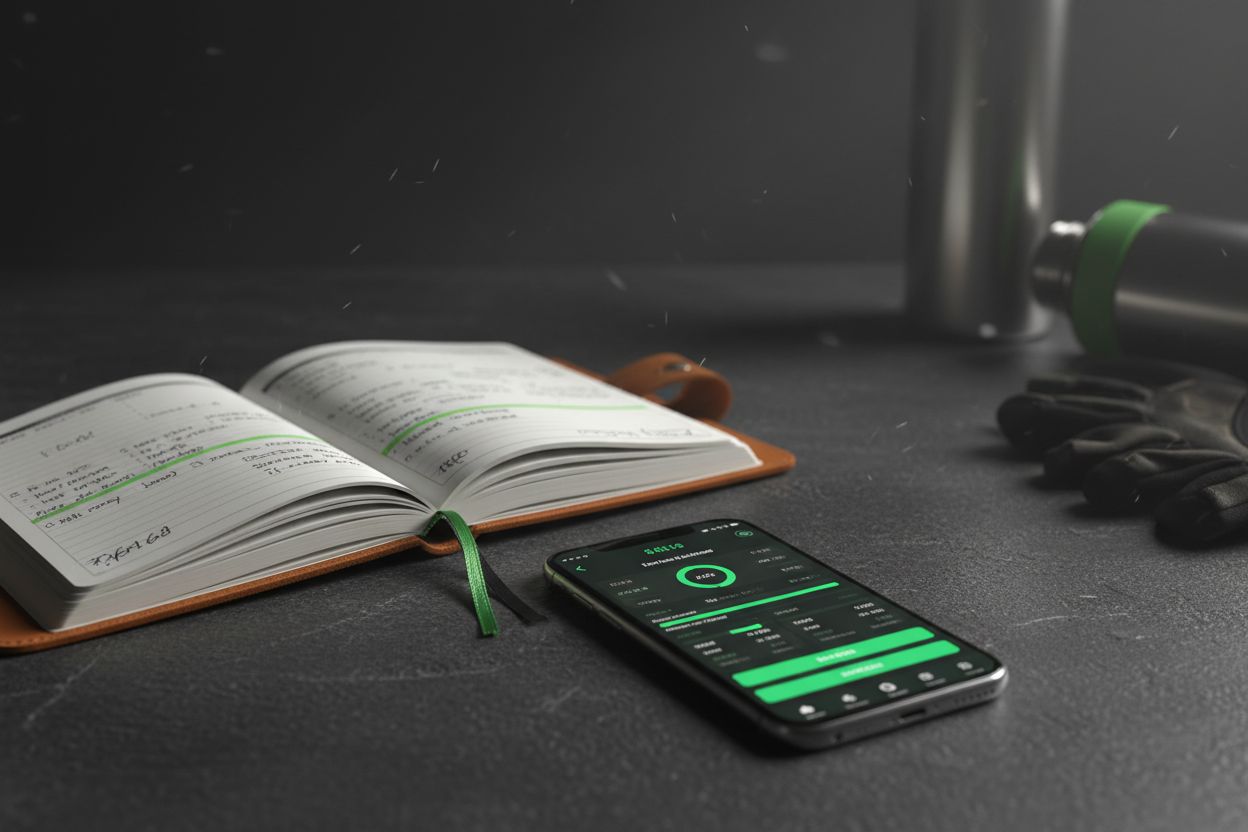
Apps and digital logs make tracking faster. If you prefer paper, a simple notebook works fine. For app users, consider a workout-tracking app to log sets, track PRs, and analyze volume trends — many lifters use apps as their training diary and performance dashboard. For more on tracking tools and guides, see Setgraph - Workout Tracker Gym Log App and its related guides in the app's article library: Setgraph App: Insights, Tips & Training Guides and Setgraph Training Guide | Maximize Your Workout.
Sample 6-week beginner program (exact numbers)
This linear progression program is beginner-friendly and uses full-body sessions three times per week (e.g., Monday, Wednesday, Friday). Start with weights you can handle for the prescribed sets and reps while maintaining form.
Week structure (repeat for 6 weeks):
Day A: Squat 3x5, Bench Press 3x5, Barbell Row 3x6
Day B: Deadlift 1x5, Overhead Press 3x5, Pull-ups or Lat Pulldown 3x6
Progression rules:
Add 5 lbs (2.5 kg) to lower-body lifts each workout and 2.5 lbs (1 kg) to upper-body lifts when you successfully complete all sets and reps with good form.
If you miss a lift, repeat the same weight next session. If you fail twice, reduce by 10% and rebuild.
Use 2–3 minutes rest between heavy sets.
Sample week-by-week plan (example starting weights for a motivated beginner):
Week 1 (A/B/A): Squat 95 lbs x3x5; Bench 65 lbs x3x5; Row 75 lbs x3x6; Deadlift 135 lbs x1x5; OHP 45 lbs x3x5
By Week 6: Expect to have added 30–50+ lbs to lower-body lifts and 10–20+ lbs to pressing movements, depending on starting point and recovery.
For a guided set of tips on optimizing training details and progression, see Optimize Your Training | Expert Tips and Workout Guides.
Progressive overload with bodyweight and home workouts
You do not need a gym to progress. Strategies for calisthenics and home training:
Increase reps or sets
Shift leverage to harder variations (knee push-up → standard push-up → decline push-up → one-arm progressions)
Add tempo changes and pauses for more time under tension
Use household items or a backpack to add weight
Reduce rest or add circuit formats to increase intensity
Example progression for push-ups: 3x8 (knee) → 3x10 (knee) → 3x8 (standard) → 4x8 (standard) → 3x6 decline.
For more beginner-friendly exercise principles across different routines, check Core Principles & Techniques for Every Lifter - Setgraph.
Periodization and planning without overcomplicating things
Periodization is simply organizing progression across weeks and months. Keep it easy:
Linear progression: steady increases over weeks. Best for beginners.
Undulating: vary reps and intensity within a week (e.g., heavy day, medium day, light day). Good for intermediates.
Block periodization: focus on strength for a block, then hypertrophy, then recovery.
Plan deloads every 4–8 weeks: cut volume or intensity by 40–60% for a week to restore capacity.
Nutrition, sleep, and recovery — the other half of progress
You cannot overload effectively if you do not recover. Key targets:
Protein: 1.6–2.2 g per kg bodyweight for muscle gain and repair
Calories: slight surplus (about 250–500 kcal/day) for steady hypertrophy, maintenance or slight deficit for fat loss while preserving strength
Sleep: 7–9 hours per night; poor sleep reduces strength and recovery
Hydration and micronutrients: support performance and healing
If you struggle to recover between sessions, prioritize sleep and nutrition before increasing load.
Special populations: women, older adults, and training with limitations
Women respond just as well to progressive overload as men. Start with the same principles but recognize individual load tolerance. For heavy lifts in pregnancy or postpartum consult a clinician.
Older adults should progress more slowly, prioritizing joint-friendly variations, balance, and mobility. Lower starting loads and smaller increments reduce injury risk.
If recovering from injury, follow rehabilitation guidance and favor gradual increases, controlled tempo, and professional supervision.
Cardio and endurance progressive overload
Progressive overload for cardio uses similar logic: more time, more intensity, or reduced rest. Examples:
Increase run or bike duration by 5–10% per week
Add intervals: more intervals or longer hard efforts
Increase incline or resistance gradually
Treat endurance training like strength training in tracking and periodizing to avoid sudden spikes in load.
Troubleshooting plateaus and common misconceptions
Myth: You must lift heavier every session. Reality: You can progress by volume, tempo, or frequency; small, consistent improvements matter more than big jumps.
Hit a plateau? Reassess recovery, nutrition, and sleep. Consider a planned deload or switch rep ranges for 4–6 weeks.
Overtraining signs: persistent fatigue, decreased performance, poor sleep, mood swings. If present, reduce volume or take several days off.
If progress stalls despite consistent effort, review your tracking data: are you actually increasing weekly volume or intensity? For tools and ideas on monitoring training load and user reviews of tracking apps, see Setgraph App Reviews (2025): User Ratings for Tracking Sets, Reps & Workouts.
Advanced topics in brief
RPE and autoregulation: use RPE to decide when to push or back off. An RPE 8 means about 2 reps left in reserve; training across 7–9 RPE can be effective.
1RM calculations: useful for planning percentages in advanced programs. Beginners rarely need exact 1RM testing; use working sets and progressions instead.
Volume landmarks: a common guideline for hypertrophy is 10–20+ weekly sets per major muscle group for intermediates. Beginners often see gains with far less.
Quick checklist to apply progressive overload safely
Warm up thoroughly and practice technique before heavy sets
Track sets, reps, weight, and RPE every session
Progress only when form is solid and recovery is good
Use small, consistent increments (microloading when needed)
Schedule regular deloads every 4–8 weeks
Prioritize protein, calories, and sleep
Frequently asked questions
Is progressive overload only for building muscle?
No. It applies to strength, power, endurance, and rehabilitative goals. The variable you emphasize (weight, time, reps, intensity) depends on your goal.
How fast should I expect results?
Beginners often see noticeable strength and neuromuscular improvements within weeks and visible muscle change in 6–12 weeks. Timelines depend on training age, nutrition, and genetics.
Can I use progressive overload with bodyweight training?
Absolutely. Use harder variations, added reps, slower tempo, or added external load like a weighted vest.
What happens if I progress too quickly?
Progressing too fast increases injury and burnout risk. If you experience joint pain or cannot recover, reduce progression rate and reassess technique and sleep.
Final thoughts
Understanding progressive overload meaning removes guesswork: gradually increase the challenge, track the results, and respect recovery. With consistent small steps—whether you train in a gym with barbells or at home with bodyweight—you will keep improving. If you want tools to log workouts and analyze your trends, apps and guides can help you stay consistent and focused; explore training guides and tracking resources to support your progress, for example Setgraph - Workout Tracker Gym Log App, the Setgraph articles hub Fitness & Workout Tips | Setgraph, and optimization guides at Optimize Your Training | Expert Tips and Workout Guides.
If you are new, start conservative, track everything, and add tiny increments week by week. Over months and years, those small increases compound into big gains.
Article created using Lovarank