Upper Body Workout for Beginners: A Complete 4-Week Guide

Getting started with upper body training can feel overwhelming, but with a clear plan you can build strength, improve posture, and move more confidently in everyday life. This guide walks you through safe warm-ups, eight essential exercises with modifications, a practical 4-week progression, recovery strategies, and simple nutrition advice so you can make consistent progress without guessing.
Why an upper body workout for beginners matters
Upper body strength supports everyday tasks like lifting groceries, carrying children, and maintaining good posture at a desk. Training the chest, back, shoulders, biceps, and triceps not only improves functional strength but also balances your body and reduces injury risk. If you want simple principles for movement quality and technique, start with a short primer on core lifting principles to complement this routine: Core Principles & Techniques for Every Lifter.
Benefits at a glance:
Better posture and upper-back strength
Improved pushing and pulling power
Reduced risk of shoulder and neck pain
Aesthetic improvements and greater confidence
Before you begin: equipment, safety, and warm-up

Equipment for beginners is minimal. Work with what you have and progress over time:
Body weight only: perfect for starting strength and learning movement patterns
One pair of light-to-moderate dumbbells (5–20 lb range to start depending on fitness)
Resistance bands for rows, assisted push-ups, and shoulder work
A bench or sturdy chair for press and dips
Safety first:
Focus on controlled movement, not speed
Breathe: exhale on the effort, inhale on the return
Keep a neutral spine and avoid shrugging shoulders on presses
If you feel sharp joint pain, stop and reassess form or choose a modification
Dynamic warm-up (5–8 minutes before each session):
Arm circles forward and backward — 30 seconds each
Band pull-aparts or scapular retractions — 10–15 reps
Shoulder dislocations with a band or broomstick — 10 reps
Inchworm to plank — 6–8 reps
Light banded rows or half push-ups — 8–10 reps
A short warm-up increases blood flow and primes muscle activation so your first working set is performed safely and effectively.
The core exercises: step-by-step
This routine focuses on compound movements first, then a few targeted isolation exercises. Aim for 2–3 sets of each exercise with 8–15 reps depending on the move and your current capacity.

Push-up (incline or knee if needed)
How to perform:
Hands under shoulders, body in a straight line from head to heels
Lower chest toward the floor with elbows at about 45 degrees
Press back up until elbows are nearly straight
Muscles worked: chest, shoulders, triceps, core
Sets/reps: 2–3 sets of 6–12 reps
Modifications: incline push-ups on a bench or knee push-ups to reduce load
Form tips: keep hips level, avoid sagging; tuck chin slightly to maintain neck alignment
Dumbbell Chest Press (flat or floor press)
How to perform:
Lie on a bench or the floor, dumbbells in each hand at chest level
Press dumbbells up until arms are nearly straight
Lower slowly back to the start
Muscles worked: chest, triceps, front shoulders
Sets/reps: 2–3 sets of 8–12 reps
Form tips: control the descent and avoid arching the lower back excessively
One-Arm Dumbbell Row
How to perform:
Place one knee and hand on a bench, spine neutral
Pull dumbbell toward your hip, retracting the shoulder blade
Lower under control
Muscles worked: lats, mid-back, biceps
Sets/reps: 2–3 sets of 8–12 reps per side
Form tips: lead with the elbow and keep the torso stable; avoid rotating the hips
Standing Overhead Press (dumbbells or band)
How to perform:
Feet hip-width, core braced, dumbbells at shoulder height
Press overhead until arms are nearly locked
Lower with control
Muscles worked: shoulders, triceps, upper back
Sets/reps: 2–3 sets of 8–12 reps
Form tips: avoid overarching the lower back; brace your core and exhale on the press
Lateral Raise
How to perform:
Stand with light dumbbells at your sides
Raise arms out to the side to about shoulder height
Lower slowly
Muscles worked: side deltoids
Sets/reps: 2 sets of 10–15 reps
Form tips: use light weight to preserve shoulder health and avoid swinging
Biceps Curl (dumbbell or band)
How to perform:
Stand tall, elbows close to your sides
Curl weights toward shoulders, squeeze at the top
Lower with control
Muscles worked: biceps
Sets/reps: 2–3 sets of 8–15 reps
Form tips: avoid using momentum; isolate the elbow joint
Triceps Overhead Extension or Triceps Kickback
How to perform:
For overhead: hold one dumbbell with both hands behind your head and extend
For kickback: hinge forward slightly and extend arm behind you
Muscles worked: triceps
Sets/reps: 2–3 sets of 8–12 reps
Form tips: keep the elbow steady and avoid swinging
Core finisher: Plank or Deadbug
How to perform:
Plank: hold a straight-line position on elbows for 20–60 seconds
Deadbug: lie supine and alternate stretching opposite arm and leg while bracing core
Muscles worked: deep core stabilizers, shoulders and low back indirectly
Sets/reps: 2–3 sets of 20–60 seconds for plank or 8–12 reps per side for deadbug
Sample beginner workouts: two options
Choose one approach depending on time and goals. Both workouts should be performed 2–3 times per week with at least one rest day between sessions.
Option A — Full upper body session (45–60 minutes):
Warm-up: dynamic warm-up (5–8 minutes)
Push movement: Push-ups or dumbbell chest press — 3 x 8–12
Pull movement: One-arm dumbbell row — 3 x 8–12 per side
Shoulders: Overhead press — 3 x 8–12
Secondary shoulder: Lateral raises — 2 x 12–15
Arms: Biceps curls — 2 x 10–15; Triceps extension — 2 x 10–12
Core: Plank or deadbug — 2–3 sets
Cool-down: light stretching
Option B — Short circuit (30 minutes)
Perform each exercise for the prescribed reps, rest 30–60 seconds, repeat circuit 2–3 times:
Incline push-ups — 10–12
Dumbbell row — 10 per side
Overhead press — 10
Biceps curl — 12
Triceps kickback — 12
Plank — 30 seconds
No-equipment alternative:
Push-ups (incline/knee)
Reverse snow angels or prone Y/T/I for back
Pike push-ups or hand-release push-ups for shoulders
Water bottles or grocery bags for curls and overhead work
For more structured program templates and coaching tips, see this training guide: Setgraph Training Guide | Maximize Your Workout.
A practical 4-week progression plan
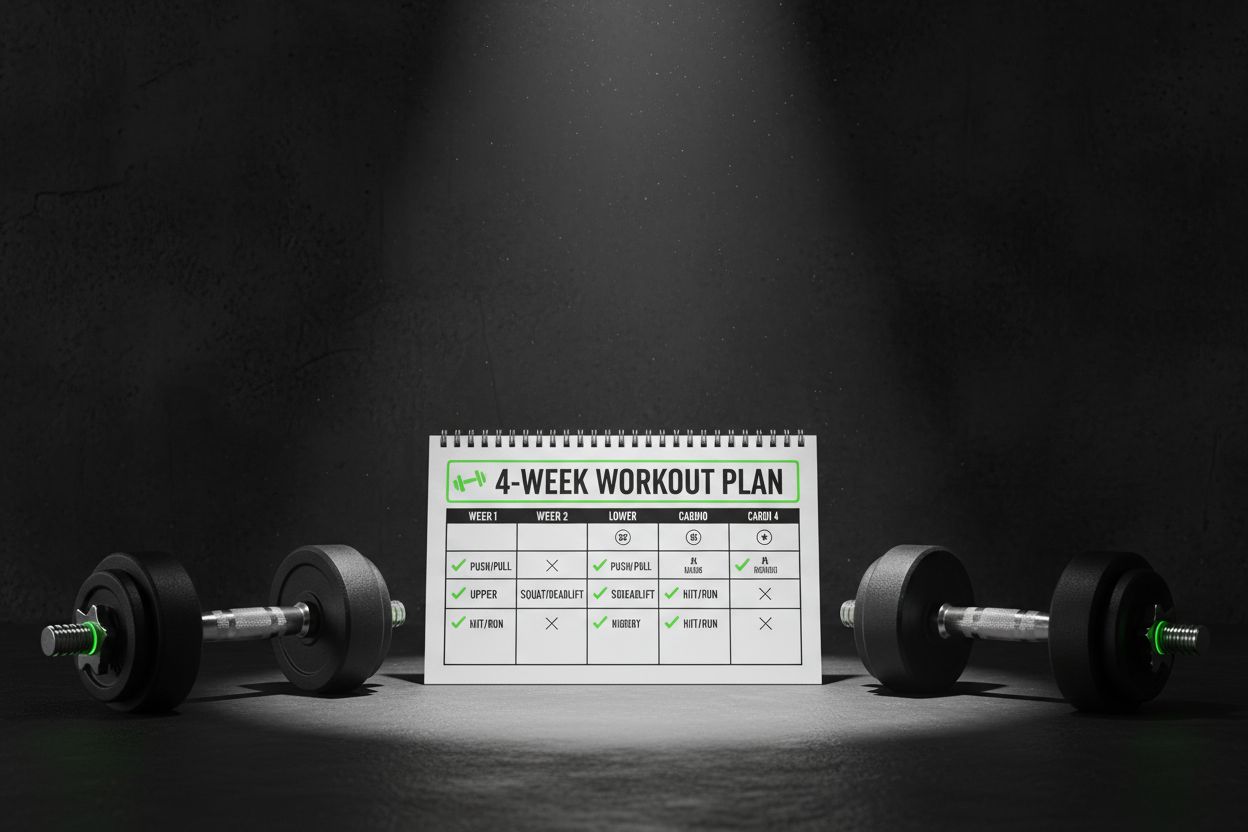
Week 1 — Learn the movements
Focus: technique and light loads
Frequency: 2 full upper-body sessions
Aim for 2 sets per exercise and moderate tempo (2 seconds down, 1 second up)
Week 2 — Add volume
Focus: build work capacity
Frequency: 2–3 sessions
Increase to 3 sets for compound lifts; keep isolation at 2 sets
Week 3 — Increase intensity
Focus: slightly heavier weights or more challenging variations
Frequency: 2–3 sessions
Reduce reps to 8–10 on main lifts and increase weight if the last reps feel manageable
Week 4 — Consolidate and test
Focus: assess progress and solidify form
Perform slightly heavier sets but stop 1–2 reps shy of failure
Test a baseline: max push-up sets, or one-rep-proxy with a heavier but safe weight
When to increase weight or difficulty
You can do two more reps than the target rep range for two sessions in a row
Form remains solid through the set
Recovery is adequate (not overly sore for multiple days)
Tracking progress matters. Simple metrics include reps completed, perceived exertion, and whether form stayed intact. For logging workouts and tracking trends consider a workout tracker to record sets, reps, and weights.
Recovery, soreness, and managing DOMS
Delayed onset muscle soreness is normal when you start training or increase workload. Expect mild to moderate stiffness 24–72 hours after sessions.
Practical recovery strategies:
Active recovery: light walking, mobility work, or a short bike ride
Sleep: aim for 7–9 hours per night to support muscle repair
Hydration: keep water intake steady throughout the day
Nutrition: see the nutrition section below
Frequency: allow at least 48 hours before working the same muscle group hard again
If soreness limits your range of motion, perform lighter sessions focused on mobility and technique until you recover. For guidance on optimizing recovery and programming, these expert tips can help: Optimize Your Training | Expert Tips and Workout Guides.
Common beginner mistakes and how to avoid them
Rushing technique: prioritize controlled tempo and solid range of motion
Ego lifting: choose a weight that allows clean reps; adding weight too fast increases injury risk
Holding breath: breathe consistently — exhale during exertion, inhale during lowering phase
Skipping warm-ups: never start heavy sets cold
Neglecting back work: balance pushing movements with pulling to protect shoulders
Troubleshooting examples:
Can’t do a full push-up? Use an incline or knees, and practice scapular push-ups to build shoulder blade control
Shoulder discomfort? Reduce range, switch to neutral-grip dumbbell presses, and add thoracic mobility work
One arm feels weaker? Start with the weaker side as the first working set and match reps on the stronger side
Mobility and flexibility: quick routines
Pre-workout dynamic moves (short): band pull-aparts, arm swings, shoulder dislocations. Post-workout static stretches: doorway pec stretch, cross-body shoulder stretch, triceps overhead stretch. Spend 5–10 minutes on mobility after training to preserve joint health.
Nutrition basics for strength gains
You do not need a complex nutrition plan to progress. Focus on consistency:
Protein: aim for roughly 0.6–1.0 grams per pound of body weight daily depending on goals
Carbs: support workouts with adequate carbs before and after sessions to fuel and recover
Meals: a balanced meal 1–3 hours before training and a protein-containing snack or meal within two hours after workouts helps recovery
Hydration: drink water throughout the day; include electrolytes if sweat losses are high
If you want basic templates for pre/post-workout snacks: Greek yogurt with fruit, a banana and nut butter, or a lean turkey sandwich are easy, portable options.
Integrating upper body workouts with other training
If you train lower body separately, alternate upper and lower days. Example week for a beginner:
Monday: Upper body
Tuesday: Lower body
Wednesday: Rest or light cardio
Thursday: Upper body
Friday: Lower body or active mobility
Weekend: Rest or light activity
Combine short cardio sessions (20–30 minutes) for conditioning if desired, but avoid doing heavy endurance work on the same day as an intense strength session unless you accept reduced performance.
Tracking progress and staying motivated
Small, consistent wins matter. Track:
Weight used and reps completed
How you feel during and after workouts
Any mobility or pain improvements
If you prefer an app for recording sets and tracking trends, the Setgraph workout tracker is an option to log workouts and view history: Setgraph - Workout Tracker Gym Log App. If you want to read user views first, see user reviews here: Setgraph App Reviews (2025): User Ratings for Tracking Sets, Reps & Workouts.
Motivation tips:
Set a small non-scale goal every two weeks, such as 3 more push-ups or 5 more pounds on a dumbbell press
Celebrate consistency rather than perfection
Train with a friend or join a class occasionally for accountability
Frequently asked questions
Q: How often should a beginner do an upper body workout?
A: 2–3 times per week is ideal, with rest days between sessions. This gives enough stimulus and recovery while you adapt.
Q: What weight should I start with?
A: Choose a weight that allows you to complete the target reps with good form and leaves 1–2 reps in reserve.
Q: How long until I see results?
A: Many beginners notice strength improvements in 3–6 weeks and visible changes in 8–12 weeks with consistent training and adequate nutrition.
Q: Can I do this at home without equipment?
A: Yes. Use bodyweight variations, resistance bands, or household items to create progressive overload.
Final steps: how to begin this week
Pick one of the sample workouts above and schedule two sessions this week. Start light, prioritize form, and record each set so you can repeat or slightly increase the load next week. If you want guided templates or printable plans, explore additional training guides here: Setgraph Training Guide | Maximize Your Workout.
Remember, the best upper body workout for beginners is the one you can do consistently with good form. Start small, track your progress, and gradually challenge your muscles — that steady approach is the fastest route to safe, lasting strength gains.
Article created using Lovarank