Push Pull Legs Week Routine: Complete 3–6 Day Guide to Progression, Nutrition & Deloads

If you want a training plan that's flexible, efficient, and scales with experience, a push pull legs week routine is one of the best frameworks you can use. It groups muscles by movement pattern so you can train with high intensity, recover properly, and hit each muscle multiple times per week. This guide walks through exactly how to set up 3, 4, 5 and 6-day variations, offers week-by-week progression, deload advice, nutrition guidance, and troubleshooting so you can get results without guesswork.
What is the Push Pull Legs Split?

The push pull legs split divides workouts into three movement categories: push (chest, shoulders, triceps), pull (back, biceps), and legs (quads, hamstrings, glutes, calves, core). Each day focuses on synergistic muscle groups so you can perform compound lifts without excessive overlap.
Push day examples: bench press, overhead press, incline dumbbell press, triceps extensions
Pull day examples: barbell rows, pull-ups, face pulls, bicep curls
Leg day examples: squats, deadlift variations, lunges, hamstring curls
A push pull legs week routine can be run as a 3-day-per-week maintenance style, or expanded to 4–6 days to increase frequency and volume. The split is popular because it balances training frequency with recovery and allows simple progression models.
Why PPL Works (the basics and the science)
PPL works because it groups muscles that assist each other, letting you perform compounds first and follow with targeted accessory work. Training frequency matters: multiple reviews suggest stimulating a muscle 2 times per week tends to be more effective for hypertrophy than once per week when volume is equated. That makes PPL ideal — you can structure the week so most muscle groups get hit twice without daily interference.
Key benefits:
Recovery-friendly: related muscles recover together while other groups train
High quality sets: compounds early in the session ensure heavy, productive work
Flexible frequency: scale between 3 and 6 training days
Clear progression: easy to increase sets, reps, or load per session
Who should use a push pull legs week routine?
PPL is adaptable:
Beginners: start with a 3-day PPL (one of each) to learn movements and build a base
Intermediate lifters: 4- or 5-day variants increase weekly volume for growth
Advanced lifters: 6-day PPL supports specialization and higher weekly volume
If you are training for a skill-specific sport with heavy conditioning demands, you can adapt PPL to include technical sessions, but monitor recovery closely.
Training Frequency Options
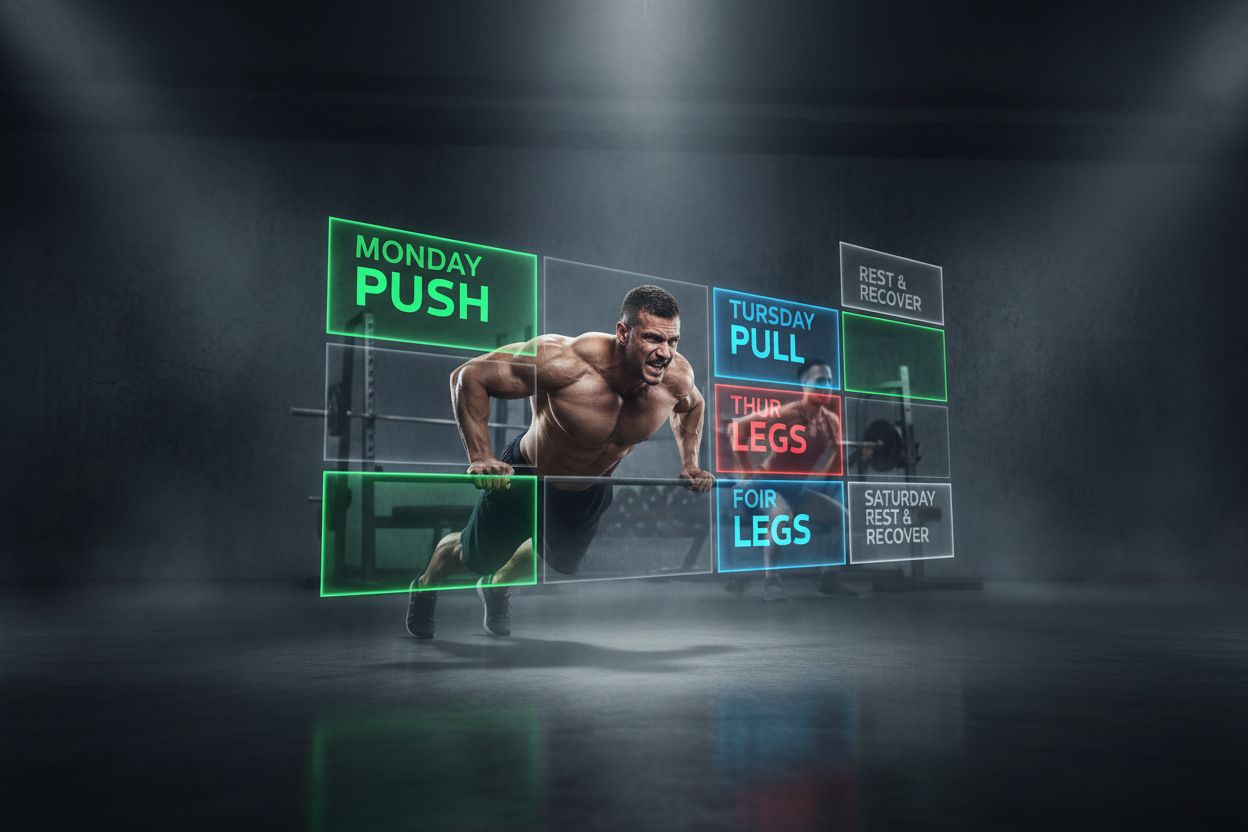
Below are practical week layouts depending on availability and goals.
3 Days Per Week (classic beginner-friendly)
Mon: Push
Wed: Pull
Fri: Legs
Use 3–5 exercises per session. Aim for full-body progression over weeks and focus on technique. This version is simple and sustainable.
4 Days Per Week (upper/lower hybrid)
A common 4-day PPL adaptation repeats one day to increase frequency for lagging muscle groups.
Mon: Push
Tue: Pull
Thu: Legs
Fri: Push (or repeat pull/legs depending on priorities)
Rotate which day repeats each week to keep balance.
5 Days Per Week (extra volume for targeted growth)
Mon: Push
Tue: Pull
Wed: Legs
Thu: Push
Fri: Pull
Legs get 1 dedicated day; you can add a short accessory leg session or a conditioning day on the weekend.
6 Days Per Week (maximize frequency)
Mon: Push
Tue: Pull
Wed: Legs
Thu: Push
Fri: Pull
Sat: Legs
This is ideal for intermediates and advanced lifters who can recover well and have optimized sleep, nutrition, and stress management.
Exercise Selection and Volume Guidelines
Choose one to two compound lifts first, then 2–4 accessory exercises. For hypertrophy aim for 10–20 sets per large muscle group per week (spread over sessions) and 6–12 sets for smaller muscles such as biceps and triceps. Strength-focused training emphasizes heavier weights and lower reps with longer rests.
Detailed example per day (balanced hypertrophy focus):
Push day
Barbell bench press: 3–4 sets x 4–6 reps (strength) or 3 x 8–12 (hypertrophy)
Overhead press: 3 x 6–10
Incline dumbbell press: 3 x 8–12
Lateral raises: 3 x 12–15
Triceps pushdown: 3 x 10–15
Pull day
Barbell row or chest-supported row: 3–4 x 6–10
Pull-ups or lat pulldown: 3 x 6–12
Face pulls: 3 x 12–15
Hammer curls: 3 x 8–12
Rear delt flyes: 3 x 12–15
Leg day
Squat (back or front) or trap-bar deadlift: 3–4 x 4–8
Romanian deadlift: 3 x 6–10
Leg press or walking lunges: 3 x 8–12
Leg curl: 3 x 10–15
Calf raise: 4 x 10–15
Abs/core: 2–4 sets
Adjust sets based on weekly volume targets. For example, on a 6-day PPL hitting legs twice, you might do 10–12 sets per leg session to reach 20–24 sets per week.
Sample Push Pull Legs Week Routine (4-week progression)

Use this 4-week template to start. It's written as a 4-day-per-week layout with an optional active recovery day.
Week 1 (establish baseline)
Day 1 Push: Bench 3x8, OHP 3x8, Incline DB 3x10, Lateral 3x12, Triceps 3x12
Day 2 Pull: Row 3x8, Pull-ups 3x6-10, Face pulls 3x15, Curls 3x10
Day 3 Rest or active recovery (walk, mobility)
Day 4 Legs: Squat 4x6-8, Romanian DL 3x8-10, Leg press 3x12, Calves 4x12, Abs 3x12
Day 5 Push (lighter): Bench variation 3x6, Dips 3x8, Flyes 3x12
Week 2 (small increase)
Add 1 set to two accessory exercises or increase weight by 2.5–5% on compounds
Week 3 (volume push)
Add 1–2 reps per set or 1 set to main lifts; keep RPE under 8 on accessory work
Week 4 (deload)
Reduce volume 40–60% and intensity 10–20% to consolidate gains and recover
Repeat with slightly heavier baseline weights or extra sets where growth is desired. This progressive overload approach keeps the push pull legs week routine moving forward.
Deload Weeks and When to Use Them
Deloads are planned lower-intensity weeks designed to reduce fatigue and restore performance. Use a deload every 3–8 weeks depending on intensity and life stress. During a deload:
Reduce total sets by 40–60%
Keep technique work and range of motion
Maintain frequency but at lower intensity
A proper deload often results in better subsequent performance and fewer injury risks.
How to Transition Between 3-Day and 6-Day Variants
Scale volume first before adding frequency. If you train 3 days and want to move to 4–5 days:
Increase weekly sets by 10–20% over 3–4 weeks
Add a short supplemental session for the area you want to prioritize
Once weekly volume is higher but manageable, split sessions to add frequency (e.g., split leg day into quad-dominant and posterior chain)
To go from 5 to 6 days, ensure sleep, nutrition and stress management are optimized and add an extra session that is moderate in volume to avoid sudden overload.
Personalizing for Goals
Strength: emphasize 3–6 rep range on compounds, 4–6 sets, longer rest. Prioritize low-rep volume with slow progressive increases.
Hypertrophy: 6–12 rep range, 3–4 sets for compounds and accessories, 10–20 sets per large muscle per week.
Fat loss: keep strength phases, reduce calories modestly, add low-impact cardio and increase daily NEAT (non-exercise activity thermogenesis).
If you want to emphasize a specific body part, increase that muscle's weekly sets by 10–30% and distribute them across sessions for higher frequency.
Home Gym vs Commercial Gym Substitutions
Most PPL movements translate well to limited equipment.
No barbell bench? Use dumbbell presses or push-ups (weighted if possible)
No squat rack? Substitute goblet squats, Bulgarian split squats, or heavy lunges
No lat pulldown? Use inverted rows or resistance bands for pull movements
No leg press? Add more unilateral leg work and tempo control
Focus on loading, range of motion, and time under tension when equipment is limited.
Nutrition Basics for a PPL Week Routine
Calories: For muscle gain, target a 250–500 kcal surplus; for fat loss, a 300–500 kcal deficit. Track and adjust every 2–4 weeks.
Protein: Aim for 1.6–2.2 g/kg body weight per day to support muscle maintenance and growth.
Timing: Prioritize a protein-rich meal within 1–3 hours post-workout and include carbs pre- and post-session for performance and recovery.
Hydration: Maintain habitual hydration; dehydration reduces performance and recovery.
If you want detailed meal timing and macronutrient breakdowns tailored to PPL intensity and a specific goal, track workouts alongside nutrition in a simple logging tool or app.
Recovery Indicators and When to Back Off
Signs you need extra recovery:
Persistent strength drops across sessions
Elevated resting heart rate and poor sleep
Excessive muscle soreness lasting more than 72 hours
Increasing joint pain or nagging injuries
If these occur, implement a deload week, reduce training frequency, or lower weekly volume for 1–2 weeks.
Common Mistakes and Troubleshooting
Doing too much volume on the first session of the week: distribute sets across the week
Neglecting posterior chain: prioritize rows, face pulls, hamstring work
Poor exercise order: compounds first for heavy loading
Not tracking progression: record load, reps, and sets each session
Ego lifting: sacrifice long-term progress if technique suffers
When you plateau:
Check calories and protein
Ensure progressive overload — add weight, reps, sets, or decrease rest strategically
Consider changing rep ranges or exercise selection for 4–6 weeks
Use a deload to reset performance
Tools and Resources
A good logging system makes a push pull legs week routine far easier to progress. If you want to track sets, reps and progression across weeks, consider a workout tracker. The Setgraph workout tracker is a simple option to log workouts and visualize progress: Setgraph - Workout Tracker Gym Log App.
For training principles and optimization tips that complement this routine, see Optimize Your Training | Expert Tips and Workout Guides. If you prefer step-by-step guides, check out Setgraph Training Guide | Maximize Your Workout.
Want user feedback before you commit to a tracker? Read real user impressions at Setgraph App Reviews (2025): User Ratings for Tracking Sets, Reps & Workouts. For a collection of additional articles and guides that support training decisions, visit Setgraph App: Insights, Tips & Training Guides.
FAQ
Q: How many exercises per PPL session is ideal?
A: Aim for 4–6 exercises on push and pull days and 5–7 on leg days if training for hypertrophy. Adjust based on time and recovery.
Q: Can I do cardio on a PPL schedule?
A: Yes. Low to moderate intensity cardio 2–4 times per week is fine. Keep it separate from heavy lifting sessions or perform it post-workout when possible to avoid compromising strength.
Q: How long before I should expect visible changes?
A: With consistent training, nutrition and progressive overload, noticeable strength and muscle changes commonly appear in 8–12 weeks. Fat loss timelines vary with deficit and individual factors.
Q: Is it okay to change exercises every few weeks?
A: Yes. Changing accessory exercises every 4–8 weeks can prevent monotony and help resolve plateaus while compounds provide continuity.
Final Notes
A push pull legs week routine is one of the most practical splits for sustained progress. It balances frequency and recovery, adapts easily to goals and equipment, and lends itself to clear progression plans. Start conservative with volume, prioritize technique, track your work, and use deloads intentionally. With consistent application and small week-by-week progression, you'll avoid common pitfalls and keep moving toward your strength and physique goals.
If you want a simple way to log each session and visualize progress across a push pull legs week routine, try a lightweight workout tracker and training guides linked above to make tracking and planning easier.
Article created using Lovarank