Progressive Overload: When and How to Increase Weight

What Is Progressive Overload?
Progressive overload means adjusting training demands as your capacity improves. Adding reps or load is a practical way to keep training challenging over time; growth and strength do not require a new personal record at every workout.
For strength and muscle-building work, start by comparing repetitions and load with similar technique and rest. Increasing sets is another option when needed. Shortening rest changes the challenge, but can reduce how much quality work you perform; it is not automatically a better hypertrophy stimulus.
Think of it like building a callus. The first time you grip a barbell, your hands might feel raw. But with repeated exposure, your skin adapts and toughens. Muscles also adapt to repeated training, through different biological processes. Gradual progression keeps the challenge appropriate as your capacity improves.
Load is a straightforward metric to record. For example, if 135 lb now meets your target reps and effort consistently, 140 lb could be the next step. Repeat 135 lb if the increase is not yet appropriate.
How Often Should You Increase Weight? The Core Answer
Increase weight when you can meet your planned repetition target with consistent technique and the intended effort. Beginners may reach that point often; experienced lifters commonly need more time. There is no reliable calendar that requires every beginner, intermediate or advanced lifter to progress at the same rate.
But that’s just the starting point. The real answer depends on several factors:
Training experience matters, but it does not determine a deadline. Early improvements reflect learning the movement as well as physical adaptation. Neural changes and muscle growth can both continue with experience; five years of lifting does not mean neural adaptation is complete.
The size of the exercise and the available equipment increments matter. A 5-lb jump is a smaller percentage of a 200-lb squat than a 20-lb curl. That does not mean every compound lift must progress faster than every isolation exercise.
Your training program structure influences how often you can progress. A linear progression program might have you adding weight every session. A periodized program might build volume for several weeks before testing new maxes.
For illustration, a 5-lb increase takes a 100-lb lift to 105 lb, a 5% change. The same 5 lb added to a 25-lb dumbbell is a 20% jump. When the next increment is too large to stay in your rep range, add reps first or use a smaller available increment.
Progression is not always linear. Use repeated performance and recovery to decide when a change is appropriate rather than expecting the same load increase indefinitely.
Progression Frequency by Experience Level
Beginner Lifters
If you’re new to strength training, congratulations—you’re in the golden phase. Your body is primed for rapid adaptation.
Frequency: Check your planned rep and effort target each session; increase only when you meet it. Repeating a load is normal.
Why it works: Your nervous system is learning movement patterns. You’re not just building muscle; you’re teaching your brain to coordinate muscle fibers efficiently. This neural adaptation happens quickly.
Here is a hypothetical squat progression. Advance only after completing the target with stable technique and the intended effort; each step can take more than one week.
Step 1: 95 lb × 3 sets × 5 reps
Step 2: 105 lb × 3 sets × 5 reps
Step 3: 115 lb × 3 sets × 5 reps
Step 4: 125 lb × 3 sets × 5 reps
The example adds 10 lb per step. That may be too large for some lifters and is not a rate to maintain for a set number of months. Smaller jumps or additional reps can be more appropriate.
The pace may slow as the task becomes familiar and your current performance improves. That is a reason to reassess the progression target, not proof that learning or muscle growth has ended.
Intermediate Lifters
When frequent small increases stop being practical, review your program and recovery. You may benefit from a longer progression cycle rather than forcing a new weight each week.
Frequency: Progress when repeated performance supports it, which may take several sessions or a longer block.
As training experience increases, improvements often become smaller and less predictable. This does not automatically mean you need more sets and heavier loads at the same time.
An intermediate progression might use weekly periodization:
Week 1: 225 lb × 4 sets × 6 reps (5,400 lb volume load)
Week 2: 235 lb × 3 sets × 4 reps (2,820 lb volume load)
Week 3: 185 lb × 2 sets × 6 reps (2,220 lb volume load; lighter week)
Week 4: 230 lb × 4 sets × 6 reps, only if the target effort and technique remain appropriate
This is a single-exercise illustration, not a complete program. Load and volume vary across the block, and week 4 is a working-set target rather than a new maximum test. Repeat or adjust a step if it is too demanding.
Advanced Lifters
If you’ve been training consistently for several years, you know that progress comes in small increments over long periods.
Frequency: Evaluate progress over a block appropriate to your goal, without requiring an increase on a fixed monthly deadline.
Progress can take longer as your current performance rises. Training age alone cannot establish how close you are to a genetic limit.
Advanced lifters often use periodized programs that build over entire training cycles:
Weeks 1-4: Accumulation phase (high volume, moderate intensity)
Weeks 5-8: Intensification phase (lower volume, higher intensity)
Weeks 9-10: Realization phase (practice heavier work; test only if appropriate to the goal and current performance)
Weeks 11-12: Deload and recovery
In this example, testing could follow the heavier-work phase if it serves your goal. A familiar working set is another way to review progress; the calendar does not require a new maximum or a particular gain in pounds.
How Much Weight to Add Each Time
Knowing when to add weight is only half the equation. You also need to know how much to add.
Choose the smallest useful increment your equipment allows. The examples below are possible starting increments, not a validated “2.5-5-10 rule”:
Lower body compound lifts (squat, deadlift, leg press):
Beginners: 5-10 pounds per progression
Intermediate: 5 pounds per progression
Advanced: 2.5-5 pounds per progression
Upper body compound lifts (bench press, overhead press, rows):
Beginners: 5 pounds per progression
Intermediate: 2.5-5 pounds per progression
Advanced: 2.5 pounds per progression
Isolation exercises (bicep curls, tricep extensions, lateral raises):
All levels: 2.5-5 pounds per progression, or increase reps instead
Judge an increment relative to your current load, target reps and technique. Body size, training history and recovery vary widely; sex or body weight alone should not set your progression rate.
Microplates are your friend. Investing in 1.25-pound plates (or even 0.5-pound plates) allows for smaller jumps. This is especially valuable for upper body lifts and for advanced lifters where a 5-pound jump might be too aggressive.
Some lifters prefer percentage-based increases: add 2-5% to your working weight each progression. This automatically scales with your strength level. A 2% increase on a 300-pound squat is 6 pounds. On a 500-pound squat, it’s 10 pounds.
Signs You’re Ready to Increase Weight
Don’t just add weight because the calendar says it’s time. Your body tells you when it’s ready. Here are the concrete indicators:
Complete all planned sets at the target reps and effort with stable technique before increasing. Merely finishing 24 total reps does not mean you are ready if the last repetitions exceed your intended effort or change the movement.
A familiar weight feeling easier is useful feedback, especially when technique and repetitions are comparable. Confirm that trend across sessions rather than basing the whole plan on one unusually good day.
Compare reps in reserve with the intended target. If the plan calls for about two remaining reps and the sets now feel substantially easier, adding a rep or a small amount of load may fit the plan. The target depends on the exercise and goal.
Check recovery as well as performance. Persistent soreness, fatigue or pain is a reason to review the plan and seek advice when appropriate, rather than automatically increasing the load.
Consistency matters. Two or three weekly training days can be a useful starting schedule, but training every muscle two or three times a week is not a minimum requirement for any adaptation. Frequency helps distribute a manageable workload.
Keep your technique repeatable as loads increase. A lighter load or coaching feedback may help when the movement changes; no single form rule can guarantee that injury will not occur.
One conservative rule is to meet the target across two comparable sessions before increasing. This is a practical decision aid rather than a guarantee; follow the progression rule of your program and adjust if technique or symptoms change.
Progression Schedules for Different Lift Types
Not all exercises progress at the same rate. Your training program should reflect these differences.
Compound Lifts (Squat, Deadlift, Bench Press, Overhead Press)
Multi-joint movements often use larger absolute loads, so a small plate increment may be easier to accommodate. Progress still depends on the exercise and person.
Use the same readiness check at every experience level: complete the planned reps with the intended effort and consistent technique, then consider a small increase.
Some beginners can add weight frequently for a time. When that stops working, keep useful exercises and adjust the progression plan. Periodization is one way to organize variation, not a requirement for every lifter.
Isolation Exercises (Bicep Curls, Tricep Extensions, Lateral Raises)
Single-joint movements focus work around one joint. Compare progress within the same exercise rather than comparing absolute loads across different lifts.
Progress when your current rep target is repeatable; adding reps may be more practical than the next weight increment.
A rep-range approach is useful for isolation work: choose a range such as 8–12, keep the load until all planned sets reach the top with the intended effort, then try the smallest available increase. Return toward the lower end only if the new load still permits it.
Hypothetical dumbbell-curl steps, with load stated per dumbbell. A step can take several sessions; the 25-to-30-lb jump is 20%, so use a smaller increment or keep building reps if 30 lb drops you below the target:
Step 1: 25 lb per dumbbell × 3 sets × 8 reps
Step 2: 25 lb per dumbbell × 3 sets × 10 reps
Step 3: 25 lb per dumbbell × 3 sets × 12 reps
Step 4: 30 lb per dumbbell × 3 sets × 8 reps, only if manageable
Bodyweight Exercises (Pull-ups, Dips, Push-ups)
These movements present a unique challenge because you can’t simply add 5 pounds to your bodyweight.
Progression options:
Add reps (most common)
Add sets
Use a weight vest or belt
Progress to harder variations
Change tempo for a specific technique goal, recording it as a change in the task rather than an automatic growth upgrade
For weighted bodyweight exercises, add external load only when the planned reps and effort support it. For unweighted exercises, build reps first or choose a suitable variation. Treat a new variation as a new baseline rather than directly comparing its rep count with the old one.
Accessory and Machine Work
Machines and cables can support either compound or isolation exercises. Select the movement and increment around the goal, not the equipment category alone.
Progression: Use a repeatable rep range and the smallest suitable load increase, without a compulsory weekly schedule.
Check your machine’s actual increments; stacks, lever arms and pulley systems differ. Compare performance on the same machine and settings rather than assuming identical displayed weights mean identical resistance.
What to Do When You Can’t Increase Weight
You’ll eventually hit a point where you can’t add weight on schedule. This is normal. Here’s how to handle it.
First, check the basics:
Are you eating enough to support the goal? A calorie deficit can make recovery and muscle gain harder, though strength gains can still occur.
Are you allowing sufficient regular sleep?
Has stress, illness or another change affected your sessions?
Does the current workload leave you ready to repeat quality training?
If the basics are dialed in and you’re still stuck, try these strategies:
Review volume before adding it. If recovery is good and a low workload is no longer challenging enough, a small increase may help. If fatigue is high and performance is falling, adding sets may make the plan harder to sustain.
Improve your technique. Sometimes you’re not weak—you’re inefficient. Film your lifts. Hire a coach. Small technique adjustments can unlock progress.
Consider a lighter week when fatigue is high. Reducing working sets is one option; the amount depends on the plan. A deload does not guarantee full recovery or a performance rebound.
Change your rep range. If you’ve been doing sets of 5, try sets of 8-10 for a few weeks. Different rep ranges provide different stimuli. When you return to your original rep range, you might find you’re stronger.
Investigate a possible limiting factor before adding work. For example, if technique review suggests knee-extension strength limits your squat, a small amount of quad-focused assistance may fit the plan. A stalled bench press alone does not show that the triceps need more training.
Be patient. A slower rate of progress does not place you into a precise experience category. Compare enough similar sessions to distinguish a trend from normal variation.
Consider planned variation if repeating the same progression rule no longer fits your goal or performance. Periodization can organize heavier and lighter work, but it is one option rather than a compulsory next stage.
A training record can be especially useful when changes become harder to notice. Review comparable sets and notes before changing the plan. Setgraph can organize logged performance, but the record does not automatically identify the right progression rate.
Common Progressive Overload Mistakes
Even experienced lifters make these errors. Avoid them to maximize your progress.
Adding weight too quickly can make it difficult to stay within the intended reps and technique. Choose a manageable increment and adjust when it is too large.
Keep the range of motion and technique consistent when comparing loads. A heavier squat performed differently is a different task, not automatically proof of stronger muscles or a diagnosis of danger.
Overlooking other options. Adding reps or adjusting sets may fit the plan better than the next load increment. An extra training day can distribute existing work; it does not automatically increase the weekly training stimulus.
A useful log records the conditions as well as the numbers. Changes in equipment, range of motion or effort can explain apparent progress or regression.
Comparing yourself to others. Your training partner might add 10 pounds to their bench every week while you’re stuck at 5 pounds per month. That’s fine. Everyone progresses at different rates based on genetics, training age, recovery capacity, and a dozen other factors.
Training through new or worsening pain. Do not increase load through sharp pain or a movement that is substantially impaired. Reduce or stop that exercise and seek assessment for persistent pain or unexplained weakness.
Do not expect the same rate of progress forever. The time between increases varies widely across people, exercises and training phases. Use repeated performance rather than a calendar label.
Use lighter periods when they serve a purpose. Some programs schedule them and others adjust workload as needed; a planned deload is not compulsory for every lifter.
Sample Progressive Overload Programs
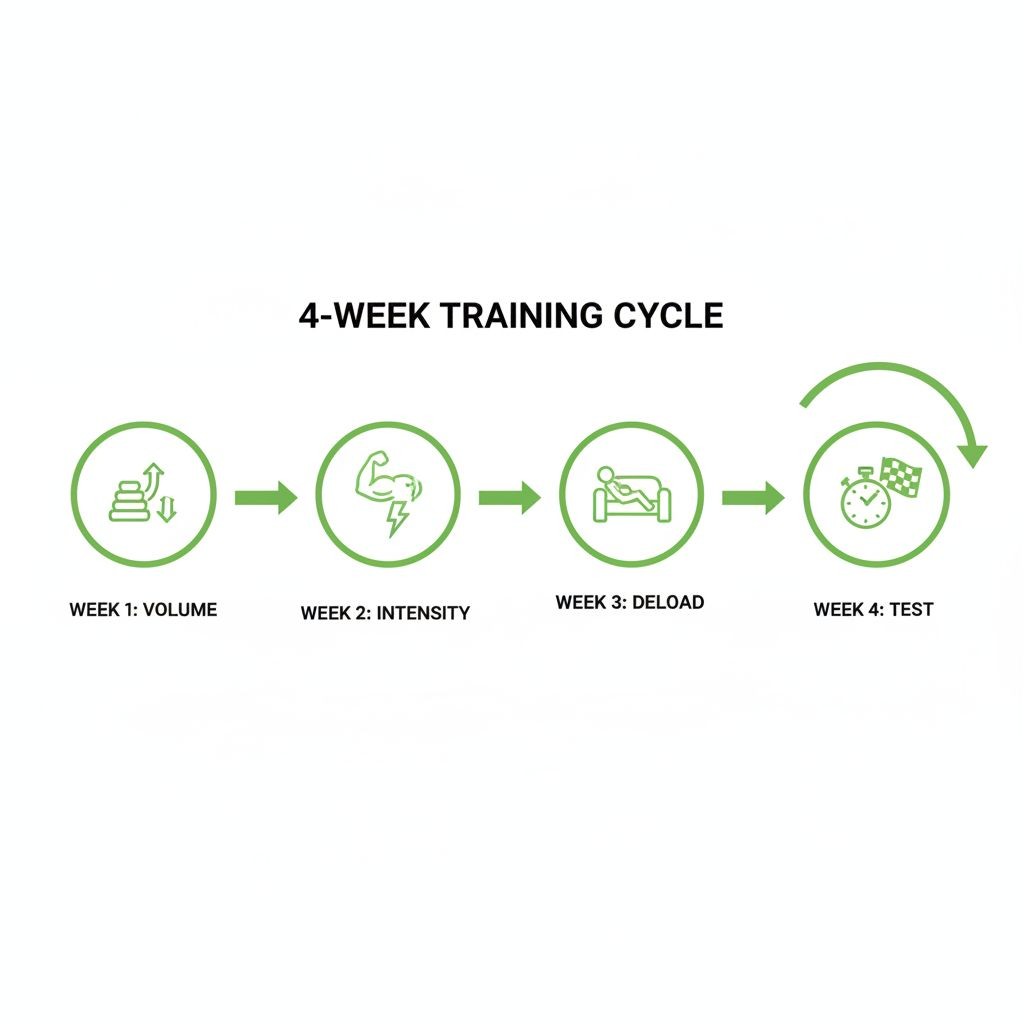
The graphic shows one illustrative cycle. Here, “test” means reviewing comparable performance; it does not require a maximal attempt. The lighter week is a choice within this example, not a required event every fourth week.
These examples illustrate progression structures for healthy adults. They are not individualized prescriptions or three mandatory stages. Warm up as needed, select manageable exercises and stop a set before technique breaks down. Pain or unexplained weakness calls for assessment rather than a heavier attempt.
Beginner Three-Day Example
Monday - Squat Focus
Squat: 3 × 5, using a manageable load
Bench press: 3 × 5
Barbell row: 3 × 8
Wednesday - Deadlift Focus
Deadlift: 1 × 5
Overhead press: 3 × 5
Pull-ups or an assisted variation: 3 sets, ending with about two good reps in reserve
Friday - Volume Day
Squat: 3×5 (same weight as Monday)
Bench Press: 3×5 (same weight as Monday)
Accessory work: 3×10-12 (progress when you hit top of range)
Keep at least a day between these sessions. Increase an exercise only after you meet its rep and effort target consistently. If you miss it, repeat the load and review rest and technique; if misses persist, reduce load or workload rather than forcing the next increase.
Intermediate Four-Week Example
Week 1 — Volume. For this illustration, use one main-lift session on Monday (squat), Wednesday (bench) and Friday (deadlift). Percentages refer to a recent, realistically estimated 1RM for that lift; reduce load if the reps are too difficult. Warm-ups and optional assistance are additional, so this is a main-lift outline.
Squat: 4×8 at 70% of max
Bench: 4×8 at 70% of max
Deadlift: 3×6 at 75% of max
Week 2 - Intensity
Squat: 3×5 at 80% of max
Bench: 3×5 at 80% of max
Deadlift: 3×3 at 85% of max
Week 3 - Deload
Squat: 3×5 at 60% of max
Bench: 3×5 at 60% of max
Deadlift: 2×5 at 65% of max
Week 4 — Review
Squat: repeat a familiar working set and compare effort and technique
Bench: repeat a familiar working set and compare effort and technique
Deadlift: repeat a familiar working set and compare effort and technique
After week 4, adjust the next block only if the completed work supports it. Repeating the same starting loads is valid; a 2–5% increase is an option, not an automatic reward for finishing the calendar.
Advanced Block-Periodization Outline
Some experienced lifters organize training into longer blocks. The following is a conceptual outline for a selected lift, not a complete weekly program; session frequency, other lifts and assistance work still need planning.
Accumulation Block (4 weeks)
High volume, moderate intensity
Focus: Build work capacity and muscle
Example: 5×10 at 60-65% of max
Intensification Block (4 weeks)
Moderate volume with heavier loads
Focus: Practice high-force performance in the target lift
Example: 4 × 4 at an individually manageable load, often below 90% of 1RM; reduce it if repeated sets approach failure
Realization Block (2 weeks)
Low volume, peak intensity
Focus: Express your strength
Example: Review a familiar heavy set; consider a 1–3RM test only if it suits the goal, recent performance and an appropriate testing setup
Deload (1-2 weeks)
Reduced volume and intensity
Focus: Recovery and adaptation
The listed blocks total 11–12 weeks: four plus four plus two, followed by one or two lighter weeks. There is no required number of pounds to gain over that period.
Recovery and Progression Frequency
Training provides a stimulus and practice; recovery supports adaptation between sessions. Plan both the work and the time and habits needed to repeat it.
Sleep supports training and general health. Adults generally need at least seven hours regularly, with individual needs varying. Keep sleep and training notes together to see whether poor nights coincide with harder sessions, without assigning a fixed percentage loss to every lifter.
Nutrition supports adaptation. For most healthy exercising adults, the ISSN position stand describes protein intakes of 1.4–2.0 g/kg/day (about 0.6–0.9 g/lb/day). An energy deficit can make muscle gain harder, but does not make strength improvement impossible. Individualize nutrition if you have a medical condition or prescribed diet.
Frequency changes how the weekly workload is distributed. Three sessions can be harder or easier to recover from than one, depending on total sets, load and effort. Compare the entire plan rather than the number of gym visits alone.
Recovery needs vary with age, health, training history and workload. Adjust from your own response rather than assuming every 50-year-old needs more rest than every 20-year-old.
Stress impacts everything. Work stress, relationship stress, financial stress—it all affects your body’s ability to recover and adapt. During high-stress periods, you might need to reduce training volume or slow your progression.
Listen to your body. Tracking metrics like resting heart rate, sleep quality, and subjective energy levels can help you gauge recovery. If these markers are off, it might not be the right time to push for a new PR.
A training record can help you notice whether sleep, rest days or workload changes coincide with performance changes. Those patterns are useful context, not proof of a single cause.
Putting It All Together
Progressive overload isn’t complicated, but it requires patience and consistency. Here’s your action plan:
Start where you are. Choose a manageable plan, repeat it consistently and increase load when performance supports the change. More experienced lifters may need longer to see clear trends.
Write down the key details: exercise, load, sets, reps and relevant technique or effort notes. A notebook works; an app can make the record easier to organize and review.
Progress intelligently. Use small increments relative to your working load and available equipment. If the next jump is too large, build repetitions first rather than forcing a named rule.
Prioritize recovery. Sleep, nutrition, and stress management aren’t optional. They’re part of the training process.
Be patient. Building serious strength takes years, not weeks. Trust the process and celebrate small victories.
The lifters who make the most progress aren’t the ones who push the hardest—they’re the ones who push smart, stay consistent, and give their bodies time to adapt. Progressive overload is a marathon, not a sprint.
Setgraph’s iOS listing describes set logging and progress charts. A record of load, reps and exercise notes can help you compare sessions and choose the next step; it does not establish how fast you should progress or guarantee muscle growth.
