Unilateral vs Bilateral Training: What Builds More Muscle and Strength?

Walk into any gym and you will see the same argument playing out in real time. One lifter is grinding heavy back squats, convinced that loading both legs at once is the only way to get big and strong. Two racks over, someone is knocking out Bulgarian split squats and swears single-leg work is the secret nobody talks about. Both camps are loud, both are confident, and until recently the research was thin enough that either side could cherry-pick a study to win the debate.
A 2025 systematic review and meta-analysis compared unilateral and bilateral resistance training for muscle growth and strength. It provides useful evidence, with only nine eligible studies and uncertainty around some outcomes. This guide explains how that evidence can inform exercise selection.
What "Unilateral" and "Bilateral" Actually Mean
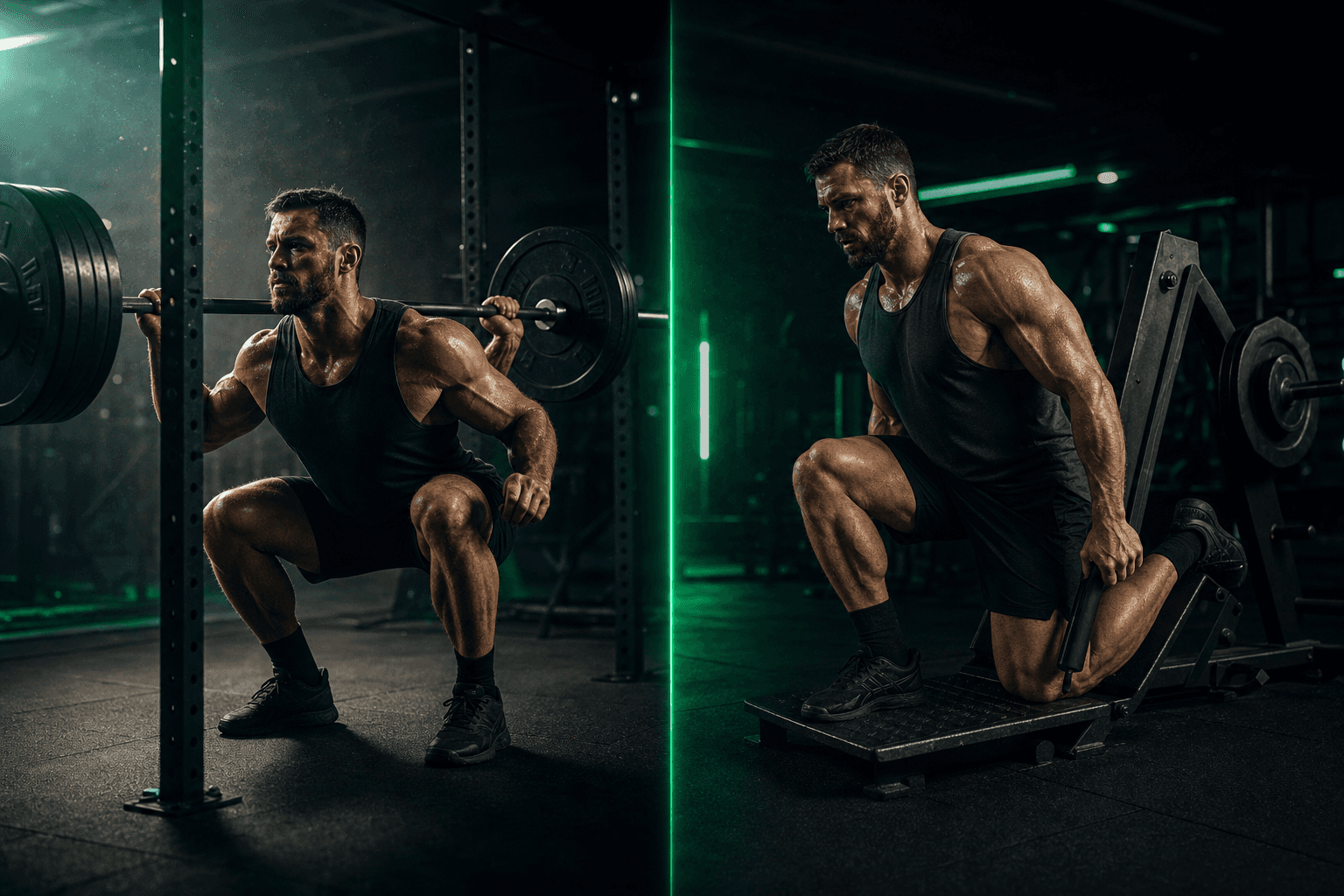
Bilateral exercises load both limbs at the same time: back squats, conventional deadlifts, barbell bench press, leg press with both feet on the platform. Unilateral exercises work one limb at a time: Bulgarian split squats, single-leg press, lunges, single-arm dumbbell rows, one-leg Romanian deadlifts.
The two approaches change the task and how you stabilize the load. Some nominally unilateral movements still use the other limb for support; a split squat, for example, does not isolate one leg completely. Bilateral exercises can accommodate larger total loads, while unilateral variations can help you examine each side under a consistent setup.
If you want a refresher on how movement selection fits into the bigger picture, our guide on compound vs isolation lifts covers a related axis of exercise choice. Unilateral versus bilateral is a separate question from compound versus isolation, and confusing the two is where a lot of gym-floor advice goes sideways.
The 2025 Meta-Analysis: No Winner for Muscle Growth
The review found no clear difference in hypertrophy between unilateral and bilateral training. Its hypertrophy estimate was imprecise, so “no significant difference” should not be read as proof that every pair of exercises is equivalent. Choose movements you can perform consistently and that suit the muscles and task you want to train.
That should not be shocking once you understand what actually drives growth. Hypertrophy is governed primarily by mechanical tension applied through a challenging range of motion, taken close enough to failure, and accumulated across enough hard sets per week. A well-executed split squat and a well-executed back squat can both deliver that stimulus to the quads and glutes. The delivery vehicle is flexible. If you want to go deeper on the real driver here, our breakdown of mechanical tension and muscle growth explains why the "which exercise is magic" question is usually the wrong one.
The practical upshot: choose the variation you can load progressively, feel in the target muscle, and recover from. For many lifters, a single-leg movement lets you challenge each side through a longer, more controlled range without the lower-back fatigue that stacks up on heavy bilateral squats. For others, the barbell squat is simply easier to add weight to week after week. Neither is "more anabolic."
Strength Follows the Principle of Specificity
The review did not establish a hypertrophy winner. Its strength findings were clearer and followed the task being tested.
In the review, bilateral training improved bilateral strength more, while unilateral training improved unilateral strength more. This supports practicing the strength task you care about. It does not by itself prove superior sprinting, cutting or injury outcomes.
A 2022 performance meta-analysis found an advantage for unilateral training in unilateral jumping and for bilateral training in bilateral strength. It did not find clear differences in sprint speed or change-of-direction performance. See strength versus hypertrophy for why different outcomes need separate measurements.
Cross-Education: Strength Transfer to the Other Limb
Training one limb can also improve strength in the untrained opposite limb. This is cross-education, a partial transfer that does not replace direct training of both sides.
A meta-analysis of 31 studies and 785 participants estimated an 11.9% strength increase in the untrained limb, with high risk of bias across studies. The older roughly 8% estimate referred to the untrained limb’s initial strength, not 8% of the trained limb’s gains. These are pooled estimates rather than an individual prediction.
Cross-education is commonly explained largely through neural adaptations, although possible contributions beyond the nervous system remain under study. It does not mean an untrained healthy limb grows as if it were trained directly. Any use after injury or immobilization should follow the treating clinician’s advice. For background, see neural adaptations in strength training.
When to Reach for Unilateral Work
Given all of that, unilateral training earns a place in most programs for reasons that have little to do with "more muscle." Use single-limb movements when:
You have a left-right imbalance. Bilateral lifts let a dominant side quietly take over. Split squats and single-arm work force each side to earn its own reps and expose the weaker limb so you can bring it up.
You want a different loading setup. Some supported or single-leg variations let you challenge the legs with less total external load. The demands depend on the exercise and technique; unilateral work is not automatically suitable for back pain.
You want to improve a specific one-limb task. Single-limb practice can help with that task, but strength findings do not prove superior sprint or cutting performance.
You want range and stretch under load. A deep split squat or single-leg press can bias the lengthened position of the quads and glutes, which pairs well with modern hypertrophy thinking.
A split squat is one option, not a universally joint-friendly exercise. Choose a variation and range you can control without pain. For alternatives, see squat variations.
When Bilateral Work Should Anchor Your Program
Bilateral practice is important when the goal is to improve a bilateral squat, bench press or deadlift. Progress with a load and amount of work you can control; there is no requirement to add five pounds every session. Other goals can call for different exercise choices.
A program can combine both approaches when they serve the goal. For example, practice the bilateral lift you want to improve and use a suitable unilateral accessory if you want to train each side separately. You do not have to include both in every program.
How to Apply This in Setgraph
Use a consistent convention when recording unilateral work so a change in naming or loading does not look like a strength change.
For example, record left and right results separately and specify whether a dumbbell load is per hand. Compare the same exercise, range, reps and effort over several sessions. Differences can guide a training discussion, but the log does not diagnose an injury or predict one.
Setgraph’s iOS listing describes set logging, exercise notes and progress charts. Use those records to compare like-for-like sessions; a chart is not a measurement of muscle growth or medical clearance. Check the features and access terms shown in your app.
Review the recorded results and notes for each side under comparable conditions. If a persistent difference affects function or causes concern, ask a qualified professional rather than diagnosing it from the chart.
Frequently Asked Questions
Q: Is unilateral or bilateral training better for building muscle?
The available review found no clear hypertrophy difference, but the evidence was limited and imprecise. Choose a suitable exercise you can train consistently rather than treating the result as proof that all variations are interchangeable.
Q: Does training one arm or leg make the other side stronger?
Yes, to a degree. The cross-education meta-analysis found strength transfer to the matching untrained limb. This does not replace direct training for muscle growth. Rehabilitation use needs clinician guidance, and preservation of size during immobilization differs from growing a healthy untrained muscle.
Q: Should I replace squats with single-leg exercises?
If your goal is a stronger bilateral squat, keep appropriate practice of that pattern. For other goals, a unilateral movement may be suitable. You do not need both approaches in every session.
Q: Are Bulgarian split squats enough on their own?
A suitable single-leg program can challenge the quads and glutes. Whether it is enough depends on the muscles and tasks you want to train, the exercises and the workload. If improving the bilateral squat is a goal, include appropriate practice of that lift; everyone does not need the same mix.
Q: How do I know if I have a left-right imbalance?
Record each side separately using the same exercise, setup, range and effort. A repeatable difference can be useful information, but an app does not diagnose its cause or guarantee that it will close. Ask a qualified professional if it affects function, causes symptoms or concerns you.
The Bottom Line
For hypertrophy, current evidence has not established a clear winner. For strength, practice of the tested pattern matters. Choose unilateral, bilateral or combined work around your goal and keep the comparisons consistent.
Ready to run a smarter mixed program and actually see whether your weak side is catching up? Start logging every set, both sides, at setgraph.app.