What Are Gym Splits? A Practical Guide to Choosing and Using Workout Splits

Staring at a row of machines and a sea of barbells can make anyone ask a simple question: what are gym splits and which one should you follow? A gym split is simply a way to divide your weekly training so each session has a clear focus. The right split helps you balance training volume, recovery, and goals—whether you’re after strength, muscle size (hypertrophy), or general fitness.
This guide explains the most common splits, gives ready-to-use sample workouts with sets and reps, outlines progression and periodization, and helps you pick the split that fits your experience, time, and goals.
What is a workout split and why use one?
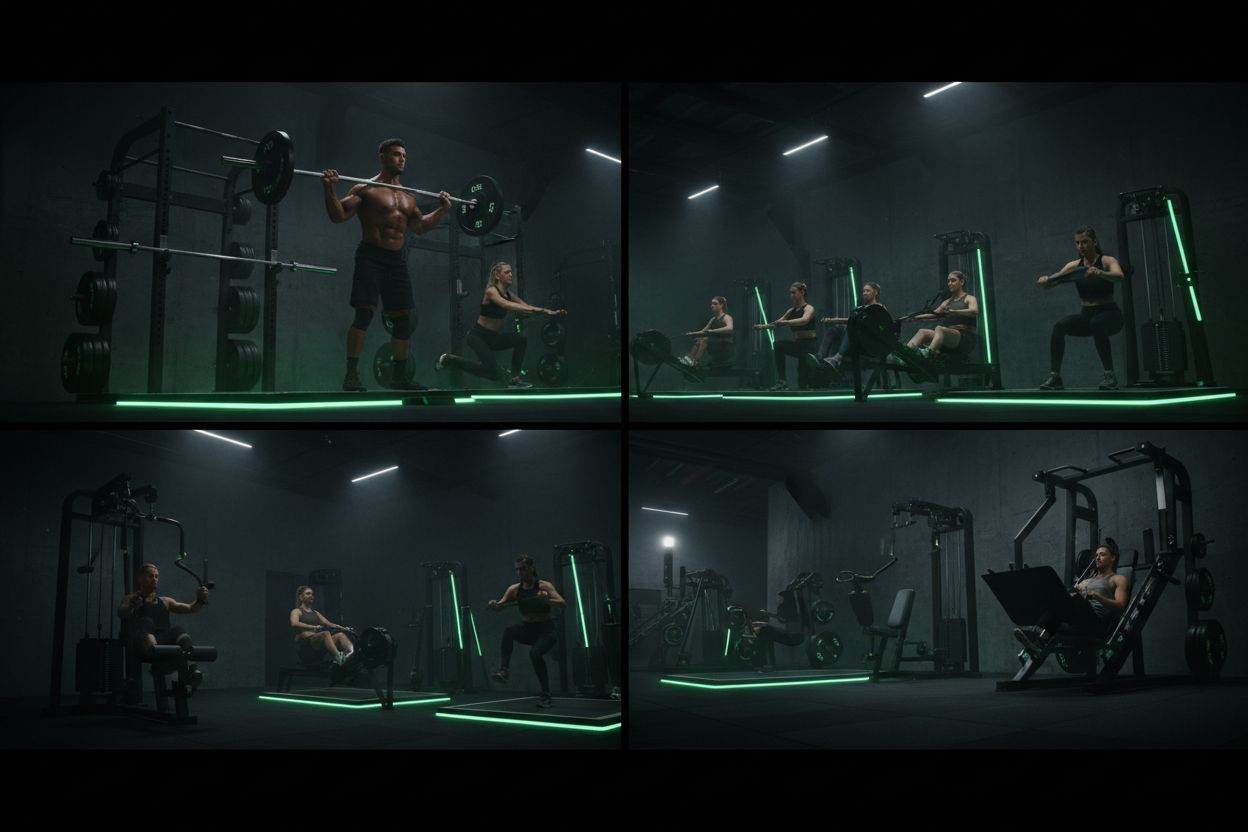
A workout split is a training schedule that assigns specific body parts or movement patterns to different days of the week. Instead of training full body every session, you break workouts into manageable chunks—upper vs. lower, push vs. pull, or individual muscle groups. The goal is to control training volume, manage fatigue, and target muscles more effectively.
Benefits of using a split:
Better recovery: You can work a muscle hard, then give it days to recover.
Focused intensity: Concentrate energy on fewer movements per session.
Scheduling flexibility: Choose a split that fits how many days you can train.
Easier progression tracking: Plan sets, reps, and volume for each muscle.
Trade-offs exist—splits often lower session frequency for each muscle compared with full-body training—so the right choice depends on your goals and constraints.
Main types of gym splits (with sample workouts)
Below are the most common splits, presented with typical weekly schedules, example exercises, and suggested sets and reps. Use them as templates and adjust to your fitness level.
Full-Body Split (Best for beginners and time-crunched lifters)
Number of days: 2–4 per week (commonly 3 days — e.g., Mon/Wed/Fri)
Description: Each workout trains most major muscle groups using compound lifts. Frequency per muscle is high (2–3x/week), great for learning movements and building consistent stimulus.
Sample 3-day full-body plan:
Workout A
Squat: 3 x 5 (strength) or 3 x 8–12 (hypertrophy)
Bench press: 3 x 5 or 3 x 8–12
Bent-over row: 3 x 6–10
Plank: 3 x 45s
Workout B
Deadlift or Romanian deadlift: 3 x 4–6 (deadlift) or 3 x 8–12 (RDL)
Overhead press: 3 x 6–8
Pull-ups or pulldown: 3 x 6–10
Farmer carry or core work: 3 x 30s
Benefits:
Fast strength and technique gains for beginners
High training frequency supports muscle protein synthesis
Efficient: covers everything in fewer sessions
Drawbacks:
Can be tiring if session density is high
Harder to specialize on one body part per session
Push/Pull/Legs (PPL) Split (Excellent for intermediates)
Number of days: 3–6 per week (3-day cycle repeated twice for 6 days)
Description: Separates movements by mechanical pattern: push (chest, shoulders, triceps), pull (back, biceps), legs (quads, hamstrings, glutes). PPL is adaptable for hypertrophy or strength.
Sample 6-day PPL (push/pull/legs twice):
Push
Bench press: 4 x 6–8
Overhead press: 3 x 6–8
Incline dumbbell press: 3 x 8–12
Lateral raises: 3 x 12–15
Triceps pushdown: 3 x 10–12
Pull
Deadlift variation (or heavy row): 3 x 4–6
Pull-ups: 4 x 6–10
One-arm dumbbell row: 3 x 8–12
Face pulls: 3 x 12–15
Hammer curls: 3 x 10–12
Legs
Squat: 4 x 5–8
Romanian deadlift: 3 x 8–12
Leg press or lunges: 3 x 10–15
Calf raises: 4 x 12–20
Benefits:
High weekly volume per muscle—good for hypertrophy
Logical recovery windows per movement type
Scales from 3 to 6 days per week
Drawbacks:
Requires more gym days for best results
Can be intense; recovery becomes priority
Upper/Lower Split (Great for strength-focused lifters)
Number of days: 2–4 per week (commonly 4 days: Upper/Lower/Rest/Upper/Lower)
Description: Alternates upper and lower body sessions. Good balance between frequency and volume; often used in strength programs.
Example 4-day upper/lower:
Upper A
Bench press: 4 x 5
Pendlay row: 4 x 6
Incline DB press: 3 x 8–10
Pull-downs: 3 x 8–12
Core work: 3 x 10–15
Lower A
Squat: 5 x 5
Romanian deadlift: 3 x 6–8
Leg curls: 3 x 10–12
Calf raises: 4 x 10–15
Benefits:
Solid strength and mass balance
Less travel to the gym than PPL for similar frequency
Drawbacks:
Upper sessions can become long if not managed
Body Part / Bro Split (Popular for dedicated hypertrophy)
Number of days: 4–6 per week (each muscle trained once per week)
Description: Each session focuses on one or two muscle groups (e.g., chest day, back day). Historically common in bodybuilding.
Sample 5-day bro split:
Day 1: Chest (4–6 exercises, 3–5 sets each)
Day 2: Back
Day 3: Shoulders/Abs
Day 4: Legs
Day 5: Arms
Benefits:
Allows high exercise variety and per-session volume
Good for bodybuilders who want to isolate muscles
Drawbacks:
Lower frequency per muscle (usually once/week)
Can be less effective for natural trainees seeking maximum hypertrophy; volume per week matters more than session variety
Variations and specialty splits
Arnold split: A hybrid of body part and movement-based training developed by Arnold Schwarzenegger—high volume and frequency for specific muscles.
Double split: Two workouts/day, useful for advanced athletes wanting higher volume or to separate strength and conditioning.
Upper/Lower with Push/Pull hybrids: Mix-and-match to suit goals.
Practical implementation: sets, reps, and weekly volume
The single most important variable for muscle growth is weekly training volume per muscle (sets × reps × load). General guidelines:
Strength focus: 3–6 sets of 3–6 reps for compound lifts
Hypertrophy focus: 3–5 sets of 6–12 reps per exercise
Muscular endurance: 2–4 sets of 12–20+ reps
Weekly sets per muscle (general):
Beginners: 8–12 sets/week per muscle
Intermediates: 10–20 sets/week per muscle
Advanced: 12–25+ sets/week, carefully managed
If a split reduces the frequency of a muscle (e.g., bro split), compensate by increasing sets per session to reach weekly targets.
Progression, periodization, and deloads
Progression options:
Linear progression: Increase weight or reps each session—works well for beginners.
Weekly volume progression: Gradually add a set to an exercise every 1–3 weeks.
Wave or undulating periodization: Vary rep ranges/intensity across sessions (e.g., heavy day, medium day, light day).
Periodization and deloads:
Schedule planned deload weeks every 4–8 weeks depending on intensity. Reduce volume by ~40–60% or lower intensity.
Use deloads to prevent accumulated fatigue (both muscular and central nervous system).
Progression tip: Track your sets, reps, and RPE. Even basic logging improves long-term adherence—consider using a workout tracker to monitor progress and volume.
How to choose the best workout split
Consider these factors:
Experience level: Full-body for beginners, PPL or upper/lower for intermediates, targeted bro splits for experienced bodybuilders.
Goal: Strength (lower reps, compound lifts), hypertrophy (higher volume, more isolation), fat loss (pair with cardio and caloric deficit).
Time availability: 2–3 days → full-body. 4 days → upper/lower. 5–6 days → PPL or bro split.
Recovery ability: Sleep, nutrition, stress, and age affect recovery. Older trainees may prefer fewer weekly sessions with moderated volume.
Equipment: Home gyms favor full-body and upper/lower; PPL and bro splits often require more machines and exercise variety.

Quick decision flow:
New to lifting or limited to 2–3 sessions/week: Choose full-body.
Can train 4 times/week, want strength and size: Choose upper/lower.
Want high-frequency hypertrophy and can train 5–6 days/week: Choose PPL.
Specifically preparing for bodybuilding shows and want max per-session volume: Consider a bro split.
Beginner step-by-step: Start here
Pick a simple split: start with a 3x full-body program.
Learn 4–6 compound movements well (squat, deadlift, hip hinge, push press, chin-up, row).
Use conservative loads: focus on form, 2–3 sets to start for each exercise.
Track workouts: record weight, sets, reps and aim for slow progression.
After 8–12 weeks, reassess: can you add frequency or move to upper/lower? If so, transition gradually.
Common beginner mistakes to avoid:
Doing too many isolation exercises too soon
Increasing volume and intensity simultaneously
Ignoring progressive overload and tracking
Underestimating recovery (sleep and nutrition)
If you want a simple way to log and track sets, reps, and progression, consider a workout-tracking app to keep training consistent and measurable, especially when switching splits. Setgraph Training Guide | Maximize Your Workout offers training resources and Setgraph’s workout tracker can help you record progress.
Adapting splits for special circumstances
Time-constrained sessions (30 minutes):
Prioritize compound lifts and limit assistance exercises.
Use supersets to increase density.
At-home training (minimal equipment):
Build full-body or upper/lower sessions around push-ups, single-leg squats/lunges, rows with bands, and hinge variations.
Increase reps and tempo to compensate for lower external load.
Older adults or injury-prone trainees:
Reduce heavy eccentric loading; favor controlled tempo and mobility work.
Increase emphasis on volume spread across more frequent, lower-intensity sessions.
Combining cardio with weight training:
Place cardio after resistance training if hypertrophy is the goal.
Separate intense cardio and heavy lifting by several hours or on different days to avoid performance drops.
Nutrition and recovery basics for split training
Protein: Aim for ~1.6–2.2 g/kg bodyweight daily when building muscle; distribute intake across meals.
Pre/post workout: A carbohydrate and protein-containing meal 1–3 hours before and within 2 hours after training supports performance and recovery.
Sleep: 7–9 hours per night is essential for growth and CNS recovery.
Supplements with evidence: Creatine monohydrate and adequate protein (whey or whole-foods) are practical, evidence-backed options.
Measuring and optimizing training volume
Calculate weekly volume by counting working sets for each muscle. For example, if you do 4 sets of bench press and 3 sets of incline dumbbell press in a week, count how many of those sets significantly tax the chest. Aim to match your target weekly sets per muscle based on experience (see Practical implementation section).
Managing fatigue: track RPE and bar speed. If performance stalls, reduce volume or add a deload.
FAQs about gym splits
Q: Are splits necessary for beginners?
A: Not strictly—beginners often progress fastest with full-body training because frequent, simple practice of compound lifts drives neural and strength gains.
Q: Should women use different splits than men?
A: No. Training principles are the same. Program choices should be based on goals, schedule, and recovery.
Q: How long until I see results from a new split?
A: Expect measurable strength or size changes within 8–12 weeks with consistent training, nutrition, and progressive overload.
Q: Can I change splits mid-cycle?
A: Yes—transition gradually and keep one or two consistent exercises to track progress. Allow a week for adaptation when increasing frequency or volume.
Common mistakes and how to avoid them
Mistake: Chasing new routines without tracking. Fix: Log workouts and review monthly.
Mistake: Doing too much volume too quickly. Fix: Increase one variable at a time (weight, sets, or reps).
Mistake: Ignoring big compound lifts. Fix: Keep main lifts as the training backbone (squat, hinge, press, row).
Final checklist to pick your split
How many days can you realistically train per week?
What is your primary goal (strength, size, endurance)?
How well do you recover (sleep, stress, age)?
What equipment do you have access to?
Answer these, pick a split that aligns with them, and commit for 8–12 weeks while tracking progress.
Conclusion
Understanding what gym splits are and how to use them removes randomness from your training. Choose a split that fits your schedule and goals, track your workouts, and focus on steady progression and recovery. Small, consistent improvements add up faster than chasing the next trend. If tracking progress sounds tedious, a simple logging tool can make it easy to measure volume, progression, and plateaus so you can adjust your split intelligently.
Further reading and resources: for guided templates, tracking tips, and training principles, see Setgraph Training Guide | Maximize Your Workout and explore the Setgraph workout tracker to keep a clear record of sets, reps, and progress.
Article created using Lovarank