How Many Sets and Reps for Strength Training? A Practical Guide

If you want a simple answer to how many sets and reps for strength training, start with 2 to 3 hard sets per exercise, train each major muscle group at least 2 days per week, and use a load that makes the last reps challenging while keeping form solid. For many beginners, 8 to 12 reps is a sensible entry point. As you get stronger and more experienced, strength-focused work usually shifts toward heavier loads and lower rep ranges. ACSM’s newest guidance says strength training should use heavier loads, around 80% of one-repetition maximum, for 2 to 3 sets per exercise, while its classic progression model uses 1 to 3 sets of 8 to 12 reps for novice to intermediate lifters and 2 to 6 sets of 1 to 8 reps for advanced lifters. (acsm.org)
The short answer

For most people, the answer is not a single magic number. It depends on your goal, training age, and how much recovery you can handle. If your main goal is strength, a practical setup is to focus on compound lifts, use heavy enough loads to make the set feel demanding, and keep your weekly schedule consistent. The current ACSM position stand emphasizes that the biggest win is simply going from no resistance training to regular resistance training, and that training all major muscle groups at least twice per week matters more than chasing an overly complicated plan. (acsm.org)
Here is a quick reference you can use:
Beginner or returning lifter: 2 to 3 sets per exercise, 8 to 12 reps, at least 2 days per week. This is a realistic starting point because it builds skill, work capacity, and strength at the same time. (myjourney.exerciseismedicine.org)
General strength focus: 2 to 3 sets per exercise with heavier loads, roughly around 80% 1RM, and a lower rep target as the load gets heavier. (acsm.org)
Advanced strength training: 2 to 6 sets of 1 to 8 reps at higher relative loads can be appropriate when your technique is solid and recovery is good. (myjourney.exerciseismedicine.org)
Muscle growth: weekly volume becomes more important, and ACSM’s 2026 update points to about 10 sets per muscle group per week as a useful target. (acsm.org)
Muscular endurance: 2 to 4 sets of 10 to 25 reps with shorter rests is the classic direction when the goal is local endurance rather than maximal strength. (myjourney.exerciseismedicine.org)
What actually drives strength gains
Strength training works because you give the muscles and nervous system a repeated reason to adapt. In practice, that means load, volume, frequency, and exercise selection all matter. ACSM’s current summary says you do not need fancy methods, machines, or failure training to make progress, and that elastic bands, bodyweight work, and home-based training can all be effective when the work is challenging enough and performed consistently. (acsm.org)
A good strength program usually starts with multi-joint exercises, then adds smaller accessory work if needed. ACSM’s guidance has long emphasized putting large muscle group, multi-joint movements first, such as squats, presses, rows, deadlifts, push-ups, and pull-ups, before moving to smaller isolation exercises. If you want help organizing that into a weekly structure, a workout planner can make it easier to map your split, your set targets, and your training days in advance. (myjourney.exerciseismedicine.org)
How many reps should you do?
For strength, lower reps with heavier loads are usually more useful than high reps with light loads. That does not mean every set has to be a grinder. It means the weight should be heavy enough that the set feels demanding and your form stays controlled. The classic ACSM model places novice to intermediate lifters at 8 to 12 reps and advanced lifters at 1 to 8 reps, while the 2026 update simplifies the message by recommending heavier loads around 80% 1RM for 2 to 3 sets per exercise when strength is the goal. (myjourney.exerciseismedicine.org)
A useful way to think about reps is this: the number on the bar is not the whole story. Five reps with a very light load is not the same as five reps near your limit. That is why strength coaches often track one-rep max estimates, relative load, or reps in reserve. NSCA notes that training to failure is not required, and in many cases is not necessary for strength development. A hard set should be challenging, but it does not have to end in complete breakdown. If you want a quick way to estimate load percentages from your best lift, the 1RM calculator can help you anchor your training around a known max. (nsca.com)
How many sets should you do?
For many people, 2 to 3 working sets per exercise is enough to build a solid strength base. NIDDK says that 2 to 3 sets for each muscle group twice per week may help, and even one set can provide benefits. ACSM’s older guidance recommends 1 to 3 sets for novice to intermediate lifters, then 2 to 6 sets for advanced lifters depending on the exercise and the goal. That is a good reminder that the right number of sets is not universal, because experience level and recovery capacity matter. (niddk.nih.gov)
If strength is your only goal, you do not need bodybuilding-style volume to make progress. But if you also want muscle growth, ACSM’s 2026 update points to higher weekly volume, around 10 sets per muscle group, as a useful hypertrophy target. In other words, strength work can stay relatively lean, while size-focused work usually benefits from more total volume. (acsm.org)
A practical rule is to start with the least amount of volume that produces progress, then add more only when the current workload stops working. ACSM also advises avoiding dramatic jumps in volume, and suggests increasing load by about 2 to 10% when you can comfortably complete the current workload for one to two extra reps on two consecutive sessions. (myjourney.exerciseismedicine.org)
How often should you train?
At minimum, adults should do muscle-strengthening work on 2 or more days each week, and all major muscle groups should be covered. CDC and NIH guidance both support that weekly minimum, and ACSM’s newest position stand says to train all major muscle groups at least 2 days per week. (cdc.gov)
For beginners, full-body training 2 to 3 days per week is a very reasonable place to start. ACSM’s classic progression model says novice lifters can train the whole body 2 to 3 days per week, intermediate lifters can use 3 full-body days or 4 upper/lower days, and advanced lifters may train 4 to 6 days per week depending on how the workload is split. NSCA also notes that it is wise to leave at least one day, and often no more than three, between sessions that stress the same muscle group. (myjourney.exerciseismedicine.org)
That is why many people do well with a simple schedule like Monday, Wednesday, and Friday. It gives you enough practice to build strength, but it also leaves room to recover and come back with better performance. If you like keeping your sessions organized, a workout log can make it easier to see whether you are repeating the same weights forever or actually moving forward. (nsca.com)
Rest periods matter more than people think
Rest time changes how many reps you can perform, how much load you can handle, and how well you recover between sets. For heavier strength work, ACSM’s classic guidance recommends about 2 to 3 minutes of rest, while lighter work can use 1 to 2 minutes. A review in Sports Medicine found that 3 to 5 minutes between sets often allowed more repetitions across multiple sets and produced better strength and power gains than very short rest periods. (myjourney.exerciseismedicine.org)
In plain language, if your goal is strength, do not rush heavy sets. Short rest can work for some sessions, but if it causes your later sets to collapse, your total training quality drops. Longer rest is often the easier way to keep your performance high when the weight gets serious. (pubmed.ncbi.nlm.nih.gov)
A simple weekly strength template
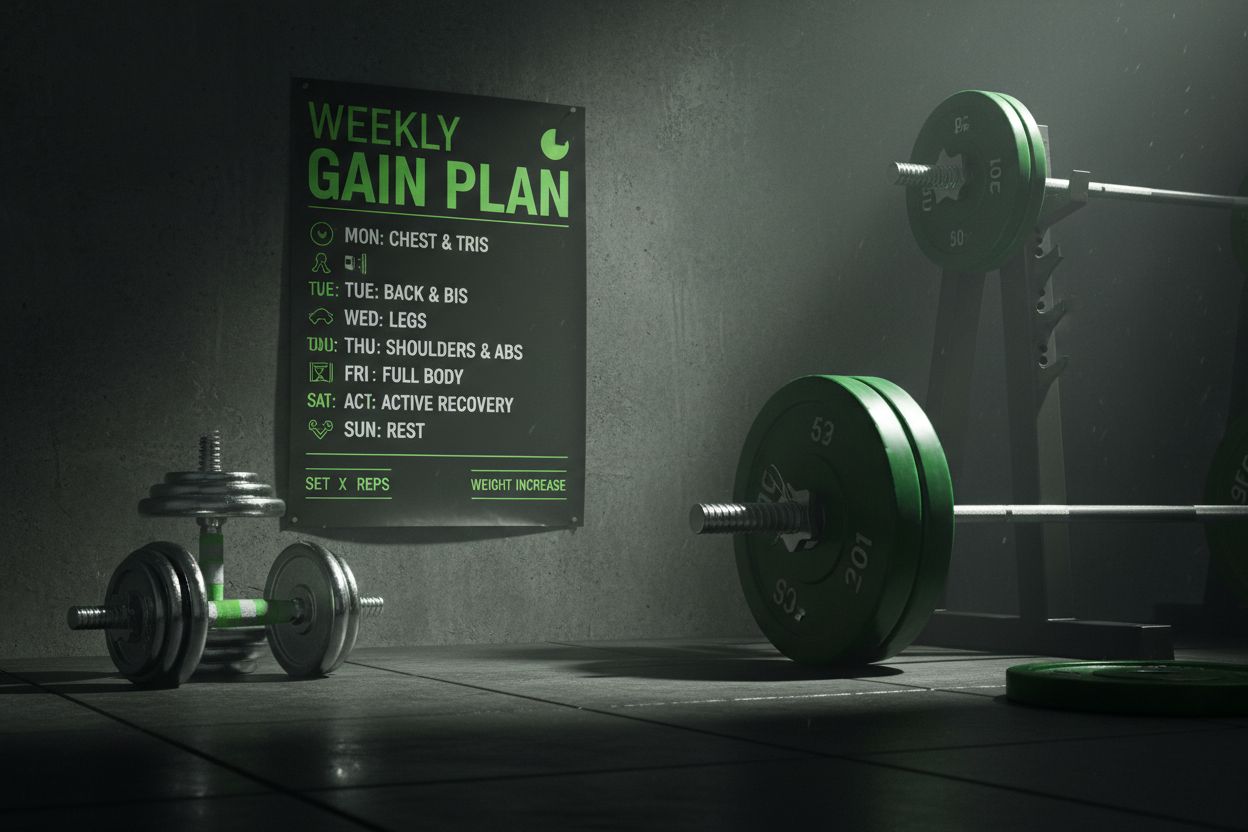
You do not need a complicated split to get stronger. A simple full-body template can be built around movement patterns instead of body parts. That usually means a squat, a hinge, a push, a pull, and a core or carry variation. This lines up well with ACSM’s emphasis on multi-joint, large muscle group exercises and with the examples it gives for major lifts. (myjourney.exerciseismedicine.org)
Here is a straightforward 3-day setup:
Day 1
Squat pattern, 2 to 3 sets
Horizontal press, 2 to 3 sets
Horizontal row, 2 to 3 sets
Core exercise, 2 to 3 sets
Day 2
Hinge pattern, 2 to 3 sets
Vertical press, 2 to 3 sets
Vertical pull, 2 to 3 sets
Carry or trunk work, 2 to 3 sets
Day 3
Squat variation, 2 to 3 sets
Press variation, 2 to 3 sets
Row variation, 2 to 3 sets
Posterior chain accessory, 2 to 3 sets
If you are newer, run most of those lifts for 8 to 12 reps. If you are already experienced and your form is solid, move the main lifts into the 1 to 8 rep range and use heavier loads. That keeps the structure simple while still matching the strength goal. (myjourney.exerciseismedicine.org)
How to progress without guessing
Progression is where most strength programs succeed or stall. If you keep doing the same sets, reps, and load forever, your body has little reason to adapt. ACSM defines progression as moving forward toward a specific goal over time, and it recommends increasing load by about 2 to 10% when the current workload becomes too manageable for consecutive sessions. (myjourney.exerciseismedicine.org)
A practical progression model looks like this:
First, hold the load steady until you can hit the top of your rep target with good form.
Then, add a small amount of weight.
If the new load feels too heavy, stay there until the reps improve.
If your form breaks down, reduce the load and build back up.
This is one of the reasons it helps to track your workouts instead of relying on memory. A detailed log makes it easier to notice small wins, spot plateaus, and see when a set of 8 has turned into a set of 10 with the same weight. (myjourney.exerciseismedicine.org)
Common mistakes to avoid
The fastest way to make strength training feel confusing is to change too many variables at once. A few common problems show up again and again:
Too much volume too soon. More sets are not always better, especially if recovery is not keeping up. (myjourney.exerciseismedicine.org)
Training to failure every set. NSCA and ACSM both note that this is not necessary for most people, and it can create more fatigue than you need. (nsca.com)
Resting too little between heavy sets. Short rest can make the next set weaker and reduce total quality. (pubmed.ncbi.nlm.nih.gov)
Skipping the big lifts. If your entire plan is small isolation work, you may miss the biggest strength-building movements. (myjourney.exerciseismedicine.org)
Not tracking anything. If you do not write down sets, reps, and loads, it is hard to know whether you are actually progressing. (myjourney.exerciseismedicine.org)
FAQ
How many sets and reps should I do for strength training?
A strong starting point is 2 to 3 sets per exercise, 2 or more days per week, using a load that feels challenging. Newer lifters can start with 8 to 12 reps, while more advanced strength work often moves into the 1 to 8 rep range with heavier loads. (acsm.org)
Is 3 sets of 10 good for strength?
Yes, it can be useful, especially if you are new. It is a sensible general training setup, but if pure strength is your main goal, you will usually want to shift some of your main lifts toward heavier loads and lower reps over time. (myjourney.exerciseismedicine.org)
How long should I rest between sets?
For heavy strength work, 2 to 3 minutes is a solid default, and 3 to 5 minutes can be even better for preserving performance across multiple hard sets. For lighter work, shorter rest periods can be fine. (myjourney.exerciseismedicine.org)
How often should I strength train?
At least 2 days per week is the baseline for adults. Many beginners do best with 2 to 3 full-body sessions weekly, while more advanced lifters often train 4 or more days depending on the split and total workload. (cdc.gov)
Do I need to train to failure?
No. Hard sets matter, but constant failure training is not required for strength progress and is often unnecessary for the average lifter. A challenging load with good form is usually the better target. (nsca.com)
The bottom line is simple: for strength training, start with 2 to 3 sets, keep the workload challenging, train each major muscle group at least twice per week, and progress gradually. Once that base is in place, the exact rep range matters less than doing the work consistently and adding load over time. (acsm.org)
Article created using Lovarank