PHUL Workout: Complete 4-Day Program for Strength and Size (2025)

What is the PHUL Workout?
PHUL stands for Power Hypertrophy Upper Lower, a training program created by Brandon Campbell that's become one of the most popular intermediate lifting routines. The program splits your training week into four distinct sessions: two upper body days and two lower body days, with each pair divided between power-focused and hypertrophy-focused training.
The genius of PHUL lies in its dual approach. Power days use lower rep ranges (3-5 reps) with heavier weights to build raw strength, while hypertrophy days employ moderate weights for higher reps (8-12) to maximize muscle growth. This combination addresses what many lifters want: getting stronger while building visible muscle mass.
Brandon Campbell designed PHUL for intermediate lifters who've moved past beginner linear progression programs but aren't ready for advanced powerlifting or bodybuilding splits. If you've been lifting consistently for 6-12 months and your beginner gains have started to plateau, PHUL might be exactly what you need.
The program typically runs on a Monday/Tuesday, Thursday/Friday schedule, giving you three rest days per week. This recovery time is crucial because you're hitting each muscle group twice weekly with significant volume and intensity.
How PHUL Works: Core Training Principles
PHUL operates on three fundamental principles that make it effective for simultaneous strength and muscle gains.
Intensity Variation
The program alternates between heavy, strength-focused sessions and moderate-weight, volume-focused sessions. On power days, you're working at 80-90% of your one-rep max, which triggers neural adaptations and builds maximum strength. Hypertrophy days drop the intensity to 65-75% of your max, allowing for more total volume and metabolic stress—both key drivers of muscle growth.
This variation prevents your body from adapting to a single stimulus. Your nervous system gets challenged on power days, while your muscles get the volume they need for growth on hypertrophy days.
Frequency and Volume
Each muscle group gets hit twice per week—once heavy, once for volume. Research consistently shows that training muscles twice weekly produces better results than once-weekly splits for most intermediate lifters. You're getting 16-20 sets per muscle group weekly, which falls right in the sweet spot for hypertrophy.
The upper/lower split also allows for better recovery compared to body part splits. When you're doing chest on Monday, your legs are recovering. When you're squatting on Thursday, your upper body is fresh.
Movement Selection
PHUL prioritizes compound movements—exercises that work multiple muscle groups simultaneously. Your power days focus almost exclusively on the big lifts: squats, deadlifts, bench press, and rows. These movements give you the most bang for your buck, allowing you to move heavy weight and stimulate maximum muscle fiber recruitment.
Hypertrophy days include compounds but add isolation exercises to target specific muscles with higher volume. This combination ensures you're building both functional strength and aesthetic muscle development.
Deload Protocols and Recovery Strategies
One aspect often overlooked in PHUL discussions is proper deloading. After 6-8 weeks of progressive overload, your body needs a recovery week. During a deload, reduce your working weights by 40-50% while maintaining the same exercises and rep schemes. This allows your muscles, joints, and nervous system to fully recover while maintaining movement patterns.
Some lifters prefer a different approach: taking a complete rest week every 8-10 weeks. Both methods work, but the reduced-intensity deload often feels better psychologically and maintains your gym routine.
Between deloads, prioritize sleep (7-9 hours nightly) and manage stress. PHUL's twice-weekly frequency per muscle group is demanding. If you're not recovering adequately, you'll stall quickly.
PHUL Workout Schedule and Split Breakdown
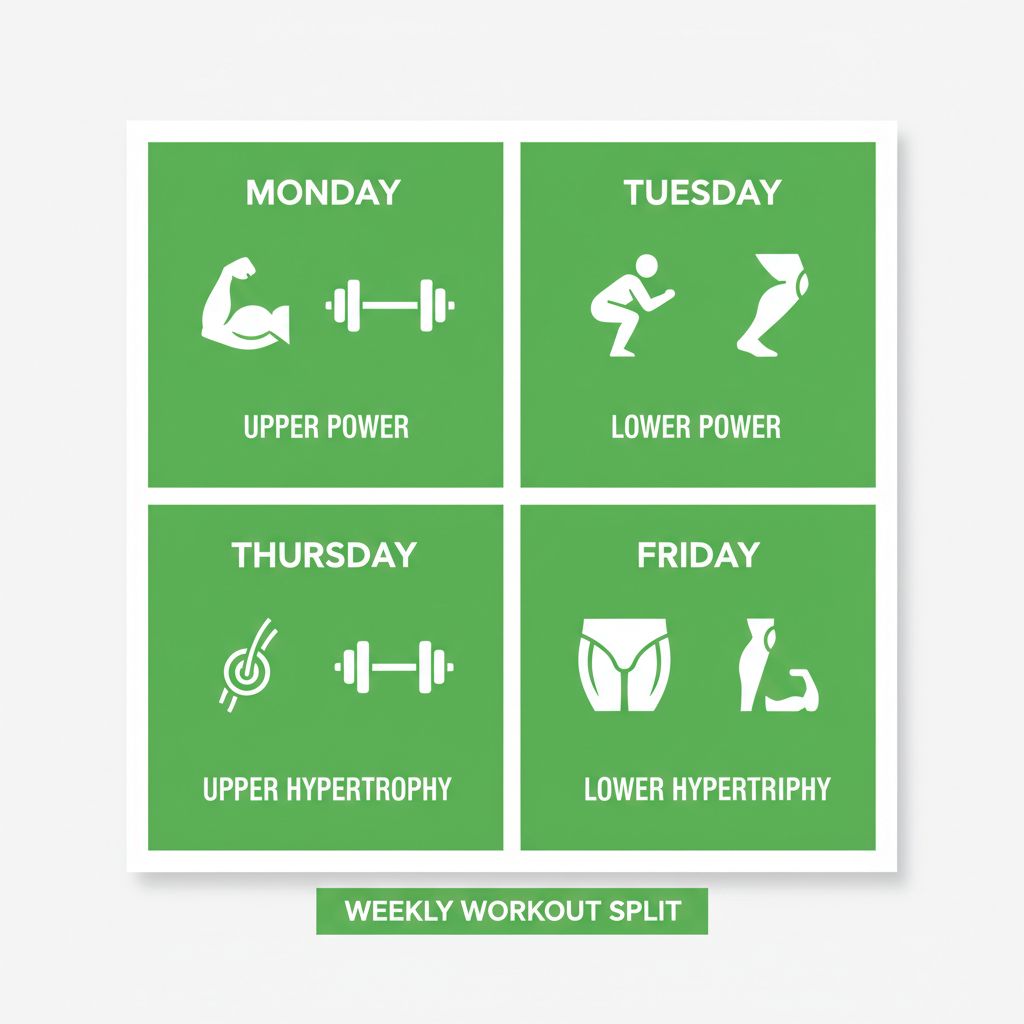
The standard PHUL schedule looks like this:
Week Structure:
Monday: Upper Power
Tuesday: Lower Power
Wednesday: Rest
Thursday: Upper Hypertrophy
Friday: Lower Hypertrophy
Saturday: Rest
Sunday: Rest
This schedule isn't set in stone. Some lifters prefer Tuesday/Wednesday, Friday/Saturday. The key is maintaining at least one rest day between upper and lower sessions, and ideally two days between the same muscle groups.
[INFOGRAPHIC: 4-day PHUL split structure showing power vs hypertrophy days with muscle groups targeted]
Comparing PHUL to Other Popular Programs
Understanding how PHUL stacks up against other intermediate programs helps you choose the right fit.
PHUL vs PPL (Push/Pull/Legs):
PPL runs six days weekly compared to PHUL's four, making it more time-intensive. PPL separates pushing and pulling movements, while PHUL combines them on upper days. If you can commit to six gym days and want more volume, PPL works well. If you prefer four days with built-in recovery, PHUL is better.
PHUL vs PHAT:
PHAT (Power Hypertrophy Adaptive Training) is actually PHUL's bigger brother, also created by Layne Norton. PHAT runs five days weekly with more volume and exercise variety. PHUL is essentially a streamlined version of PHAT. Choose PHAT if you want more volume and have five days available; stick with PHUL for a more manageable four-day commitment.
PHUL vs nSuns:
nSuns focuses heavily on the main compound lifts with high volume and built-in progression. It's more powerlifting-oriented than PHUL. If your primary goal is maximizing your squat, bench, and deadlift numbers, nSuns might edge out PHUL. For balanced strength and aesthetics, PHUL wins.
PHUL vs 5/3/1:
Jim Wendler's 5/3/1 uses monthly progression cycles and submaximal training. It's excellent for long-term strength development but includes less hypertrophy-specific work than PHUL. Many lifters actually run 5/3/1 for main lifts and add PHUL-style accessories.
Complete PHUL Workout Plan: Day-by-Day Breakdown
Here's the complete program with specific exercises, sets, and reps.
Day 1: Upper Power
Barbell Bench Press: 3-4 sets × 3-5 reps
Incline Dumbbell Bench Press: 3-4 sets × 6-10 reps
Bent Over Row: 3-4 sets × 3-5 reps
Weighted Pull-ups (or Lat Pulldown): 2-3 sets × 6-10 reps
Overhead Press: 2-3 sets × 5-8 reps
Barbell Curl: 2-3 sets × 6-10 reps
Skull Crushers: 2-3 sets × 6-10 reps
Rest 3-5 minutes between heavy compound sets, 2-3 minutes for accessory work.
Day 2: Lower Power
Barbell Squat: 3-4 sets × 3-5 reps
Deadlift: 3-4 sets × 3-5 reps
Leg Press: 3-5 sets × 10-15 reps
Leg Curl: 3-4 sets × 6-10 reps
Calf Exercise: 4 sets × 6-10 reps
Note: Some lifters alternate squats and deadlifts weekly rather than doing both heavy on the same day. Listen to your body—if you're consistently gassed after squats, consider this modification.
Day 3: Upper Hypertrophy
Incline Barbell Bench Press: 3-4 sets × 8-12 reps
Flat Bench Dumbbell Flye: 3-4 sets × 8-12 reps
Seated Cable Row: 3-4 sets × 8-12 reps
One Arm Dumbbell Row: 3-4 sets × 8-12 reps
Dumbbell Lateral Raise: 3-4 sets × 8-12 reps
Seated Incline Dumbbell Curl: 3-4 sets × 8-12 reps
Cable Tricep Extension: 3-4 sets × 8-12 reps
Rest 60-90 seconds between sets to maintain metabolic stress.
Day 4: Lower Hypertrophy
Front Squat: 3-4 sets × 8-12 reps
Barbell Lunge: 3-4 sets × 8-12 reps
Leg Extension: 3-4 sets × 10-15 reps
Leg Curl: 3-4 sets × 10-15 reps
Seated Calf Raise: 3-4 sets × 8-12 reps
Calf Press: 3-4 sets × 8-12 reps
Exercise Substitutions for Home Gyms and Limited Equipment
Not everyone has access to a fully-equipped commercial gym. Here are effective substitutions:
No barbell?
Bench Press → Weighted Push-ups or Heavy Dumbbell Press
Barbell Row → Dumbbell Rows or Inverted Rows
Barbell Squat → Goblet Squats or Bulgarian Split Squats
Deadlift → Dumbbell Romanian Deadlifts or Single-Leg Deadlifts
No cable machine?
Cable Rows → Resistance Band Rows
Cable Tricep Extensions → Overhead Dumbbell Extensions
Lat Pulldown → Resistance Band Pulldowns or Pull-ups
No leg press?
Leg Press → Hack Squats, Belt Squats, or High-Rep Goblet Squats
No incline bench?
Incline Press → Floor Press with elevated shoulders or Decline Push-ups
The key is maintaining the power/hypertrophy split and hitting similar movement patterns, even if the exact exercises differ.
Real Results: What to Expect from PHUL
Let's talk realistic expectations. I've seen dozens of lifters run PHUL, and here's what typical progress looks like:
Months 1-3:
Most intermediate lifters add 5-10 pounds to upper body lifts monthly and 10-20 pounds to lower body lifts. You might gain 3-6 pounds of bodyweight (mix of muscle and some fat) if eating in a surplus. Visible muscle development in shoulders, back, and legs becomes noticeable.
Months 4-6:
Strength gains slow to 2-5 pounds monthly on upper lifts, 5-10 pounds on lower. Muscle gain continues at 1-2 pounds monthly. Your physique starts looking noticeably different—fuller chest, wider back, more defined arms.
Months 7-12:
Progression becomes more challenging. You might add 10-20 pounds to major lifts over this period. Muscle gains slow but continue with proper nutrition. This is when periodization becomes important (more on that later).
One lifter I know ran PHUL for 10 months, going from a 185-pound bench to 235, 275-pound squat to 335, and 315-pound deadlift to 405. He gained 12 pounds of bodyweight. That's solid progress, though individual results vary based on genetics, nutrition, and recovery.
Benefits and Advantages of PHUL
PHUL offers several distinct advantages that explain its popularity.
Balanced Strength and Aesthetics
Unlike pure powerlifting programs that prioritize the big three lifts, or bodybuilding splits that focus solely on muscle size, PHUL develops both. You're getting stronger on compounds while building muscle with higher-volume work. This makes it perfect for lifters who want to look good and perform well.
Time Efficiency
Four training days weekly is manageable for most people. Each session runs 60-90 minutes depending on rest periods and conditioning. Compare this to six-day PPL splits or high-frequency programs, and PHUL becomes attractive for busy lifters.
Built-in Recovery
Three rest days weekly, plus the upper/lower split, means muscle groups get adequate recovery. You're not destroying your chest three times weekly like some bro-splits. This reduces injury risk and prevents overtraining.
Proven Track Record
Thousands of lifters have run PHUL successfully. The program has been around long enough to prove it works for the target audience: intermediate lifters wanting balanced development.
Common Mistakes and Form Cues for Main Lifts
Even with a solid program, poor execution kills results. Here are the most common mistakes I see:
Bench Press Mistakes:
Flaring elbows too wide (increases shoulder injury risk)
Not retracting shoulder blades (reduces stability and power)
Bouncing the bar off your chest (reduces muscle tension)
Fix: Keep elbows at 45-degree angle, squeeze shoulder blades together and down, pause briefly at chest.
Squat Mistakes:
Knees caving inward (valgus collapse)
Rising with hips first (good morning squat)
Not hitting proper depth
Fix: Push knees out actively, keep chest up throughout the movement, squat to where hip crease is below knee level.
Deadlift Mistakes:
Rounding lower back under heavy loads
Starting with hips too low (turning it into a squat)
Jerking the bar off the floor
Fix: Brace core hard, find your optimal hip height (usually higher than you think), pull the slack out of the bar before initiating the lift.
Row Mistakes:
Using momentum and body English
Not fully retracting shoulder blades
Rowing to the wrong position (too high or low)
Fix: Keep torso stable, squeeze shoulder blades together at the top, row to lower chest/upper abdomen.
Drawbacks and Limitations of PHUL
No program is perfect. Here's where PHUL falls short.
Limited Specialization
If you want to maximize one specific goal—pure strength, pure hypertrophy, or athletic performance—specialized programs will outperform PHUL. It's a jack-of-all-trades program, which means it's master of none.
High Intensity Can Be Taxing
Two heavy power days weekly is demanding, especially on your central nervous system. If you're not recovering well, sleeping enough, or managing stress, PHUL can grind you down. Some lifters find they need to reduce power day frequency or intensity.
Not Ideal for Advanced Lifters
Once you're squatting 2x bodyweight, benching 1.5x bodyweight, and deadlifting 2.5x bodyweight, you'll likely need more specialized programming. PHUL works best for that intermediate phase.
Lacks Built-in Periodization
The basic PHUL template doesn't include planned progression or periodization. You're expected to add weight when you can, but there's no structured wave loading or planned deloads. This works initially but becomes limiting over time.
Periodization Strategies for Long-Term PHUL Progression
To run PHUL beyond the typical 3-6 months, you need to add periodization.
Linear Periodization Approach:
Run 4-week blocks where you gradually increase weight while decreasing reps on power days. Week 1: 4×5, Week 2: 4×4, Week 3: 4×3, Week 4: Deload. Then start the next block with slightly heavier weights.
Wave Loading:
Alternate between heavier and lighter weeks. Week 1: Heavy (3-5 reps), Week 2: Moderate (6-8 reps), Week 3: Heavy (3-5 reps with more weight than Week 1), Week 4: Deload.
Block Periodization:
Run 6-week strength blocks focusing on power days, then 6-week hypertrophy blocks emphasizing volume days. This allows you to specialize temporarily while maintaining the PHUL framework.
Auto-regulation:
Use RPE (Rate of Perceived Exertion) or RIR (Reps in Reserve) to adjust daily intensity based on how you feel. On power days, work up to a top set at RPE 8-9, then do back-off sets. This prevents grinding yourself into the ground on bad days.
Who Should Do PHUL (and Who Shouldn't)
PHUL works best for specific lifters.
Ideal Candidates:
Intermediate lifters who've completed a beginner program (Starting Strength, StrongLifts, etc.) and can no longer add weight every session. If you've been lifting 6-12 months consistently, you're probably ready.
Lifters who want balanced development between strength and size. If you care about both your bench press max and how your chest looks, PHUL fits perfectly.
People with 4 days weekly to commit to training. The schedule is flexible, but you need those four sessions.
Lifters comfortable with compound movements who have decent form on squats, deadlifts, bench press, and rows.
Not Ideal For:
Complete beginners should start with simpler programs that build foundational strength and teach proper form. PHUL's volume and intensity is too much when you're still learning movement patterns.
Advanced lifters (3+ years of consistent training) typically need more specialized programming to continue progressing.
People who can only train 2-3 days weekly—you won't get enough frequency for optimal results.
Lifters with specific goals like powerlifting competition prep or bodybuilding shows need specialized programs.
Female-Specific Considerations and Modifications
PHUL works excellently for women, but some modifications can optimize results:
Volume Adjustments:
Women typically recover faster from training and can handle more volume, especially on lower body. Consider adding an extra set to leg exercises or including an additional glute-focused movement like hip thrusts.
Exercise Selection:
Many women prefer emphasizing glutes and legs over upper body. Swap front squats for Bulgarian split squats, add glute bridges to lower days, or include more hip-dominant movements.
Menstrual Cycle Considerations:
Some women find they're stronger during the follicular phase (days 1-14) and benefit from scheduling heavier power days then, with hypertrophy work during the luteal phase (days 15-28). This isn't universal, but worth experimenting with.
Upper Body Emphasis:
Women often need more upper body volume to see growth. Adding an extra set or two to back and shoulder work on hypertrophy days can help.
The core PHUL structure works regardless of gender—the principles of progressive overload, frequency, and intensity variation apply universally.
PHUL Progression and Weight Increases

Progression is where many lifters stumble. Here's how to add weight systematically.
Power Days Progression
Start with weights you can handle for 3-5 reps with 1-2 reps left in the tank. When you can complete all prescribed sets at the top of the rep range (5 reps), add 5 pounds to upper body lifts or 10 pounds to lower body lifts.
Example: You're benching 185 for 4 sets of 5. Next session, try 190. If you get 5,5,4,4, stick with 190 until you hit 5,5,5,5, then move to 195.
Hypertrophy Days Progression
Use the same principle but with 8-12 rep ranges. When you hit 12 reps on all sets, increase weight by 5 pounds (2.5 pounds for smaller movements like curls).
Alternatively, add reps before adding weight. If you're doing 3 sets of 8, progress to 3×9, then 3×10, then 3×11, then 3×12, then increase weight and drop back to 3×8.
When Progression Stalls
If you fail to progress for 2-3 consecutive sessions:
Check your recovery (sleep, nutrition, stress)
Take a deload week
Reduce weight by 10% and build back up
Consider adding periodization
Tracking your workouts becomes essential here. Apps like Setgraph make it easy to log every set, track progression over time, and identify when you're stalling. You can see your complete exercise history at a glance, which helps you make informed decisions about when to add weight or deload.
Nutrition and Diet for PHUL
Your training is only half the equation. Nutrition determines whether you build muscle, lose fat, or spin your wheels.
Bulking on PHUL
To maximize muscle growth, eat in a 300-500 calorie surplus. Aim for:
Protein: 0.8-1g per pound of bodyweight
Carbs: 2-3g per pound (fuel for heavy training)
Fats: 0.3-0.5g per pound
Prioritize carbs around training. Have a carb-rich meal 2-3 hours before your session and another post-workout. This supports performance and recovery.
Expect to gain 2-4 pounds monthly, with roughly half being muscle if you're training hard and eating right.
Cutting on PHUL
PHUL works for fat loss, but you'll need to adjust expectations. Eat in a 300-500 calorie deficit while maintaining protein at 1-1.2g per pound of bodyweight.
You won't add much weight to the bar while cutting, but you can maintain strength and even build some muscle if you're newer to training. Focus on maintaining your power day weights and accept that hypertrophy day performance might dip slightly.
Consider reducing volume by 10-20% if recovery becomes an issue. Drop one set from each exercise or reduce training days to three weekly.
Maintenance and Recomposition
Eating at maintenance (matching calories burned) allows for slow recomposition—losing fat while building muscle. This works best for beginners and intermediate lifters with higher body fat percentages.
Progress will be slower than bulking, but you'll avoid the bulk/cut cycle. Keep protein high (1g per pound) and be patient.
Common Mistakes to Avoid
Beyond form issues, here are program-level mistakes that derail progress:
Skipping Power Days
Some lifters hate low-rep training and only do hypertrophy work. This defeats the purpose of PHUL. The power days build the strength foundation that allows you to use heavier weights on hypertrophy days.
Adding Too Much Volume
PHUL provides enough volume for growth. Adding five extra exercises per session leads to junk volume and impairs recovery. If you want more work, add one or two exercises maximum, and only for lagging body parts.
Inconsistent Training
Missing sessions regularly kills progress. PHUL requires four sessions weekly. If you can only train three days consistently, choose a different program.
Ignoring Recovery
Sleeping five hours nightly, eating in a massive deficit, and training six days weekly while running PHUL is a recipe for burnout. Respect the recovery days and prioritize sleep.
Not Tracking Workouts
If you're not recording weights, sets, and reps, you're guessing at progression. Use a notebook or app to track every session. This data tells you when to add weight, when to deload, and what's actually working.
Frequently Asked Questions
How long should I run PHUL before switching programs?
Run PHUL for at least 12-16 weeks to see meaningful results. Many lifters successfully run it for 6-12 months with proper periodization. Switch when you stop progressing despite good recovery and nutrition, or when your goals change (like training for a powerlifting meet).
Can I combine PHUL with cardio or sports training?
Yes, but manage total stress carefully. Add 2-3 cardio sessions on rest days, keeping them moderate intensity (30-40 minutes). For sports training, you might need to reduce PHUL to three days weekly or lower the volume to prevent overtraining.
What accessories should I add if I have specific weak points?
For lagging chest: Add another pressing variation on upper hypertrophy day. For weak back: Include face pulls or band pull-aparts daily. For small arms: Add one extra bicep and tricep exercise on hypertrophy days. For weak lockout on bench: Add board presses or floor presses. For squat depth issues: Add pause squats or box squats.
How do I transition from beginner programs to PHUL?
Run your beginner program until linear progression stalls (you can't add weight every session). Take a deload week, then start PHUL using 85-90% of your current working weights. This gives you room to progress while adapting to the new volume.
What are realistic strength and muscle gain expectations per month on PHUL?
First 3 months: Add 5-10 pounds monthly to upper body lifts, 10-20 pounds to lower body lifts. Gain 1-2 pounds of muscle monthly (3-4 pounds total bodyweight if bulking). Months 4-6: Gains slow to 2-5 pounds monthly on upper lifts, 5-10 pounds on lower. Muscle gain continues at 1-2 pounds monthly. Beyond 6 months: Progress becomes more variable and slower.
How should I adjust PHUL if I'm cutting vs bulking?
Bulking: Run the program as written, focus on progressive overload, eat in a surplus. Cutting: Maintain power day weights, accept slower progression, potentially reduce volume by 10-20% if recovery suffers, keep protein high (1-1.2g per pound).
What's the difference between PHUL and PHAT programs?
PHAT runs five days weekly vs PHUL's four. PHAT includes a dedicated power day for upper and lower, then three hypertrophy days (chest/arms, legs, back/shoulders). PHAT has more total volume and exercise variety. Choose PHAT if you want more volume and have five days available; choose PHUL for a more manageable four-day commitment.
Can beginners do PHUL?
Not recommended. Beginners progress better on simpler programs with more frequent practice of basic movements. Run a beginner program like Starting Strength or StrongLifts for 3-6 months first, then transition to PHUL.
Do I need to do both squats and deadlifts on lower power day?
The original program includes both, but many lifters alternate them weekly to manage fatigue. Week 1: Heavy squats + moderate deadlifts. Week 2: Heavy deadlifts + moderate squats. This approach works well for most people.
How long should I rest between sets?
Power days: 3-5 minutes for main compounds, 2-3 minutes for accessories. Hypertrophy days: 60-90 seconds for most exercises. Adjust based on recovery—if you're still breathing hard, wait longer.
Making PHUL Work for You
PHUL isn't a magic program, but it's a proven framework that works for intermediate lifters who want balanced strength and muscle development. The four-day schedule fits most people's lives, the upper/lower split allows for adequate recovery, and the power/hypertrophy split addresses both neural and metabolic adaptations.
Success with PHUL comes down to consistency, progressive overload, and proper recovery. Track your workouts religiously—knowing exactly what you lifted last session is crucial for progression. Eat enough to support your goals, whether that's building muscle or maintaining strength while losing fat. Sleep 7-9 hours nightly. Manage stress where possible.
The program gives you structure, but you need to bring the effort and discipline. Show up four days weekly, push yourself on power days, chase the pump on hypertrophy days, and trust the process for at least 12-16 weeks before judging results.
If you're ready to start tracking your PHUL workouts and want a simple way to log every set, monitor your progression, and see your strength gains over time, Setgraph makes it effortless. Create your PHUL workout routine once, then access your complete exercise history every time you train. No complicated setup—just fast, simple tracking that helps you focus on what matters: getting stronger and building muscle.
Article created using Lovarank