Beginner Gym Workout: Your Complete Guide to Starting Strong

Why Beginners Need a Structured Gym Workout Plan
Walking into a gym for the first time can feel overwhelming. Rows of unfamiliar machines, free weights scattered across the floor, and people who seem to know exactly what they're doing—it's enough to make anyone want to turn around and leave.
Here's the thing: those confident gym-goers weren't born knowing how to deadlift or which machine works which muscle. They started somewhere, and most of them started with a plan.
A structured beginner gym workout plan eliminates the guesswork. Instead of wandering from machine to machine hoping you're doing something productive, you'll know exactly which exercises to perform, how many sets and reps to complete, and which muscle groups you're targeting. This clarity builds confidence fast.
Research shows that beginners who follow structured programs see better results than those who wing it. A 2019 study in the Journal of Strength and Conditioning Research found that novice lifters following periodized training plans gained 40% more strength over 12 weeks compared to those doing random exercises.
But the benefits go beyond physical gains. Having a plan reduces decision fatigue—you're not standing in the middle of the gym floor trying to figure out what to do next. You walk in, check your workout, and get to work. This mental clarity makes it easier to stay consistent, which is the real secret to long-term progress.
Understanding Strength Training Basics for Beginners
Strength training isn't just about building bigger muscles (though that's a nice bonus). It's about teaching your body to move efficiently under load, building bone density, improving metabolic health, and creating a foundation for whatever fitness goals you pursue later.
At its core, strength training involves progressive resistance. You challenge your muscles with weight, they adapt by getting stronger, and you gradually increase the challenge. Simple in theory, but there are a few key concepts every beginner should understand.
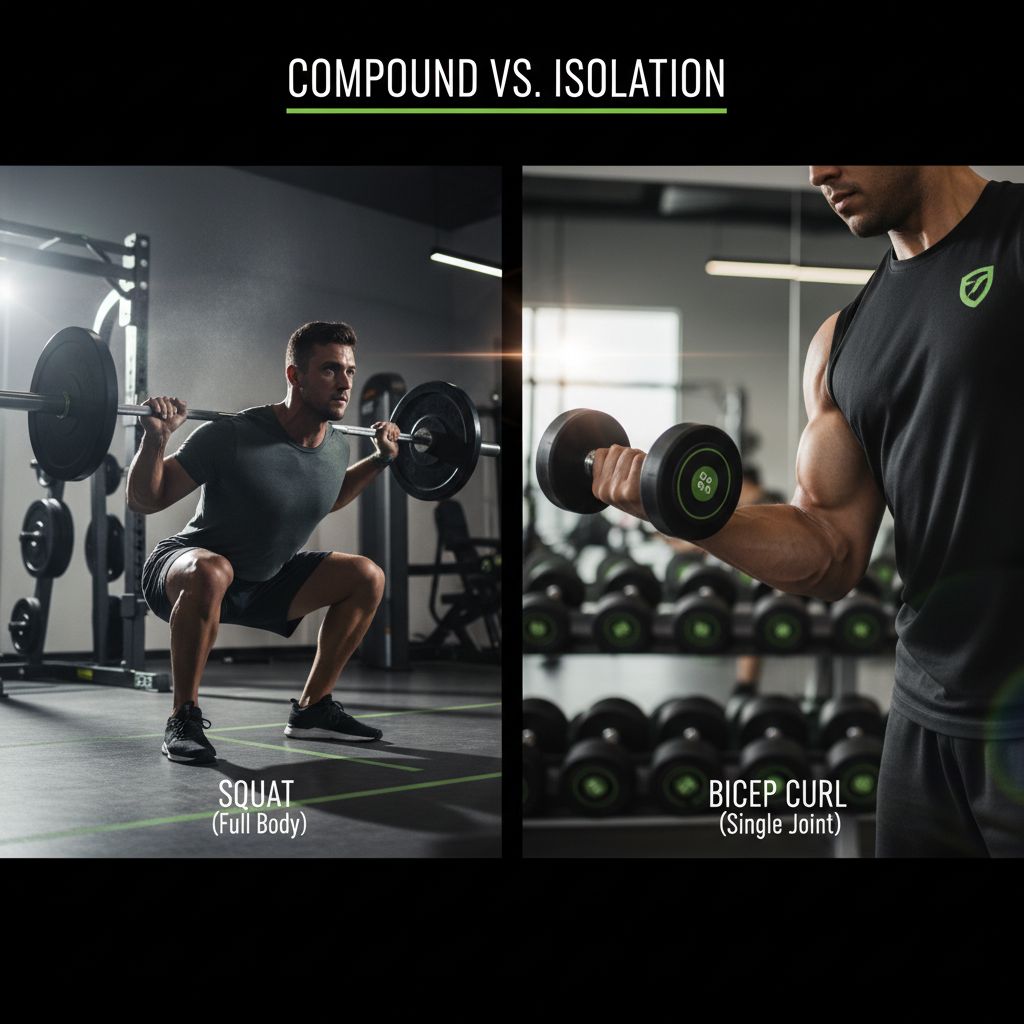
Compound vs. Isolation Exercises
Compound exercises work multiple muscle groups simultaneously. Think squats (legs, core, back), bench press (chest, shoulders, triceps), or rows (back, biceps, core). These movements give you the most bang for your buck, especially when you're starting out and time is limited.
Isolation exercises target specific muscles—bicep curls, leg extensions, or calf raises. They have their place, but beginners should prioritize compounds first.
Sets and Reps Explained
A "rep" (repetition) is one complete movement of an exercise. A "set" is a group of consecutive reps. If your workout calls for 3 sets of 10 reps, you'll perform the exercise 10 times, rest, repeat that twice more.
For beginners, 3-4 sets of 8-12 reps works well for most exercises. This range builds both strength and muscle endurance without overwhelming your nervous system.
Rest Periods Matter
Rest between sets isn't wasted time—it's when your muscles partially recover so you can maintain good form on subsequent sets. For compound exercises, rest 2-3 minutes. For isolation work, 60-90 seconds is usually sufficient.
Free Weights vs. Machines: What's Better for Beginners?
This debate has raged for decades, but the truth is both have value.
Machines offer a fixed movement path, which helps you learn the motion pattern without worrying about balance. They're safer when you're fatigued and excellent for targeting specific muscles. The downside? They don't teach your stabilizer muscles to work, and the fixed path might not match your body's natural movement.
Free weights (dumbbells, barbells) require more coordination and engage stabilizer muscles. They're more functional—the strength you build transfers better to real-world movements. But they have a steeper learning curve and higher injury risk if your form breaks down.
The smart approach? Start with machines to build basic strength and confidence, then gradually incorporate free weights as your form improves. Many successful lifters use both throughout their training careers.
What to Bring to the Gym: First-Timer Checklist
Showing up prepared makes your first gym session less stressful. Here's what you actually need (and what you can skip):
Essential Items:
Water bottle: Hydration is non-negotiable. Aim to sip water between sets, not just when you're thirsty.
Workout clothes: Breathable fabric that allows full range of motion. You don't need expensive gear—a basic t-shirt and athletic shorts or leggings work fine.
Athletic shoes: Cross-trainers or running shoes with good support. Avoid worn-out shoes that could compromise your stability.
Small towel: For wiping down equipment after use (gym etiquette 101).
Phone or notebook: To track your workouts. More on this later.
Nice to Have:
Headphones: Music can boost performance by 15% according to some studies, plus it signals you're focused.
Lock: If your gym has lockers, bring a lock for your valuables.
Post-workout snack: Protein shake or a banana for the drive home.
Skip These (At Least Initially):
Lifting gloves (your hands will adapt)
Weight belt (not needed for beginner weights)
Fancy supplements (focus on consistency first)
Gym bag full of unnecessary items
Keep it simple. The less you have to think about logistics, the more mental energy you have for the actual workout.
Gym Etiquette and Confidence Tips for Beginners
Let's address the elephant in the room: gym anxiety is real. About 50% of people report feeling intimidated in gym environments, according to a 2020 survey by RunRepeat.
The good news? Most of that anxiety is in your head. The vast majority of gym-goers are focused on their own workouts, not judging yours. But understanding basic gym etiquette helps you blend in and feel more comfortable.
Unwritten Rules Every Beginner Should Know:
Wipe down equipment after use: Use the provided spray and paper towels. Nobody wants to sit in your sweat.
Don't hog equipment: If someone asks to "work in" (alternate sets with you), say yes unless you're almost done. It's standard practice.
Rerack your weights: Always. This is the cardinal sin of gym etiquette. Put weights back where you found them.
Give people space: Don't set up right next to someone when there are empty areas available. Respect personal bubbles.
Limit phone use: Quick workout tracking is fine. Scrolling Instagram between sets while occupying equipment is not.
Ask before giving advice: Unless someone is about to injure themselves, keep unsolicited form tips to yourself.
Overcoming Gym Intimidation:
Start during off-peak hours (mid-morning or early afternoon) when the gym is less crowded. This gives you space to learn equipment without feeling watched.
Remember that everyone started as a beginner. That person deadlifting 400 pounds? They once struggled with the empty bar. The fitness journey is personal—you're not competing with anyone else in the gym.
If you're unsure how to use a machine, ask a staff member. That's literally what they're there for. Most gyms offer free orientation sessions for new members—take advantage of this.
Finally, fake it till you make it. Walk with purpose, even if you're not entirely sure where you're going. Confidence is a skill you can practice.
Complete Beginner Gym Workout Plan (With Variations)
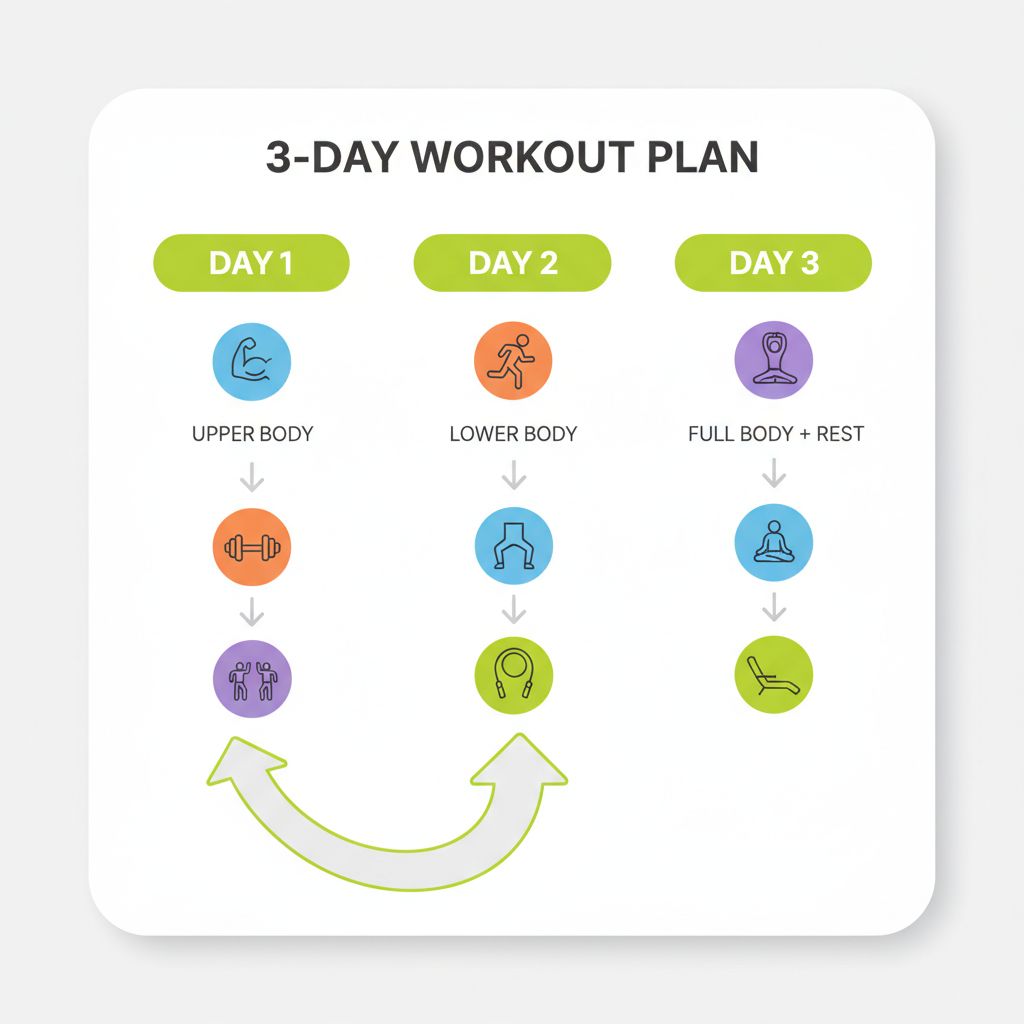
This 3-day full-body routine hits all major muscle groups twice per week, giving you enough stimulus to grow while allowing adequate recovery. You'll perform this Monday, Wednesday, and Friday (or any three non-consecutive days).
Workout A (Monday/Friday alternating):
Goblet Squat: 3 sets × 10 reps
Dumbbell Bench Press: 3 sets × 10 reps
Lat Pulldown: 3 sets × 10 reps
Dumbbell Shoulder Press: 3 sets × 10 reps
Plank: 3 sets × 30 seconds
Workout B (Wednesday, then Monday/Friday alternating):
Leg Press: 3 sets × 12 reps
Dumbbell Row: 3 sets × 10 reps per arm
Machine Chest Press: 3 sets × 10 reps
Leg Curl: 3 sets × 12 reps
Cable Tricep Pushdown: 3 sets × 12 reps
Dumbbell Bicep Curl: 3 sets × 12 reps
[INFOGRAPHIC: 3-day beginner workout split showing Workout A and Workout B exercises with simple illustrations and set/rep schemes]
4-Day Upper/Lower Split (For Those With More Time):
If you can commit to four days per week, an upper/lower split allows more volume per muscle group:
Monday - Upper Body:
Dumbbell Bench Press: 3×10
Lat Pulldown: 3×10
Dumbbell Shoulder Press: 3×10
Dumbbell Row: 3×10
Tricep Pushdown: 3×12
Bicep Curl: 3×12
Tuesday - Lower Body:
Goblet Squat: 3×10
Leg Press: 3×12
Leg Curl: 3×12
Calf Raise: 3×15
Plank: 3×30 seconds
Thursday - Upper Body:
Incline Dumbbell Press: 3×10
Cable Row: 3×10
Lateral Raise: 3×12
Face Pull: 3×15
Overhead Tricep Extension: 3×12
Hammer Curl: 3×12
Friday - Lower Body:
Romanian Deadlift: 3×10
Bulgarian Split Squat: 3×10 per leg
Leg Extension: 3×12
Seated Calf Raise: 3×15
Dead Bug: 3×10 per side
How to Choose the Right Weight:
This is the question every beginner asks. Here's the practical answer: pick a weight where the last 2-3 reps of each set feel challenging but doable with good form. If you could easily do 5 more reps, go heavier. If you're struggling to complete the prescribed reps with proper technique, go lighter.
For your first workout, err on the side of too light. It's better to finish feeling like you could have done more than to be so sore you can't move for a week. You'll dial in the right weights within 2-3 sessions.
Essential Warm-Up and Cool-Down Protocols
Skipping your warm-up is like trying to sprint in freezing weather—your body isn't ready, and something's going to pull or strain.
A proper warm-up serves three purposes: it increases blood flow to your muscles, lubricates your joints, and primes your nervous system for the work ahead. This doesn't mean 20 minutes on the treadmill (unless you enjoy that). Five to ten minutes is plenty.
Effective Warm-Up Structure:
General warm-up (3-5 minutes): Light cardio to raise your heart rate. Brisk walking, cycling, or rowing at conversational pace.
Dynamic stretching (3-5 minutes): Movement-based stretches that take your joints through their full range of motion:
Arm circles (10 forward, 10 backward)
Leg swings (10 per leg, front-to-back and side-to-side)
Hip circles (10 per direction)
Bodyweight squats (10 reps)
Walking lunges (10 per leg)
Specific warm-up sets: Before your first working set of each exercise, do 1-2 lighter sets. For example, if you're bench pressing 80 pounds for your working sets, do one set of 10 reps with just the bar, then one set of 5 reps with 50 pounds.
Cool-Down (5-10 minutes):
After your last exercise, spend a few minutes bringing your heart rate down gradually. Light walking works well. Then do some static stretching—holding stretches for 20-30 seconds on the major muscle groups you worked.
Static stretching post-workout can reduce muscle soreness and improve flexibility over time. Focus on:
Hamstring stretch
Quad stretch
Chest doorway stretch
Shoulder cross-body stretch
Tricep overhead stretch
This isn't the most exciting part of training, but it's insurance against injury and helps you recover faster between sessions.
Detailed Exercise Instructions With Form Cues
Poor form doesn't just limit your results—it's a fast track to injury. Here are detailed breakdowns of the key exercises in your beginner workout plan.
Goblet Squat:
Hold a dumbbell vertically at chest height, gripping the top weight plate with both hands. Stand with feet shoulder-width apart, toes slightly pointed out. Keeping your chest up and core braced, push your hips back and bend your knees to lower down. Your elbows should track between your knees at the bottom. Descend until your thighs are parallel to the floor (or as low as you can go with good form), then drive through your heels to stand back up.
Common mistakes: Letting your knees cave inward, rounding your lower back, or shifting your weight onto your toes.
Dumbbell Bench Press:
Lie on a flat bench with a dumbbell in each hand, positioned at chest level. Plant your feet firmly on the floor. Press the weights straight up until your arms are fully extended, then lower them back down with control until you feel a stretch in your chest. The dumbbells should travel in a slight arc, not straight up and down.
Common mistakes: Bouncing the weights off your chest, flaring your elbows out too wide (keep them at about 45 degrees from your body), or arching your back excessively.
Lat Pulldown:
Sit at the lat pulldown machine and grab the bar with a grip slightly wider than shoulder-width, palms facing away. Lean back slightly (about 10-15 degrees) and pull the bar down to your upper chest, focusing on driving your elbows down and back. Squeeze your shoulder blades together at the bottom, then control the weight back up.
Common mistakes: Using momentum by rocking back and forth, pulling the bar behind your neck (unnecessary and risky), or not achieving full range of motion.
Dumbbell Row:
Place your left knee and left hand on a bench for support, keeping your back flat and parallel to the ground. Hold a dumbbell in your right hand, arm hanging straight down. Pull the dumbbell up toward your hip, keeping your elbow close to your body. Squeeze your shoulder blade at the top, then lower with control. Complete all reps on one side before switching.
Common mistakes: Rotating your torso as you pull (keep your shoulders square), using too much weight and sacrificing form, or not pulling high enough.
Plank:
Start in a push-up position but rest on your forearms instead of your hands. Your body should form a straight line from head to heels. Engage your core by pulling your belly button toward your spine, squeeze your glutes, and don't let your hips sag or pike up. Hold this position while breathing normally.
Common mistakes: Holding your breath, letting your lower back sag, or hiking your hips too high.
[INFOGRAPHIC: Step-by-step visual guide showing proper squat form from setup to bottom position to standing, with common mistakes highlighted]
For exercises not detailed here, don't hesitate to watch form videos from reputable sources or ask a trainer for a quick demonstration. Five minutes learning proper form now saves months of frustration (or injury) later.
Progressive Overload: When and How to Increase Intensity
Here's a truth that surprises many beginners: you can't do the same workout with the same weights forever and expect to keep improving. Your body adapts to stress, and once it's adapted, it has no reason to get stronger or build more muscle.
This is where progressive overload comes in—the gradual increase of stress placed on your body during training. It's the single most important principle for long-term progress.
How to Apply Progressive Overload:
Add weight: The most straightforward method. Once you can complete all prescribed sets and reps with good form, increase the weight by the smallest increment available (usually 5 pounds for lower body exercises, 2.5 pounds for upper body).
Add reps: If you're doing 3 sets of 8 reps, work up to 3 sets of 12 reps before adding weight.
Add sets: Going from 3 sets to 4 sets increases total volume.
Decrease rest time: Resting 90 seconds instead of 2 minutes between sets increases workout density.
Improve form: Controlling the weight more slowly or achieving better range of motion counts as progression.
When to Progress:
A good rule of thumb: when you can complete all sets with 2 reps "in reserve" (meaning you could have done 2 more reps if forced), it's time to increase the challenge.
For most beginners, this happens every 1-2 weeks for the first few months. You're in the "newbie gains" phase where your nervous system is learning to recruit muscle fibers efficiently, leading to rapid strength increases.
Don't rush it. Adding 5 pounds per week doesn't sound like much, but that's 260 pounds in a year—which is obviously unsustainable. Progress will slow down, and that's normal. The key is consistent, gradual improvement over months and years.
Tracking Your Progress:
You can't manage what you don't measure. Write down every workout—exercises, sets, reps, and weights used. This creates a clear record of what you need to beat next time.
Many lifters use workout tracking apps for this. Setgraph makes this process simple by letting you log sets and reps quickly, view your exercise history at a glance, and see exactly what you did last workout. When you approach the bench press, you can pull up your previous session and know you need to beat 3 sets of 10 reps at 80 pounds.
This data-driven approach removes guesswork and keeps you accountable to progressive overload.
Common Beginner Mistakes and Injury Prevention
Most gym injuries aren't dramatic—they're the result of small mistakes compounded over time. Here are the pitfalls to avoid:
Mistake #1: Doing Too Much, Too Soon
Enthusiasm is great, but your connective tissues (tendons, ligaments) adapt slower than your muscles. Going from zero to six days per week of intense training is a recipe for overuse injuries.
Start with three days per week. After 4-6 weeks of consistent training, consider adding a fourth day if you're recovering well.
Mistake #2: Ignoring Pain Signals
There's a difference between muscle soreness (normal) and joint pain (not normal). Soreness feels like a dull ache in the muscle belly and typically peaks 24-48 hours after a workout. Pain is sharp, localized to a joint, and often hurts during the exercise itself.
If something hurts beyond normal muscle fatigue, stop that exercise. Pushing through joint pain doesn't make you tough—it makes you injured.
Mistake #3: Neglecting Proper Form for Heavier Weights
Ego lifting—using weights too heavy to control properly—is common among beginners trying to keep up with more experienced lifters. Don't fall into this trap.
Perfect form with 50 pounds builds more muscle and strength than sloppy form with 80 pounds. Plus, you'll avoid the setbacks that come with injury.
Mistake #4: Skipping Leg Day
Yes, this is a meme, but it's based in reality. Many beginners focus on "mirror muscles" (chest, arms, abs) and neglect their lower body. This creates imbalances and limits overall strength development.
Your legs contain the largest muscle groups in your body. Training them releases more growth hormone and testosterone, which benefits your entire physique.
Mistake #5: Not Eating or Sleeping Enough
You don't build muscle in the gym—you build it during recovery. If you're training hard but only sleeping 5 hours per night and eating like a bird, you won't see results.
Aim for 7-9 hours of sleep and eat enough protein (0.7-1 gram per pound of bodyweight). Your body needs raw materials to repair and build muscle tissue.
Injury Prevention Checklist:
Always warm up before lifting
Learn proper form before adding significant weight
Progress gradually (don't jump 20 pounds in one session)
Listen to your body and take rest days seriously
Stay hydrated during workouts
Address muscle imbalances (if one side is noticeably weaker, do extra work on that side)
Nutrition Basics for Beginner Lifters
You can't out-train a bad diet. While nutrition deserves its own comprehensive guide, here are the fundamentals every beginner should know:
Protein is Priority #1:
Protein provides the amino acids your muscles need to repair and grow. Aim for 0.7-1 gram per pound of bodyweight daily. For a 150-pound person, that's 105-150 grams.
Good sources: chicken breast, lean beef, fish, eggs, Greek yogurt, cottage cheese, protein powder.
Don't Fear Carbohydrates:
Carbs fuel your workouts and replenish muscle glycogen. Unless you have a specific reason to restrict carbs, include them around your training. Rice, potatoes, oats, and fruit are all solid choices.
Pre-Workout Nutrition:
Eat a meal containing protein and carbs 2-3 hours before training. If you're training first thing in the morning, even a banana and a protein shake 30 minutes before can help.
Post-Workout Nutrition:
The "anabolic window" isn't as critical as once thought, but getting protein within a few hours post-workout is beneficial. A meal with 20-40 grams of protein and some carbs works well.
Hydration Matters:
Dehydration of just 2% can decrease strength and performance. Drink water throughout the day, not just during your workout. A good baseline is half your bodyweight in ounces (150-pound person = 75 ounces of water daily).
Rest, Recovery, and Workout Frequency
More isn't always better. Your muscles grow during rest, not during the workout itself. The workout is the stimulus; recovery is when adaptation happens.
How Many Rest Days Do You Need?
For beginners training three days per week, you're already getting four rest days. This is plenty. As you advance to four or five training days, you'll still want at least two complete rest days per week.
Rest days don't mean lying on the couch all day (though that's fine occasionally). Light activity like walking, swimming, or yoga can actually enhance recovery by increasing blood flow without adding significant stress.
Active Recovery vs. Complete Rest:
Active recovery involves low-intensity movement that doesn't tax your muscles significantly. A 20-minute walk, gentle stretching, or easy cycling all count. This can reduce muscle soreness and improve your readiness for the next workout.
Complete rest means minimal physical activity. You need these days too, especially if you're feeling run down or noticing decreased performance.
Signs You Need More Recovery:
Persistent muscle soreness that doesn't improve
Decreased strength or performance in the gym
Trouble sleeping or feeling constantly fatigued
Increased resting heart rate
Loss of motivation to train
Getting sick more frequently
If you're experiencing several of these, take an extra rest day or even a full week off. You won't lose your gains, and you'll come back stronger.
Sleep: The Most Underrated Recovery Tool:
During deep sleep, your body releases growth hormone and repairs muscle tissue. Consistently getting less than 7 hours can impair muscle recovery by up to 30%.
Prioritize sleep like you prioritize your workouts. Keep a consistent sleep schedule, make your bedroom dark and cool, and limit screen time before bed.
Tracking Progress and Measuring Success

The scale doesn't tell the whole story. In fact, for beginners, it can be misleading. You might be building muscle and losing fat simultaneously, which means the scale barely moves even though your body composition is improving dramatically.
Better Ways to Track Progress:
1. Strength Gains:
This is the most reliable metric for beginners. Are you lifting heavier weights or completing more reps than last month? That's progress. Keep a detailed workout log—this is where apps like Setgraph shine, automatically tracking your set history so you can see your progression over time.
2. Progress Photos:
Take photos from the front, side, and back every 2-4 weeks in the same lighting and clothing. Visual changes often appear before the scale moves.
3. Body Measurements:
Measure your chest, waist, hips, thighs, and arms monthly. Muscle takes up less space than fat, so you might get smaller measurements while getting stronger.
4. How Your Clothes Fit:
Probably the most practical metric. Are your shirts fitting tighter in the shoulders and looser in the waist? That's a win.
5. Energy Levels and Mood:
Regular strength training improves energy, sleep quality, and mental health. These subjective improvements matter just as much as physical changes.
When Will You See Results?
This is the question everyone wants answered. Here's the realistic timeline:
Weeks 1-2: Neurological adaptations. You'll feel stronger as your nervous system learns to recruit muscle fibers more efficiently. Minimal visible changes.
Weeks 3-4: Noticeable strength increases. You might start seeing subtle definition, especially if you're lean.
Weeks 6-8: Others might start commenting on your physique. Muscle definition becomes more apparent.
Weeks 12+: Significant visible changes. Your body composition has shifted noticeably.
Remember, consistency beats intensity. The person who trains three days per week for a year will see far better results than someone who goes hard for a month then quits.
Should You Hire a Personal Trainer?
Personal trainers aren't necessary for everyone, but they can be valuable, especially in the beginning.
When a Trainer Makes Sense:
You have previous injuries or physical limitations that need accommodation
You're completely overwhelmed and don't know where to start
You have the budget and value the accountability
You want to learn proper form quickly with expert feedback
When You Can Skip the Trainer:
You're comfortable learning from videos and written guides
You have a limited budget (trainers can cost $50-100+ per session)
You're self-motivated and consistent
You're willing to start conservatively and learn as you go
If you do hire a trainer, even just for 3-5 sessions to learn the basics, make sure they're certified (NASM, ACE, NSCA are reputable certifications) and have experience working with beginners.
Alternatively, many gyms offer free orientation sessions where staff will show you how to use equipment. Take advantage of these.
Balancing Cardio and Strength Training
Should beginners do cardio? The short answer: it depends on your goals.
If your primary goal is building strength and muscle, prioritize strength training. You can add 2-3 cardio sessions per week for heart health and calorie burning without interfering with recovery.
If you're focused on fat loss, combining strength training with cardio creates a powerful one-two punch. Strength training preserves muscle while you're in a calorie deficit, and cardio increases your total calorie burn.
How to Structure Both:
Option 1: Separate days. Strength train Monday, Wednesday, Friday. Do cardio Tuesday, Thursday, Saturday.
Option 2: Same day, different times. Strength train in the morning, cardio in the evening (or vice versa).
Option 3: Cardio after strength training. Complete your lifting workout, then do 20-30 minutes of moderate cardio. This ensures you have full energy for the weights.
Avoid doing intense cardio right before strength training—it'll compromise your performance and increase injury risk due to fatigue.
Your First 12 Weeks: What to Expect
Starting a beginner gym workout program is exciting, but it helps to know what's coming. Here's a realistic month-by-month breakdown:
Month 1: The Learning Phase
You'll be sore. Like, really sore. This is DOMS (Delayed Onset Muscle Soreness), and it's completely normal. It'll decrease significantly after the first few weeks as your body adapts. Focus on learning proper form and establishing the habit of showing up consistently. Don't worry about lifting heavy yet.
Month 2: Building Momentum
Soreness decreases. You're getting comfortable with the exercises and the gym environment. Strength gains come quickly—you might be lifting 20-30% more than when you started. This is mostly neurological adaptation, but it feels great.
Month 3: Visible Changes
You're starting to see definition. Clothes fit differently. People might start asking if you've been working out. Your confidence in the gym has grown significantly. You know where everything is and how to use it.
Beyond Month 3:
You're no longer a complete beginner. You might be ready to explore more advanced programming, add training days, or focus on specific goals. But the fundamentals you've built—consistency, proper form, progressive overload—remain the foundation of everything you do.
The journey from beginner to intermediate takes most people 6-12 months of consistent training. Don't rush it. Master the basics, and everything else becomes easier.
Taking the Next Step
You now have everything you need to start your beginner gym workout journey: a structured plan, detailed exercise instructions, progression strategies, and realistic expectations.
The hardest part isn't the workout itself—it's showing up consistently, especially when motivation fades. That's where having the right tools makes a difference. Whether you use a notebook, spreadsheet, or a dedicated app, tracking your workouts transforms random gym sessions into a progressive training program.
If you want a simple way to log your sets, track your progress, and see exactly what you need to beat each workout, check out Setgraph. It's designed specifically for lifters who want to focus on training, not complicated app features.
But regardless of how you track your workouts, the most important thing is to start. Not next Monday. Not after you've read five more articles. Today.
Pick up those weights, follow the plan, and trust the process. Your future self will thank you.
Article created using Lovarank